Search for a 52V 20Ah pack and you will find two VATOSO listings selling what looks like the same battery.
We have already reviewed the other one, the listing with the charger in its title and the 2000W ceiling. This Vatoso 52V 20Ah battery is the second listing: it asks 279.99 against the twin's 288.99, carries a 1500W title ceiling and a three-month warranty, and its box story stops at the battery.
I read the listing, the parameter card and both written reviews. The record here is two same-day texts that read like advertising copy, and the listing argues with itself about its own charger and its own board. Both matter more than the price gap, because one of the arguments decides whether the pack ever fills completely.
A perfect score carried by two ads
The rating reads 5.0 out of 5 from 2 global ratings, and the histogram shows a full 100 percent in the five-star band, which does reconcile with the count. Both written texts went up on the same day in late July, and neither carries a purchase badge. Neither has a single helpful vote.
The first text compares brands, calls the price unbeatable for the specs, and then recites the spec list, 52V, 20Ah, 50A BMS and XT60 included, nearly phrase for phrase from the listing.
The second text describes a 1900W motor on an e-motorcycle with no voltage sag and a BMS that has never tripped. Both are shaped like the bullets. Neither describes ownership in any way Amazon's badge system confirms.
I read the perfect score as presentation, not evidence. Nobody badged has reported a metered capacity, a range figure, a ride of any length, or a failure. The 1900W figure in the second text is worth a note on its own: it sits between the title's 1500W ceiling and the bullets' 2000W, and an unbadged text that recites marketing language is not proof of the higher ceiling.
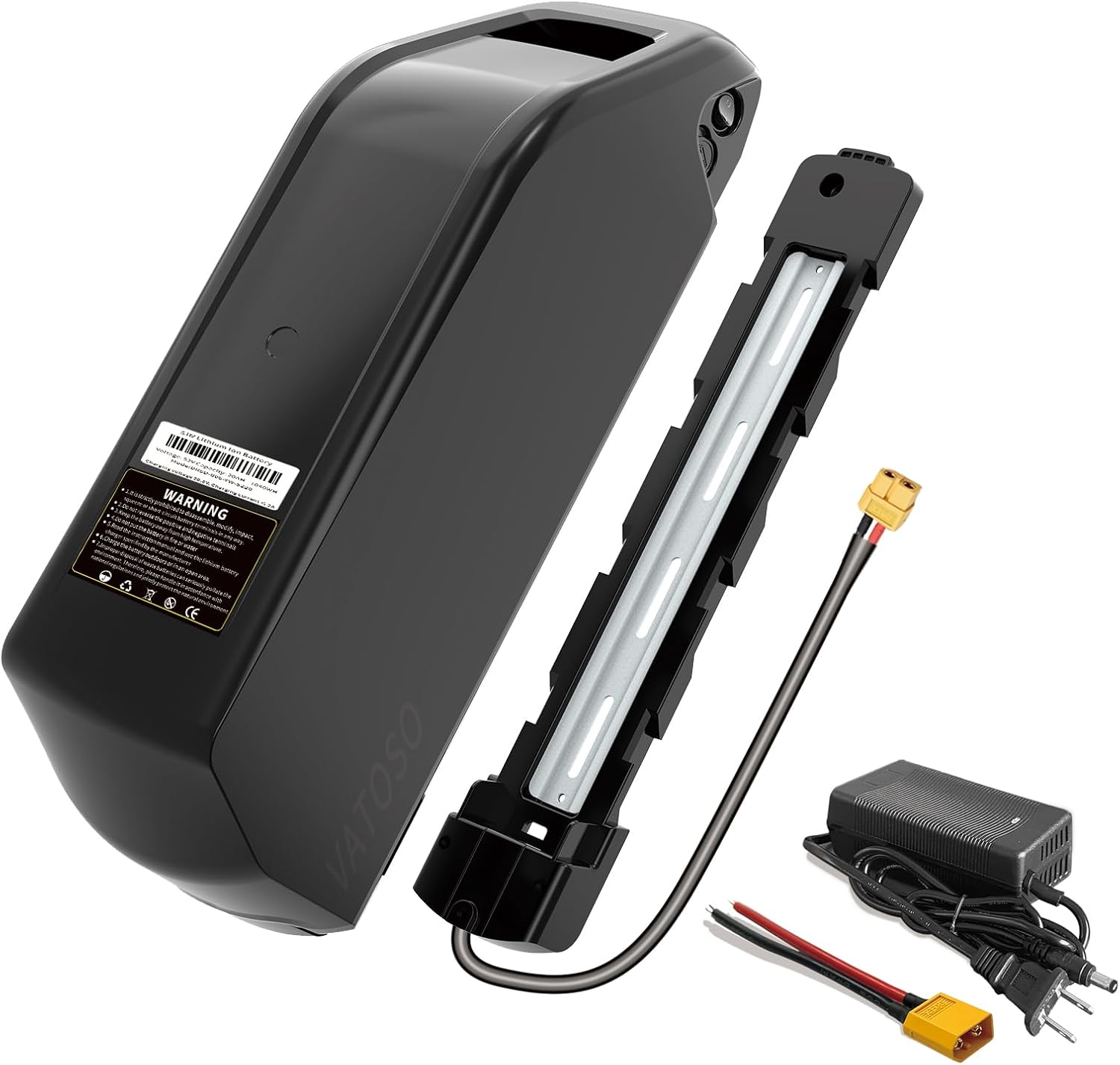
Three ceilings and a board the listing argues about
The power story prints three different numbers on one page. The title says 100W to 1500W.
Bullet one says 100-2000W. The parameter card says 0-2000W.
So the title understates its own bullet and its own card, which is at least a mistake in the honest direction.
The board story is less tidy. The title and the card both say 50A. Bullet two says the pack has a built-in 30A smart BMS, with a missing first letter in the word built-in that appears on the other VATOSO listings too, so it is house copy, not a one-off typo.
One of those two numbers is wrong, and the arithmetic tells you which one matters.
A 1500W motor at 52V draws about 28.8 amps, inside either board. A 2000W motor draws about 38.5 amps, over a 30A board and inside a 50A one.
The title's 1500W ceiling is therefore the only number that works no matter which board is really in the case. Plan around 1500W and the dispute stops mattering. If you genuinely need 2000W continuous, ask the seller which board ships before you pay, or step up to a pack whose board number is not disputed.
The charger question decides whether it fills
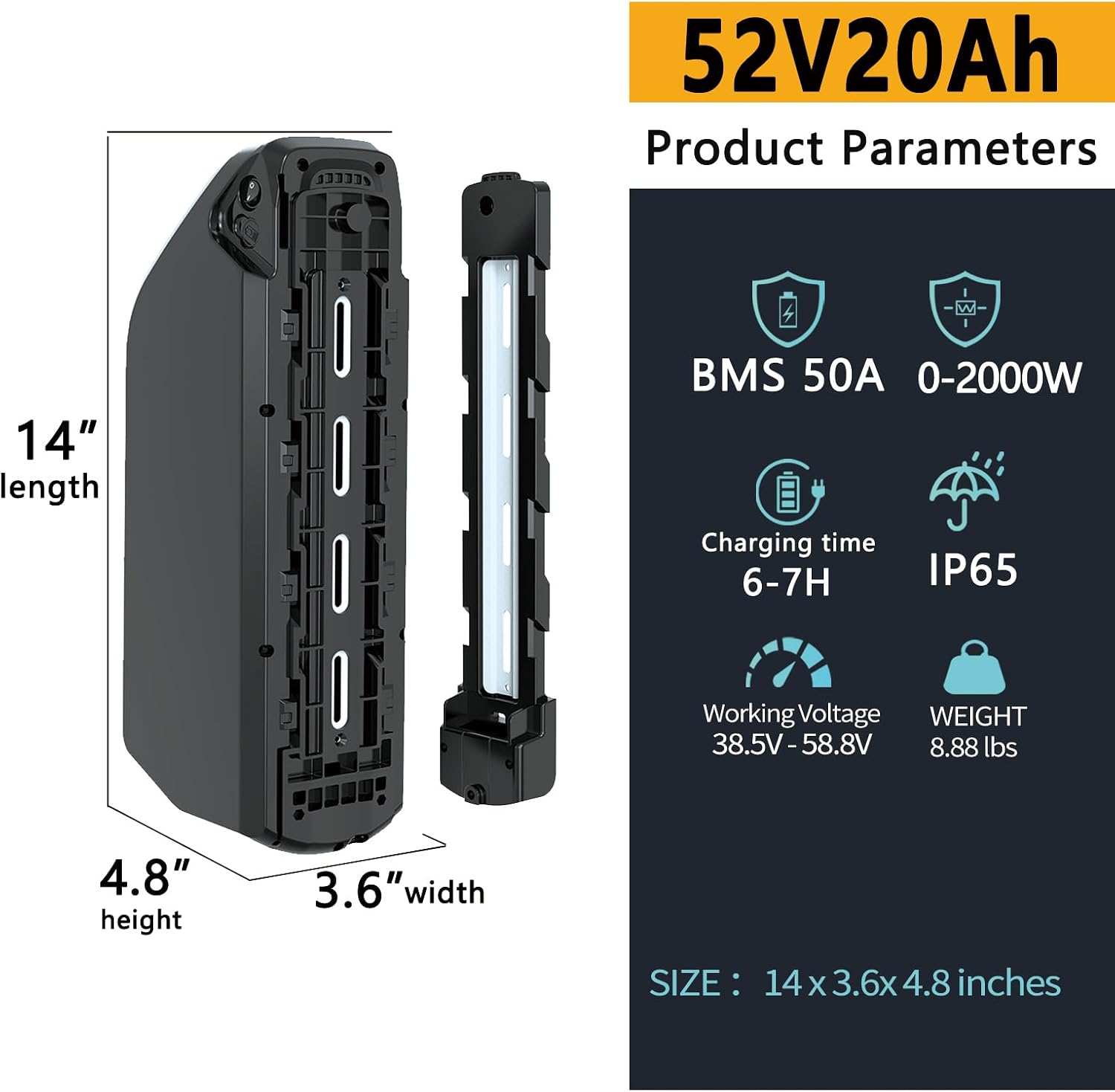
The parameter card commits to real 52V chemistry. Its working voltage runs from 38.5V to 58.8V, and 58.8 is exactly 14 series cells at 4.2 volts, which is what a true 52V pack is. Bullet four then says fast charging runs through standard 54.6V lithium charging equipment, included.
Fifty-four point six volts is 13-series math, the charging voltage of a 48V-class pack. Put a 54.6V charger on a 14-series pack and it stops at about 3.9 volts per cell, roughly 80 to 85 percent full. You would see about 830 to 880 of the printed 1040 watt-hours, and no fault light, just range that never matches the label.
The covered twin listing sells the same class of pack with a charger named in its title, and that charger question was the spine of its review too.
What ships in the box is itself a three-way argument. The title promises an XT60 connecting wire and a base.
Bullet four says charging equipment is included. The details table's Included Components row reads, simply, battery. The card's charging-time row says 6 to 7 hours, which for 20 amp-hours implies about a 3A charger.
So the listing cannot tell you whether a charger ships, what voltage it would be, or what amperage it would carry. Ask the seller for the charger's printed output before you pay, because the answer decides whether this pack ever fills.
What the printed weight says
The card prints 8.88 pounds, about 4 kilograms, for a claimed 1040 watt-hours. That is about 0.26 kilowatt-hours per kilogram at pack level. Wikipedia's standard band for lithium-ion cells states 160 to 300 watt-hours per kilogram, and that band describes bare cells.
A finished pack with a case, a board and wiring always lands below its cells, so a pack cannot weigh this little while carrying this much charge.
The figure matches the twin listing's 8.8 pounds almost exactly, so the two listings share the same optimistic number.
Treat the capacity as unproven, weigh the pack when it arrives, and meter a full charge. The details table makes this harder than it should be: unlike the twin's listing, there is no capacity row, no weight row and no cell composition row in the specs, so the gallery card is the only place every number lives.
Reading the IP65 claim
The card and the bullets both claim an IP65 case. Read that narrowly: IP65 means dust tight and protected against low-pressure jets, not submersion, and not a pressure washer. Mount it with the connectors sheltered and the case drained downward, and it will do what the rating actually says.
Choosing between the two listings
The two listings sit close together on price and far apart on details. This one lists at 279.99 with a three-month warranty, a 1500W title ceiling, and no charger named in its title. The twin lists at 288.99 with a one-month warranty, a 2000W title ceiling, and the charger named in the title.
The gap is small, and the warranty term is short on both, which puts the real weight on the charger question and on whichever listing's box story survives an email to the seller.
On value, 1040 watt-hours at 279.99 works out to about 27 cents per watt-hour, which sits close to the middle of the 324 packs on our comparison table.
The specs box beside this review renders the live comparison as prices move. Within the family we have reviewed, the 48V 25Ah rung and the 52V 30Ah shell both cost less per watt-hour, and the 30Ah adds real range if your bike accepts the bigger case.
The decision comes down to this. If you already own a 58.8V charger, or the seller confirms one ships in the box, the cheaper listing with the longer warranty is the better buy of the two. If neither is true, the twin's charger-included story, thin as its own record is, answers the question this listing dodges.
Frequently Asked Questions
Does the Vatoso 52V 20Ah include a charger?
The listing cannot decide. Bullet four says charging equipment is included, the title names only an XT60 wire and a base, and the details table's Included Components row reads battery. Ask the seller for the charger model and its printed output voltage before ordering, and get the answer in writing.
Can it really run a 2000W motor?
Only if the 50A board figure is the true one. A 2000W motor draws about 38.5A at 52V, which overruns the 30A board named in bullet two. The title's own 1500W ceiling draws about 28.8A and works on either reading, so plan around 1500W.
Will a 54.6V charger work on this pack?
It will charge it incompletely. The card's 58.8V working top means 14 series cells, and a 54.6V charger stops a 14S pack at about 3.9 volts per cell, roughly 80 to 85 percent full. You would lose about a fifth of the rated range on every charge without any warning light.
Is the 5.0 rating trustworthy?
It rests on two texts posted the same day, neither purchase-badged, both shaped like the listing's own bullets, with zero helpful votes between them. There is no badged ownership evidence in either direction, so treat the score as presentation and judge the pack on the listing's verifiable numbers instead.
How does this listing differ from the other Vatoso 52V 20Ah review?
Same pack class, same manufacturer, two independent listings. The twin costs more, names a charger in its title, claims a 2000W ceiling, and carries a one-month warranty against this listing's three months. Its record is also larger. Both listings print the same optimistic 8.8-pound weight, so the meter test applies to either one you buy.