An ebike battery usually dies from the inside. The cells give out after a few seasons while the case, the lock barrel, and the mount on the frame are all still fine, which is why a full replacement feels wasteful. Going cheap means a bare cell pack with no enclosure of its own, and that hands you every hard part of the job.
The Varstrom 48V 10.4Ah is exactly that kind of product. Its title says the battery case isn't included, and it means it: you get a pouch-cell pack, a 30A BMS, and a 3A charger, and nothing to put the first item in.
Four buyers have rated it so far, and the most useful of them pulled the dead cells out of a Heybike housing and made this assembly the only pack that would fit.
That's a promising story, but it's also the whole evidence base. The listing doesn't publish dimensions or weight, its own title and bullets disagree on what motor size the pack supports, and one buyer says theirs doesn't hold a charge. Here's what the numbers do and don't support.
A bare pack, a mid-field price, and a thin but clean record
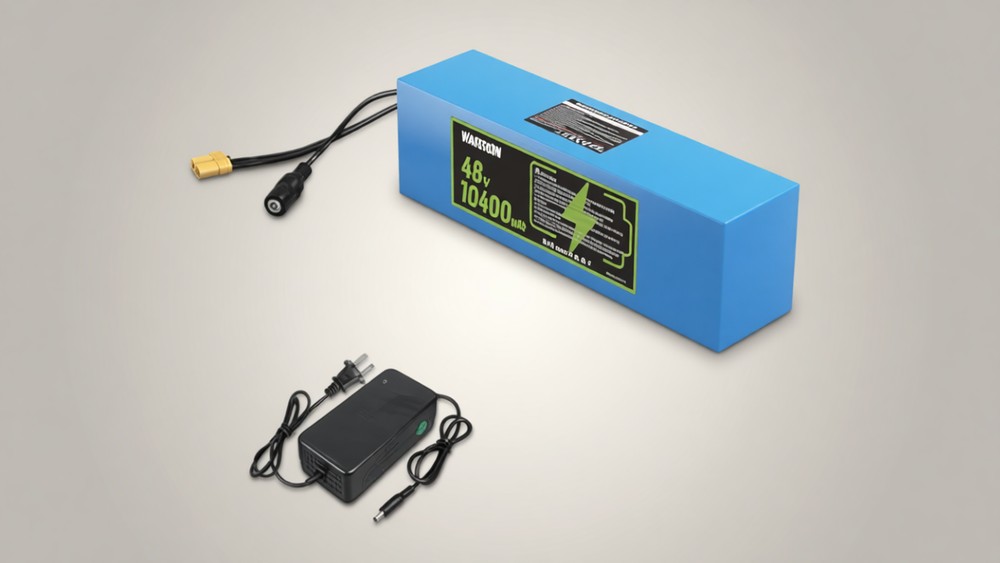
What you're buying is simple to describe. Grade-A lithium pouch cells configured for 48 volts and 10.4 amp-hours, which is 499 watt-hours, a 30A BMS board, and a 54.6V 3A charger. No case, no bracket, no mounting hardware.
The manufacturer of record is Dongguan CZM Technology, and the spec table lists the pack's special feature as "Disc", which describes nothing on the page and tells you how much attention the metadata got.
Four ratings stand at 4.3 stars, and all three written texts are purchase-confirmed, which is a cleaner base than most listings this age can show. That's still a very small sample, and the histogram carries a tell: it reads 64 percent five stars against 36 percent three stars, a split that four ratings cannot actually produce.
The shares are pooled across the seller's variant family, so this specific listing has never been rated on its own.
On price per watt-hour the pack sits near the middle of the 301 batteries we track, and it's worth saying plainly that this is not a bargain position. Check it against the alternatives on our comparison table. What you're buying is a form factor, not a deal: bare cells that fit where an enclosed pack cannot.
The title says 750W, the bullets say 1200W
The listing argues with itself about power, and the disagreement is the size of a whole motor class.
The title caps the pack at 0-750W motors. Three separate bullets say it powers 0-1200W motors, handles peak 1200W loads, and offers universal compatibility across e-bikes, scooters, and ATVs. Both numbers can't be the design limit.
The arithmetic leans toward the bullets. Thirty amps at 48 volts is about 1440 watts of continuous headroom, which covers a 1200W device with room to spare. Nothing on the page supports the 750W figure, and our own recorded title for this ASIN said 1200W before the listing was reworded, so the lower number arrived recently and without an explanation.
The practical read: the BMS is a protection ceiling, not a performance promise, and the number that matters for your build is what your controller actually draws. A 500W or 750W setup sits comfortably inside either claim. A 1000W motor is inside the bullets' claim and outside the title's, and if that's your build you're trusting the bullets over the header.
The rebuild job: what a bare pack asks of you
Everything the enclosed pack would do for you, this one hands back. You provide the enclosure that protects the pouch cells, the wiring that reaches your controller, and the connector match, which the listing itself tells you to confirm.
Pouch cells store more energy per unit of volume than cylindrical 18650 cells, which is why a bare pouch assembly fits spaces a round-cell pack can't, but they have no rigid metal can of their own and depend entirely on whatever housing you put them in.
The most useful owner text shows the job done well. One buyer has reported pulling the dead cells out of an original Heybike battery housing, finding this the only assembly that would fit that space, and getting the bike back to normal over three weeks of riding. The original pack was 15 amp-hours, so this one holds about two-thirds of the capacity the bike was designed around.
The same buyer closed with the honest summary of the whole category: "only time will tell how long they hold up."
The listing's own silence is the obstacle. There are no dimensions and no weight anywhere on the page, so the fit question that decided the Heybike buyer's project is one the listing refuses to answer. Measure your housing's interior before you order, because this page will not do it for you.

Range, charging, and the 1000-cycle question
No owner has reported a distance figure, so range stays arithmetic. The ebikes.ca consumption bands, with minimal pedaling, run 6 to 8 watt-hours per kilometer for gentle assist, 9 to 12 for typical assisted riding, and 14 to 20 for throttle-heavy or loaded riding.
Four hundred ninety-nine watt-hours spans roughly 62 to 83 kilometers at the gentle end, 42 to 55 in typical use, and 25 to 36 if you ride hard. That's a commuter's range, not a tourer's, and it's the honest limit of a 10Ah-class pack.
Charging is one place the listing checks out. Ten point four amp-hours on the included 3A charger is about three and a half hours minimum from empty, against about five and a quarter on a 2A unit, so the bullet's claim that 3A runs thirty percent faster than 2A points the right way. The old published figure of six to seven hours doesn't survive that arithmetic.
The durability claim is the one to discount. The bullets promise 1000-plus full cycles with better than 80 percent capacity retention, and say the pack outlasts standard batteries by double.
Battery University's BU-808 puts 300 to 500 full-depth cycles as the ordinary expectation for lithium-ion, and this record is months old, not years. One buyer has already reported that theirs doesn't hold a charge well, without detail, and the seller's answer isn't on the page. Treat 1000 cycles as a target the pack hasn't been shown to hit.

Buy it only if you already have the case
The decision is enclosure first. If you have a working battery case with dead cells inside, the patience to move a connector or two, and a place to put a BMS board, this is one of the least expensive ways to put 499 watt-hours back into a bike you already like. If you're shopping for a battery you can bolt on and ride, this isn't that product, and no amount of capacity fixes that.
The terms deserve a read before you order. The warranty is 30 days for return and 365 days for repair or replace, which is a real warranty but a shorter repair window than the multi-year promises some sellers make. Stock stood at only 15 units when we checked, so the listing may not be a long-term fixture.
It's also the wrong pack if you need the listing to tell you what fits, because it publishes neither size nor weight, or if you want a record that proves the cycle-life claim, because four ratings can't do that. What it does offer is a shape no enclosed pack matches, a charger included, and a purchase-confirmed record with one genuine rebuild success in it.
For the right buyer, that's enough. For most buyers, an enclosed pack from the comparison table is the calmer choice.
Frequently asked questions
Will it fit inside my existing battery case?
The listing publishes no dimensions and no weight, so it can't answer that. What's known: one buyer has reported this assembly fitting inside an original Heybike housing built for a 15Ah pack, where it was the only option that fit.
Pouch cells pack energy densely, which helps, but the only reliable method is measuring your case's interior and comparing it against the pack's listed voltage leads and connector position, which means contacting the seller.
What motor can this pack actually run?
The title says 0-750W and three bullets say 0-1200W, and the page never reconciles them. The 30A BMS allows about 1440 watts of continuous draw at 48 volts, which covers either figure. Check your controller's rated current instead of the title, because the BMS is a safety ceiling, not a horsepower claim.
How long does a full charge take?
About three and a half hours minimum from empty on the included 3A charger, and about five and a quarter on a 2A charger. Most riders don't run a pack to empty, so real charges land shorter than that.
Will the cells really last 1000 cycles?
Nobody can prove that from a record this young, and the claim comes from the seller, not from any owner. The ordinary expectation for lithium-ion is 300 to 500 full-depth cycles before capacity drops to about 80 percent, and one buyer has already reported weak charge retention. If cycle life is the reason you're considering this pack, treat the number as a promise, not a measurement.
What does the warranty cover?
Thirty days for returns and 365 days for repair or replacement. That first month is the window to meter the pack's actual capacity and confirm the connector situation, and the repair year covers an early failure after that. It's a shorter service commitment than some competitors offer, and worth weighing against the bare-pack price.
Check the latest price on Amazon, or see how it compares on cost per watt-hour in the full battery table.