Every battery listing wants a perfect score, and this one has one. Five ratings, no stars below five, and a price at the low end for the capacity. If you read only the number, this looks like the safest cheap 36V pack on the market.
Open the reviews and the score stops meaning anything. Two written texts exist, both one line long, both about the transaction rather than the pack: one says the transaction was smooth, one says it works well. No range numbers, no word on how it mounted, no word on how it holds up after a winter.
The perfect score is five people who didn't hit a disaster in week one, and nothing more.
There's also a wrinkle the old review never faced. This same ASIN sold as a 10.4Ah pack when we first covered it, and the live page now says 10.5Ah under model HL3610.5, at a higher price, with a 1500-cycle claim that no chemistry on the page supports.
What follows works through what the record actually shows, what the cycle and range claims are worth, what the 30A BMS genuinely backs, and what a 5-pin Hailong swap demands of your frame.
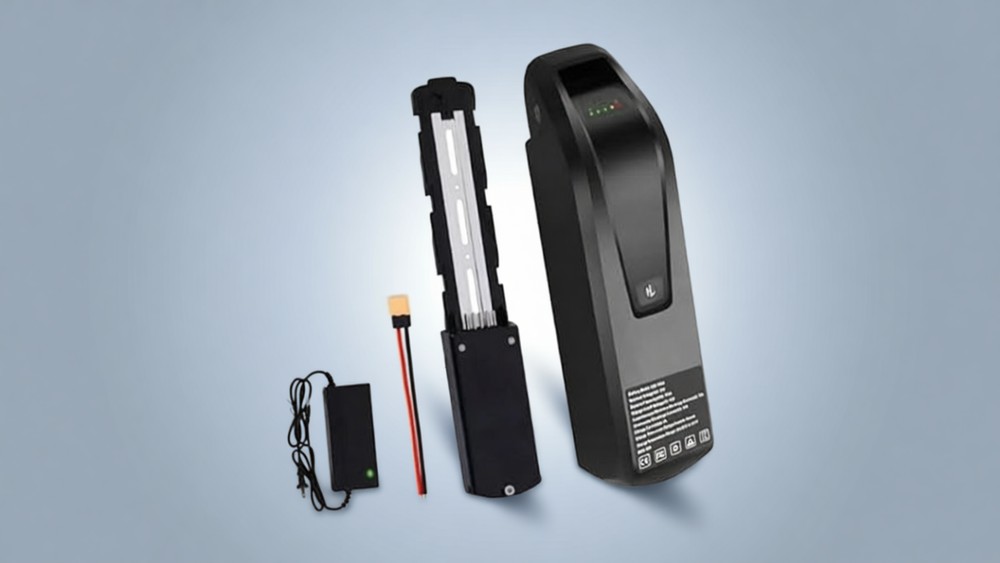
A perfect score that says almost nothing
The listing shows a perfect five-star rating from five buyers, and the written record tells you nothing about the pack itself. One buyer has mentioned the transaction was smooth, another simply said it works well, and neither offered a range or fit report.
This same ASIN sold as a 10.4Ah pack when our first review ran, at a lower price. The live page now lists a 10.5Ah version under model HL3610.5, and 36 times 10.5 is 378Wh. The slug on this page keeps the old 10Ah name so the old link keeps working, and every figure below comes from the live listing.
So the perfect score is an absence of bad news rather than a body of good news. Nobody has described range, mounting, or durability, which means the first season on this pack is your own test, not a written-up one.

The cycle claim is the number to discount
The listing claims over 1500 deep cycles with 85 percent or better capacity retention, and it names no chemistry anywhere. That is roughly three times the figure consumer lithium-ion makers conservatively publish. Battery University's BU-808 puts the standard manufacturer spec at 300 to 500 full discharge cycles, with only LiFePO4 at shallow discharge reaching higher counts.
The details table on this listing says only Lithium Ion, so treat the 1500 as a marketing number until proven otherwise.
The listing's own range claim of 20-30 km (12.4-18.6 miles) is worth a close look because it is honest by accident: it sits inside the math band for 378Wh rather than above it.
At 15 to 25 watt-hours per mile of moderate assist, 378Wh gives roughly 15 to 25 miles. Throttle-only riding near 30 watt-hours per mile lands around 12. A pack whose own range claim matches its capacity math is rarer than it should be.
The three percent self-discharge rate and the power balance claim are unverifiable without a meter and a season. They cost nothing to print, and the listing prints them next to the cycle claim, which is the one number on the page you should discount hardest.

What the 30A BMS backs, and the three motor windows
The math that holds: 30A at 36V is about 1080W continuous on a fresh pack, real headroom over the 750W ceiling. The board lists six protections: overcharge, over-discharge, over-current, short circuit, over-temperature, and overload. A 750W motor drawing hard on a climb sits well under what the BMS allows, so the ceiling is honest.
The motor windows are the messy part. The title says 250-750W, one bullet says 100W to 750W, and the same bullet calls this a 36V 500W battery. Three windows on one page, none of them wrong for the BMS, none of them reconciled with each other.
Match by controller voltage and connector instead of by wattage. The listing's own capacity-matching advice is garbled ("within 5-10AH of your original. If old is 10AH, choose 10-17.5AH"), so do not lean on it: your controller must be 36V, and the plug must match your bike's.
Hailong shape, 5-pin plug, and an IP65 rating with a caveat
The listing's own bullet calls this a Hailong pack: a plate bolts to the downtube and the pack slides on and locks. The base is 5-pin and measures 13.58 by 2.55 by 0.98 inches, the battery 14.47 by 3.74 by 3.5 inches, and the listing itself demands you confirm your bike's mounting space is larger before ordering.
The IP65 claim means dust-tight and protected against water jets per the IEC 60529 standard. It is not an immersion rating, and the same bullet warns against prolonged exposure to heavy rain, which is consistent with what IP65 actually certifies.
Three things the page never states: the weight, the charger, and the cell brand. Any packing list, shipping weight, or cell claim in an older review of this pack does not come from the live listing, and the absence matters if you are matching a pack you have to carry up stairs.
Paying the pricier third for a pack nobody has described
This pack sits in the pricier third of the 301 packs we track per watt-hour, so it is not a bargain, and the live spot renders in the specs box below. Check it against the field on the battery comparison table before deciding the price is right.
It suits a rider who already has a 5-pin Hailong base and wants a like-for-like swap at a low dollar figure, with the sense to test the pack inside the 1-year warranty window. The UAZ 36V 10.5Ah asks you to be the reviewer, because the written record on its own listing runs two sentences deep.
Anyone who wants a pack with years behind it, a stated charger, or a known weight should keep shopping, because the page supplies none of those. If your base and plug already match, the risk you carry is a thin record, and that is at least a risk you can name.
Frequently Asked Questions
Will it fit my bike?
Your controller must be 36V and your connector must match the 5-pin base. The battery measures 14.47 by 3.74 by 3.5 inches and the base plate 13.58 by 2.55 by 0.98 inches, so confirm your mounting space is larger than both, as the listing itself instructs.
Is it really waterproof?
IP65 means dust-tight and protected against water jets, not submersion, per the IEC 60529 code. The listing's own advice to avoid prolonged heavy rain matches that rating. Ride it in weather, do not soak it.
How long does it take to charge?
The listing does not say which charger ships. On a typical 2A 42V charger for a 36V pack, 378Wh works out to about five hours plus a tail at the end. Verify what is actually in the box before you plan around it.
How long will it last?
The manufacturer claims over 1500 deep cycles with 85 percent capacity retention, which sits near three times the 300 to 500 cycles Battery University reports as the conservative manufacturer norm for consumer lithium-ion. No chemistry is named, so the claim is unproven on this listing.
What does the USB port do?
Per the listing bullets, the pack includes a USB interface for charging devices, an LED power indicator, a power switch, and a safety lock with anti-theft protection. The lock secures the pack to its own base plate, which deters a grab-and-run rather than a thief with tools.
Still weighing 36V options? The battery comparison table sorts every pack we track by price per watt-hour.