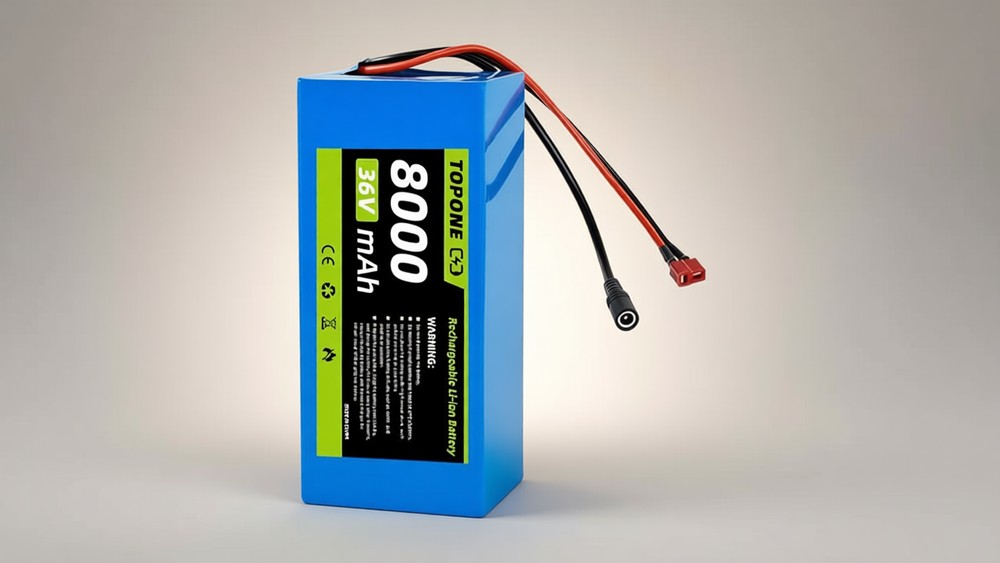
Somebody shopping for this pack had one problem: a frame that refuses every normal battery. The Topone 36V 8Ah answered it with 288Wh in a case about eight inches long, and almost nothing else. That original listing is gone now. What follows is a rebuild from the recorded listing data, written as a replacement-buying guide, because the pack's story is worth knowing even though you can no longer buy this exact shell.
A dead listing and the record it leaves
Amazon's page for B0GCRGYNXF now returns a Page Not Found error, confirmed again on 1 November 2026. What survives is the recorded listing data and our own data row. The row records a 2.8 average rating with no rating count. The February 2026 article recorded a two-rating pooled record in which the five stars belonged to a 48V 20Ah variant of the same listing family, and one buyer's two-star described a unit that arrived dead and later worked. Neither figure can be re-checked, and no written review text was ever captured for this ASIN. I won't invent one.
That record matters less than the specs, because the specs were the pitch. The listing sold a 36V 8Ah pack with a 20A continuous BMS, a charge cut-off at 42V, a discharge cut-off at 27.5V, an XT60 adapter, a charger and an AC plug in the box. It claimed a waterproof casing with no IP rating behind it.
The smallest tank on the shelf
Twenty-eight amp-hours times 36 volts gives 288Wh, and that number is the whole review. Our own comparison table tracks 324 packs, and this one sits in the pricier third of them at about thirty-four cents per watt-hour, which you can check live in the battery table. Small packs price badly. The case, the BMS, the bracket and the charger cost roughly the same whether the tank holds 288Wh or 0.72 kWh, so a small shell spreads those fixed costs over fewer watt-hours. You pay a premium for the missing size, and that's the honest framing for this entire category of pack.
The em3ev 36V battery guide lists the standard 36V tanks at about 0.36 kWh for 10Ah, 0.54 for 15Ah and 0.72 for 20Ah. This pack sits below the smallest rung on that table. Its range scales from the same guide's 0.96 kWh 48V anchor the way we scale every pack: at 0.30 of that reference row, that works out to roughly 9 to 12 miles at full throttle and 15 to 20 with low pedal assist. Hills and cold cut into both figures. If your ride is longer than that, no amount of clever mounting fixes it.
Charging was listed at 1A to 5A with the charger's own amperage never specified. At a typical 2A, an 8Ah tank fills from empty in about four hours, which is one genuine advantage of a small pack. The 42V charge cut-off confirms a 10-series layout, since ten cells at 4.2V each is 42V, and the 27.5V discharge cut-off works out to about 2.75V per cell. Both numbers agree with each other, which is not always true of listings in this class.
One listing, three wattage stories
The title said 100W-1000W motors. The listing's own recorded text rated it for 200W-500W. The BMS math gives two more answers: 20A at 36V is a 720W continuous ceiling, and the title's 30A option would allow 1080W. A 1000W motor draws about 28A at 36V, which fits a 30A board and blows straight through a 20A one. Pick any two of those four numbers and the other two disagree.
The practical read is the cautious one. Treat 720W as the ceiling this pack was built for, run a 500W motor and you sit comfortably inside it. The deeper problem is the pairing of a 20A board with 8Ah of cells. Full-board draw empties this tank in under fifteen minutes, so the pack lives or dies on gentle use. That's fine for a short-frame runabout puttering at 15mph. It's a poor match for a throttle-heavy commute.

The weight that only closes on premium cells
The listing claimed about 3.4 pounds, which is 1.54kg for 288Wh. That's 0.187 kWh per kilogram at pack level, above the 0.13 to 0.16 band where complete packs normally land. Lithium-ion cells run 0.16 to 0.30 kWh per kilogram bare, per Wikipedia's lithium-ion battery page, and a finished pack always weighs more than its cells because the case, BMS and wiring ride along.
For this weight to close, the cells would need to sit at the top of the bare-cell band, leaving about half a kilo for the case, BMS and bracket. Premium cells in a budget pack is possible but unlikely, so treat the figure as optimistic until you put the pack on a scale. This is the same weigh-and-meter-on-arrival discipline we apply to every pack in this price class.
Matching a replacement now that the listing is dead
If you owned this pack, the replacement search needs four measurements, and the recorded specs tell you exactly what they are.
Voltage first. This is a 36V system charging at 42V, and any replacement needs the same 10-series chemistry and a 42V charger. A 48V pack and its 54.6V charger will not drop in. Connector second: the XT60 adapter was part of the box, so check what your controller actually takes before ordering. Size third: about 7.9 by 2.8 by 2.8 inches is the space your frame gives you, and few packs are that small, which is why this shell existed at all. Mount fourth: confirm the bottle-cage or bracket mount your bike carries.
The natural upgrade is the 15Ah rung of the same table, at about 540Wh, nearly double the tank for a pack that is still manageable in tight frames. Our Topone 36V 11Ah review covers the sibling rung and the storefront's exit from the marketplace. Whatever you pick, run it past the comparison table and sort by price per watt-hour, because at this size the spread between packs is enormous.

Frequently Asked Questions
How far did the Topone 36V 8Ah actually go?
Scaled from the em3ev range anchor, about 9 to 12 miles at full throttle and 15 to 20 with low pedal assist. Nobody's recorded ride report exists for this ASIN, so those figures are arithmetic, not owner accounts.
Was the 5-star rating for this pack?
No. The February article recorded that the five stars in the pooled rating belonged to a 48V 20Ah variant. The surviving row records 2.8 for this listing with no count.
Can I run it with a 1000W motor?
Only on the 30A board variant the title mentioned, and even then barely, because 1000W draws about 28A at 36V. The 20A board tops out at 720W. The listing's own text rated the pack for 200W to 500W motors.
Is a small 36V pack cheaper per watt-hour?
No, usually the opposite. Fixed costs don't shrink with the tank, so this pack's recorded price worked out to about thirty-four cents per watt-hour, the pricier third of the 324 packs we track.
What should I check on a replacement?
Voltage class (36V, 42V full), connector, dimensions near 7.9 by 2.8 by 2.8 inches, and the mount. Weigh the new pack when it arrives and check the charge cut-off with a meter before the first full ride.