An 11Ah pack sounds too small until you look at what it has to carry. A five-mile commute each way burns maybe a third of 528Wh, and the pack slides into the downtube instead of hanging off the back of the bike. For riders who wanted the lightest Hailong build they could get, this was the rung to buy.
The pricing was the strange part. In the SHEWAIHE ladder, every bigger pack costs less per watt-hour. Its 15Ah Hailong sibling sits at 0.23, the 20Ah folding rung at 0.21, against 0.25 for this 11Ah one. Capacity was the thing you paid extra to shrink.
That rung is gone now. The listing died, the review record froze at 3.7 stars from about five buyers, and nobody new can add a verdict. What the recorded data still holds - the ladder math, the 31.25A draw behind the 1500W claim, the connector classes, the 5.5-hour charge floor - is what a replacement hunt has to work from.
The short verdict: the SHEWAIHE 48V 11Ah pack was a mid-table price for the smallest rung of its own ladder, in a case family that works, with a motor claim its own listing never proved. If you own one and it's still riding, keep riding it. If you're shopping for a replacement, the brand's bigger rungs were better value, and the match-the-hardware checklist further down matters more than any spec in the title.
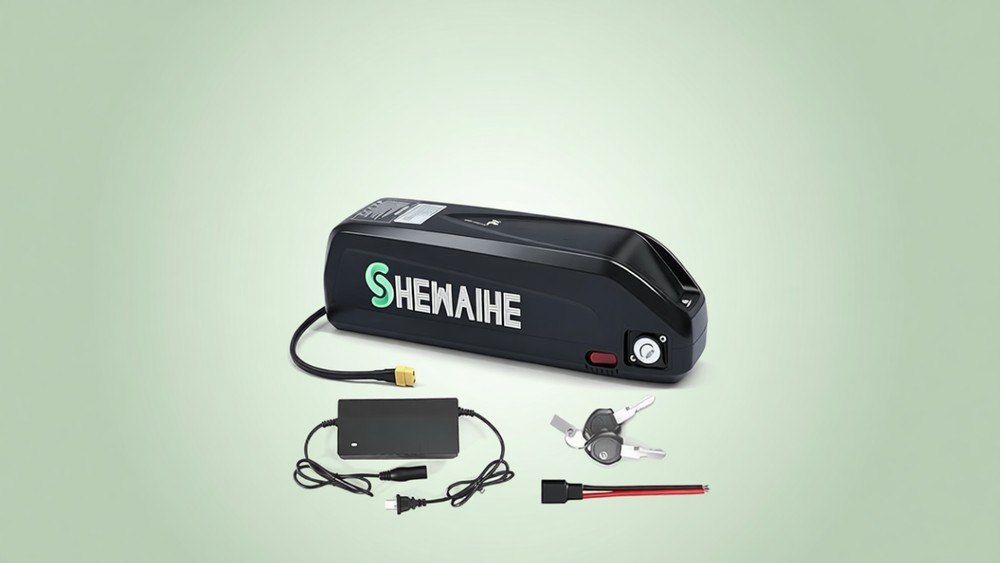
What the ladder priced
At 132 for 528Wh, the pack worked out to 0.25 per watt-hour, close to the middle of the 324 packs in our comparison data. Mid-table doesn't sound like a complaint until you look sideways at the same brand's shelf. The SHEWAIHE 48V 15Ah Hailong sibling sold 48V x 15Ah = 720Wh at 169, about 0.23 per watt-hour.
The folding 20Ah rung sold 960Wh at about 200, 0.21. Even the family's 36V 15Ah packs landed near 0.25. Every bigger rung cost less per unit of energy, and the smallest rung bought roughly two pounds less weight on the downtube and not much else.
Our battery comparison table renders the exact position live, and it moves with every data refresh, which is why we keep ranks out of the prose.
What the 1500W claim needed
The title claimed motors from 100W to 1500W, a range wide enough to cover nearly anything with a battery in it.
1500W at 48V is 31.25A continuous. The listing never printed a BMS amp rating in the data we recorded, so the top of that range was unverifiable even when the pack sold. The old version of this article asserted a 30A board, and even granting that number, 30 x 48 = 1440W, four percent short of the claim's own ceiling.
The connector adds a second ceiling. Hailong-style baseplates come in 4-pin, 5-pin and 6-pin classes, and batterydex's connector guide puts them at 20-25A, 25-30A and 30-35A, with pin counts that don't interchange. A 1500W draw needs 31.25A, which is above every standard pin class in the format.
Meanwhile the bigger 15Ah sibling claimed only 100-1000W. The 1500W top reads like ladder-title copy-paste rather than a per-rung rating. A 750W motor, for contrast, draws about 15.6A and fits every class with room to spare.
Living with 528Wh
The em3ev 48V guide puts real-world hub-drive consumption at roughly 24-31Wh per mile on throttle and 15-19Wh per mile with light pedal assist. Scaled to 528Wh, that's about 17-22 miles on throttle alone and about 28-35 miles with light pedaling. The old version of this article gave one blended band of 17-28 miles for all riding, which mixed the two regimes into a number that matches neither.
For a 12-mile round-trip commute, even the throttle-only figure leaves room to spare, and flat riding with real pedaling pushes well past it.
Charging ran on the 2A current the family's other listings ship: 11Ah at 2A is 5.5 hours from empty, plus a tail while the cells even out. Any replacement or second charger has to state 54.6V output, because a 48V pack is 13 cells in series and 13 x 4.2V = 54.6V full. The listing itself never named a charger.
Weight was never recorded either. A Hailong-case 11Ah pack typically runs about 2.5-3kg against roughly 3.5-4kg for a 15Ah in the same case. Treat those as expectations rather than specs - the listing took its weight figures with it.
A record that can't grow
The record stood at 3.7 stars from about five buyers when we last saw it, with no text captured and no count beyond that. That was never enough buyers to describe the pack, and the listing's death makes the freeze permanent.
In the Hailong class, the complaints that repeat across our reviews are fit and connectors - a slot that doesn't match the case, a baseplate pin count that doesn't match the mount - more often than cells failing.
A 3.7 average from a handful of early buyers fits that pattern. Some of it was probably the pack, some of it was probably frames and controllers that didn't agree with it, and nobody can sort those apart now.

Matching a replacement now
With the pack gone from Amazon, a replacement hunt runs on measurements rather than a product page. The order that works: measure the Hailong slot in your frame, because the case has to slide into it. Match the baseplate pin count, because 4-pin and 5-pin baseplates don't interchange.
Match the discharge connector on the controller side. Then buy a charger that states 54.6V output. If the replacement is used, meter its capacity before you trust it - a pack that claims 11Ah and delivers 8 cuts every range estimate in this article by about a quarter.
Search 48V 11Ah Hailong packs on Amazon for what's currently listed, or look one rung up. The SHEWAIHE 48V 15Ah Hailong review covers the sibling that was better value in the same case family, and more form factors are in the review archive.

Common questions before you order a replacement
Will it fit my frame's Hailong slot?
Measure the slot before anything else. Hailong cases differ slightly between manufacturers, and the case has to slide in and latch. If your frame was sold as Hailong-compatible, compare the replacement's case dimensions against the old pack. If it wasn't, you're shopping for an externally mounted pack instead.
What charger does a 48V pack need?
One that states 54.6V output, which is 13 cells in series at 4.2V each. Charge current sets the floor on charge time: 11Ah at 2A is 5.5 hours from empty before the tail. A charger that only says "48V" without the output voltage isn't specific enough to trust.
Was the 1500W claim real?
There's no way to know, and the listing's death settled it in the worst way. The claim needed 31.25A continuous, the listing never printed a board rating, and the standard Hailong baseplate classes top out below that figure. A 750W motor sits comfortably inside every class, and that's the honest ceiling this pack was sold for.
How much range should I expect from 528Wh?
About 17-22 miles on throttle alone and about 28-35 with light pedaling, using the em3ev consumption anchor for 48V hub drives. Hills, cold weather and heavy throttle cut into both figures. Flat riding with real pedaling can beat them.
Why did the smallest pack cost the most per watt-hour?
Because the case and the electronics cost roughly the same whatever the capacity, so each extra amp-hour diluted their share of the price. The 15Ah sibling sold 720Wh for 37 more, and the 20Ah folding rung sold 960Wh for about 68 more. The 11Ah rung's premium bought weight savings, and for short commutes that's a real thing, but it was never a value play.