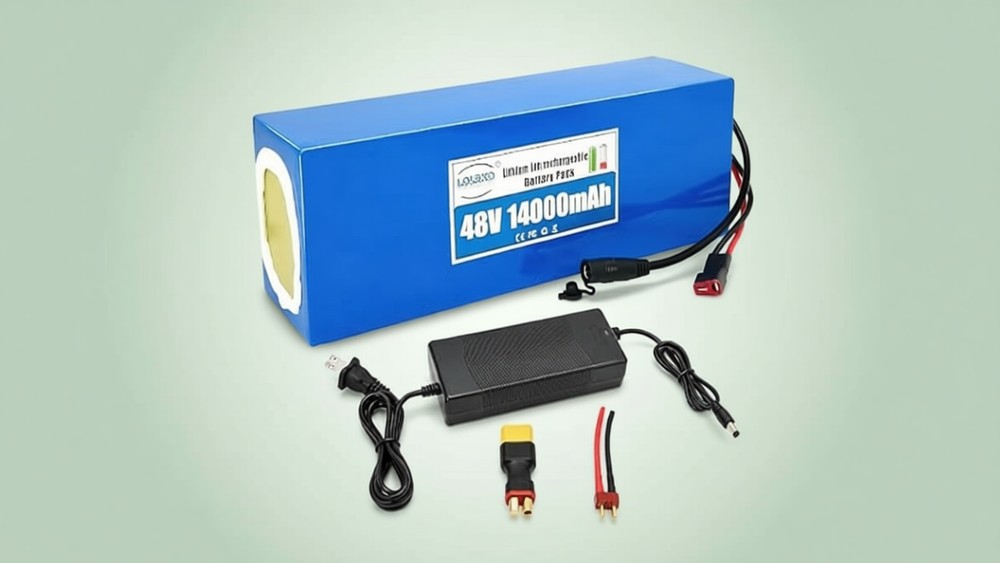
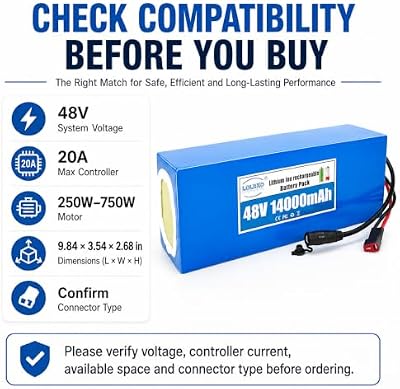
You have a 48V ebike with a tired pack, a budget, and a mounting space about ten inches long. That is the buyer this LOLRKO pack is built for, and the listing knows it. It names no bike brands. It asks you to confirm voltage, controller current, space, and connector before you order, which is more honesty than most listings at this price manage.
The choice is harder than the price suggests. This is a soft pack, PVC-wrapped with no hard case, so your frame or a bag does the structural work a plastic shell would normally do. And the listing prints figures that do not fully agree with each other, on amps and on weight, before you spend a cent.
This article walks through the numbers the listing argues with, the six-owner record, and where the pack lands on our battery comparison table. Everything here traces back to the live listing and its parameter cards, scraped this week.
The listing sells two BMS numbers
Read the second bullet twice. Its heading is a 25A BMS claim in block capitals.
The sentence under it says the pack has an integrated 20A battery management system. The title agrees with the heading. The parameter cards split the difference, one card printing 25A and a separate card labeling 20A as the maximum controller current.
That pairing is actually a sensible design, once you read the 20A card as advice rather than contradiction. A 25A BMS is the protection ceiling. The 20A figure is what the seller wants your controller to draw.
Plan around 20A and you get a working ceiling of 960W, since 20A times 48V equals 960W. The title's 250W-800W motor claim sits inside that with room to spare. Push to the full 25A and the ceiling rises to 1200W, but you are spending the BMS's whole allowance on the motor.
The practical read: treat 960W as the honest ceiling for a comfortable build, and treat the 800W claim as safe. An 800W motor at full draw sits at about 17A. That is inside even the cautious reading.
Three printed weights, and only some of them close
The listing gives three weight readings and they disagree. The bullet says about 6.2 pounds. The spec table carries a Battery Weight row of 2.4 kilograms, about 5.3 pounds.
A separate Item Weight row says 6.16 pounds. The parameter card prints 6.2 pounds and 2.8 kilograms together, which pair fine with each other but not with the 2.4-kilogram row. Half a kilo is missing somewhere.
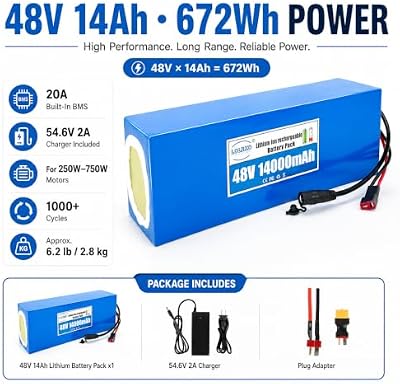
Here is why the smaller number matters. Six hundred seventy-two watt hours in a 2.4-kilogram finished pack works out to 280 watt hours per kilogram at pack level.
Even the 2.8-kilogram reading gives 240. Wikipedia's battery figures put the best NMC cells above 300 watt hours per kilogram and Panasonic's 2170 cells at about 260, and those are cell numbers before you add a case, a BMS, wiring, and PVC wrap (Wikipedia, lithium battery chemistries, fetched live this week).
A finished pack that light would need cells better than anything mass-produced, plus zero grams of packaging. That is not impossible to print and it is very hard to build. This is arithmetic, not an accusation.
The instruction it produces is simple: put the pack on a scale when it arrives, and meter its capacity on the first ride if you can. If 6.2 pounds is the real weight, the density question softens to a note. If 5.3 pounds is the real weight, you have learned something the listing's own numbers already whispered.
What six owners settle, and what nobody measured
The record is six purchase-badged five-star texts spread across thirteen months, with a year of silence between October 2025 and October 2026. Nobody has said a critical word, which at a sample of six tells you more about sample size than about the pack.
One owner has fitted it to a Sohoo 500W ebike, the only named bike in the whole record, and reports it working as expected. Their advice is the useful part: photograph how the old pack is wired before you remove it, then match the new wiring exactly. A 500W draw runs about 10A on this pack, comfortably inside the cautious 20A reading.
Another owner has powered a child's electric motorcycle with one, reporting good battery life between charges.
A third bought one for a son's ebike and calls the duration long. The newest text, from late October 2026, is a first-impressions note: a couple of rides, charges good, decent range. Decent is the only range word in thirteen months of record.
And one owner has done something the listing never claims: they overvolted a Jetson ride-on dirt bike with it and report that it hauls. That is off-label use. It says the pack delivers current, and it is also a reminder that generic soft packs attract projects the spec sheet was never written for. The BMS will trip at 25A whatever the project is.
What nobody has done matters just as much. Nobody has metered capacity against the 14Ah label.
Nobody has counted cycles toward the 1000-plus claim. Nobody has tested the 800W ceiling or reported a range number. The record's verdict is fitment and delivery, not endurance.
Charger math, range math, and fitting the space
The included charger is 54.6V at 2A. That is 13S arithmetic, 13 cells at 4.2V, which is the correct charging voltage for a 48V-class NMC pack.
The chemistry here is just "lithium ion" in the spec rows, no NMC or LFP claim anywhere, but the 54.6V charger and the 672Wh math only reconcile on a 13S NMC build. Charging 14Ah at 2A takes at least seven hours once the taper is counted.
Range depends on the draw, and the honest numbers are smaller than sellers imply. At a pedal-assist 15 to 20 watt-hours per mile, 672Wh gives roughly 34 to 45 miles. Full throttle on a heavy setup can double the consumption figure, which lands you nearer 20 miles.
Our battery table sorts the whole market by price per watt-hour so you can see what else the money buys.
The footprint is 9.84 by 3.54 by 2.68 inches per the bullet, though the spec row's own Item Dimensions says 2.76 at the third measure.
A hundredth-of-an-inch disagreement matters less than the connector question, and the listing answers it well: the box includes a T-Plug to XT60 adapter, so either common controller plug connects without soldering. Measure your case before ordering anyway, because the listing names no bike models to check against. Check the current LOLRKO price before you commit either way.
Where the price lands
At 125.00 for 672Wh, this pack costs about 19 cents per watt-hour. That is the cheaper third of our 301-battery table.
The recent rebuilds that beat it are the sinigerel 48V 20Ah at about 15.6 cents and the lfpnerye 48V 25Ah LiFePO4 at about 17 cents, and both of those are hard-case packs with heavier weight budgets. If your frame wants a hard shell, read the lfpnerye review first. If your build already has a bag or a box and every ounce matters, the soft format is the argument for this pack, see the current listing.
The sinigerel 48V 20Ah review covers the other end of the same question: a pack whose printed weight only closes at the top of the cell market. Between the three, the pattern is consistent. Budget soft packs price well and ask you to verify the physics yourself.
Common Questions About the LOLRKO Record
Is the LOLRKO 48V 14Ah battery good for an 800W motor?
The listing claims it, and the arithmetic allows it. An 800W draw at 48V runs about 17A, inside both the 20A controller guidance and the 25A BMS ceiling. No owner in the record has tested that ceiling, so you would be the first.
Why does the listing say both 20A and 25A?
The title, bullet heading, and BMS card say 25A. The bullet's body sentence and the max-controller card say 20A.
The most useful reading is that 25A is the protection ceiling and 20A is the recommended continuous draw. Plan your build around 20A and both numbers stay true.
How long does the charger take?
The 54.6V 2A charger needs at least seven hours for the 14Ah pack, and a bit more with the charge taper at the top. That is a standard overnight charge, not a fast one.
Can I trust the 672Wh capacity?
The math is right, 48 times 14 equals 672. Whether the cells deliver it is unproven, because no owner has metered the pack and the printed weights leave the density question open. Weigh the pack on arrival and you will know more than the record can tell you.