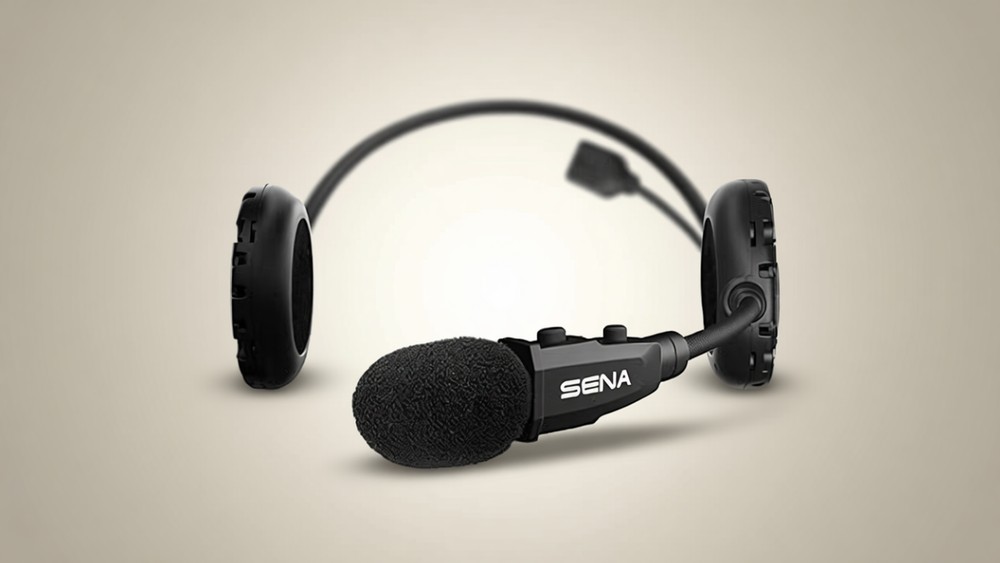
Most helmet headsets are built to disappear: flat speakers under the liner, buttons on a clamp you learn by feel. Sena's 3S Plus Boom takes the opposite approach and puts the microphone on a gooseneck an inch from your mouth, with the two control buttons riding on the boom itself. For jet and open-face helmets, where there is no chin bar to mount things on, that design makes sense.
The 3S Plus is also one of the few Sena units that still talks only to one other rider. No mesh, no group conference, 400 meters of open-terrain range and nothing more. That is exactly right for a rider-and-passenger pair or two friends riding together, and exactly wrong for a group.
What makes this one worth a close look is the paperwork. The listing's own spec table quotes 20 hours of talk time in one field and 8 hours in another, and Sena's own page carries both figures too. Below, the eleven written owner texts get read against that spec sheet, failure cluster first.
The short verdict: the boom design and the call quality hold up in the recent record, the pair-job range claim has one owner who measured it, and the value is the weak side.
At 99.00 for a single unit, the 3S Plus Boom costs about 49.50 per rider, which lands it in the pricier third of our intercom table. That is a real premium for a two-rider headset, and the sections below are what you are paying for and what you are not. The ladder's other rung, the kit with both microphone styles at the same price, is covered in the Sena 3S Plus Universal review.
Twenty hours, eight hours, and two pages that disagree
The Amazon spec table says talk time runs up to 20 hours, and the listing bullet repeats the same figure.
One field lower on that same table, the battery average life line says 8 hours. Sena's own product page carries the split too: the prose promises up to eight hours of talk time on a single charge with seven days of standby, while the spec block underneath lists up to 20 hours for Bluetooth intercom.
So the manufacturer's own paperwork disagrees with itself by more than double. Nobody in the owner record settles it with a number. The closest thing is a rider who reports a good battery that lasts for hours with the volume wide open, which is a compliment, not a measurement.
Category context, and not a fact about this headset: manufacturer talk-time figures are usually measured at moderate volume with no music streaming, and owners who ride with the volume up report less.
The practical read is to plan around the smaller figure. Charging takes 3 hours on the USB-C port, and the charging window runs from 0 to 45 degrees Celsius, which matters if the headset winters in an unheated garage.
The boom mic is the design, and the record splits on wind
The hardware is the pitch. A 180mm gooseneck boom carries the microphone and the two control buttons, so nothing mounts outside the helmet shell. The speakers are 23mm units, 4.3mm thick, with foam padding, and the whole kit weighs 55 grams.
The listing aims it at jet and open-face helmets, and Sena's page says the same.
The owner record splits on how that boom behaves in moving air. The August 2026 one-star text reports wind noise through the mic so loud the rider could not hear their wife talk, and distortion on top of it when she did come through. The same rider's app would not connect to anyone.
The April 2026 text, which is the most-endorsed recent one on the page, describes the opposite experience: the foam on the boom keeps wind down, calls work while riding at 60 to 70 mph, and the whole setup runs through the handlebar controls of a CFMoto 450NK.
That rider calls it the best helmet setup found at its price, with the caveat that the speakers run painfully loud with too much high end until a set of earplugs tames them.
There is a reason both things can be true. Category context again: a boom places the microphone element near the mouth, which tolerates wind better than a flat pad sewn into the liner, but no boom erases wind at speed, and an open-face helmet exposes more of it than a full-face does. Two more owners land on the speaker side of the ledger.
One wishes the speaker quality were a little better, and a July text in Spanish calls the speakers poor quality outright.

The 2023 failure cluster, and the quieter two years after
The loudest critical text on the page comes from September 2023, and it is the only one of the eleven without order confirmation behind it. The story: a first unit failed 31 days after ordering, which was two uses because the buyer was overseas.
The buttons on the boom stopped working and the thing would not turn on or off. Sena's replacement process took nearly two months, and the replacement then failed the same way after three uses. The text ends with two words: Get Cardo.
An older one-star from June 2023 reports a different defect: the volume-adjust beeps played so much louder than the music that the headset was unusable, and a factory reset plus firmware updates did not fix it. Neither text has been echoed by anything since. That does not erase them, and it does not prove the current stock is clean either.
The 2025 and 2026 record holds one clear defect report: a left ear speaker that stopped working in February 2025, returned without trouble. A January 2026 buyer received a box missing pieces and never got to use the thing, while conceding it may have worked fine.
The rest of the recent pool reads positive, including a rider who has now purchased three of these, one for each family member, and has not paid full price yet. The listing carries a 2-year warranty, which is worth something against a 31-day first failure, and the EU spare-parts line backs it with 2 years of parts availability.
Four hundred meters, two riders, one owner who measured it
The June 2025 text is the only owner distance report in the whole record: the intercom works up to a quarter mile away. That matches the 400-meter claim exactly, and it is worth more than the claim itself, because the same rider adds that the original 3S needed the bikes nearly side by side. The Plus generation moved the number, and one owner has noticed.

Some context on where that number sits, and this is about the category rather than this headset: Bluetooth 5 radios reach roughly 40 to 400 meters as a class, per Wikipedia's Bluetooth article, so this claim rides at the very top of the band and assumes open terrain with nothing between the helmets. Trees, buildings, and hills all take their cut.
The scope stays fixed at two riders. There is no mesh and no group conference here, and no firmware setting adds one. The family buyer in the record solved group coverage with three separate units, which is three pairs, not a group call, and worth understanding before a third rider joins the plan.
On water, the spec table says Not Water Resistant in plain words, with no IP code anywhere on the page, and no owner text reports rain either way. That is an honest label, and rarer than it should be in this category.
Frequently Asked Questions
Does it work in a full-face helmet?
The listing and Sena's own page both specify jet and open-face helmets, and the boom design is the reason: there is nowhere for a gooseneck to sit comfortably against a full-face chin bar. That is the designed fit rather than a hard ban, but the record contains no full-face reports either way, so nobody can tell you how it goes.
Is the Sena 3S Plus Boom waterproof?
No, and the listing says so. The spec table reads Not Water Resistant, and neither the listing nor Sena's page claims any IP code for it. For wet-weather riding, that is a line to take seriously rather than explain away.
Is the battery life 8 hours or 20 hours?
Both numbers appear, and they appear on both Amazon's table and Sena's own page. The 20-hour figure is the spec-block number for Bluetooth intercom, the 8-hour figure is the prose and battery-average-life number. Plan around the smaller one, charge in 3 hours, and keep the charging temperature between 0 and 45 degrees Celsius.
Can it do group rides?
No. It is a 1:1 intercom, two riders, and that is the whole design. If three or more riders need to talk, this is the wrong product, and the owner who bought three units for the family was buying three separate pairs, not a group system. Riders who need groups want mesh, and our intercom comparison sorts by rider count so the mesh options are one click away.
Is it worth it against cheaper generic sets?
The April 2026 rider arrived here after trying a cheaper helmet-mounted set whose speaker rattled, then earbuds, then slim sleep earbuds that kept dropping connection, and landed on this as the best setup found for the money.
Another owner wishes the speakers were better, and one calls them poor quality. What the premium buys is the boom design, the 2-year warranty, and a brand with a support process behind it, as long as you accept the 49.50-per-rider position in the pricier third of the table rather than expecting a bargain.