Budget battery listings tend to compete on one number, and this one leads with amp-hours. The SEENRONGYUAN 48V 13Ah stores 624 watt-hours in a silver fish case, which is a mid-sized pack by today's standards, at a price per watt-hour that lands close to the middle of the 301 packs we track. That's the fair part of the story.
The rest of the story is a rating shaped like a barbell. Eleven buyers have scored it 3.7 out of 5, and they didn't cluster. 48 percent gave it five stars, 26 percent gave it four, and 26 percent gave it one, with nobody at all in the middle. The verified record leans positive and includes one detailed complaint that has nothing to do with the cells. The listing itself argues with its own spec sheet about the BMS current. I'll take the claims first, then the buyers, then the arithmetic the page lets us check.
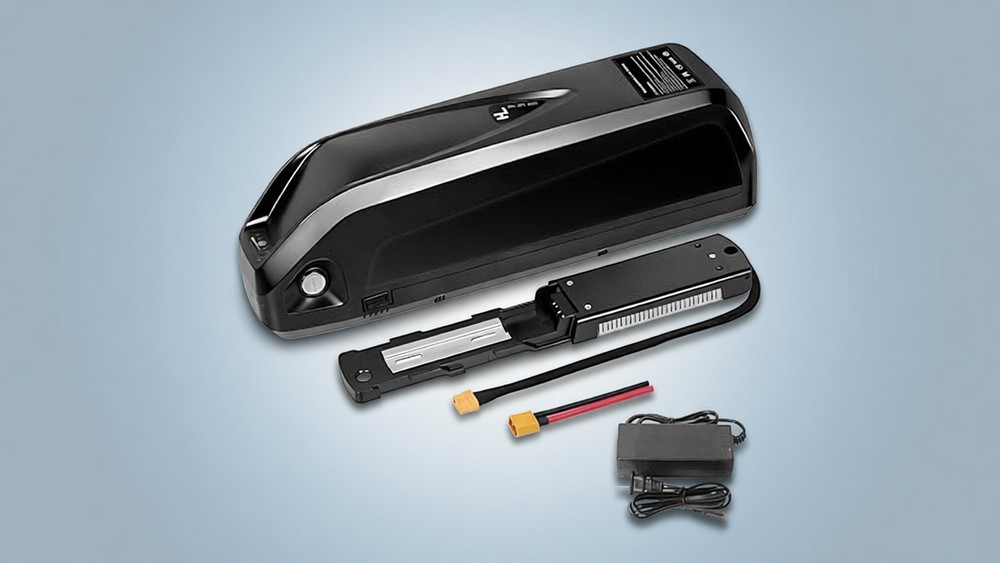
What the listing promises, and where it argues with itself
The spec sheet reads well on its face. The SEENRONGYUAN 48V 13Ah measures 390 by 75 by 111mm in a silver fish case, weighs 7.7 pounds per the spec table, and carries an LED charge indicator, a keyed anti-theft lock, an IP65 housing and a 5-pin base. The box includes the battery, a 54.6V 2A charger, the holder, two keys and a manual.
Now the contradiction. The title and the first bullet say the pack carries a 30A BMS. The third bullet says it's equipped with a 40A BMS. Both can't be true, the page doesn't say which is, and the difference isn't cosmetic. A BMS current rating limits what the pack can continuously supply, and a controller that demands more than the BMS allows cuts out under load even when voltage and capacity match. If your controller draws up to 30 amps, one of these figures says you're fine and the other says you're at the limit.
The warranty statement is three months, manufacturer, and that's the entire sentence. For a component that ages with every charge cycle, three months is a short leash, and it colors how I'd read every other claim on the page. The motor range, 100 to 1000 watts, is a catalog window with no test behind it. And IP65 means dust-tight and protected against low-pressure jets, not submersible, whatever the word waterproof in a bullet suggests.
What the verified buyers actually wrote
Nine buyers left text. Five of those are tied to actual orders, and they're mostly short and positive. The most useful one comes from April, a four-star from a Lectric XP4 owner: the pack fits well, it takes a while to charge, and it's very worth it at the price paid, which was a hundred and fifty-five dollars when they bought. That's the only text naming a bike it fits, the only one touching charge time, and the only one with a purchase price in it.
The July records add install speed. One owner reports the bike was back up and running 30 minutes from the time the battery arrived. Another says it shipped on time and works fine on their ebike. A third simply says it works as advertised. That's the entire verified positive record, and none of it runs to more than two sentences.
The one-star deserves its own paragraph because it's detailed where the praise isn't. Its author bought the pack as a spare and charges it in the house, and the manual, in their words, terrible, never says which way to position the key for on, off and lock. The red switch goes unexplained. The capacity light doesn't go on, so they can't tell whether the battery is charging at all. Notice what this complaint is and isn't: it's about documentation and indicator behavior, not about cells failing, and it's exactly the kind of problem that a three-month warranty and a thin manual both point toward.
The four unverified texts are generic five-star praise, steady charge through weekend rides, long battery life, a lockable enclosure delivering stable power. No numbers in any of them, so I weight them lightly. Between the verified record and the histogram, one gap stands out: 26 percent of eleven raters gave one star, and none of the five-star texts explains what went wrong for them. The record is too small to answer that, and I won't pretend it does.

Charge time and range, with the arithmetic shown
Charge time is set by the charger, and the page supplies the numbers to work it out. The supplied unit pushes 2 amps into a 54.6-volt pack, which is about 109 watts. Six hundred twenty-four watt-hours at 109 watts is just under six hours, and real charging adds a taper at the end, so call it six to seven hours from empty. That matches the XP4 owner's takes-a-while complaint exactly. If that pace doesn't suit you, a 3A or 5A charger shortens it, provided the BMS accepts the higher current, and given the unresolved 30A versus 40A question I'd ask the seller before assuming.
Range is where I show the arithmetic instead of inventing a band, because not one owner in the record reports a mile figure. The pack stores 624 watt-hours. Wikipedia's e-bike overview puts a typical per-charge range at 25 to 75 miles depending on the power level used. Where you land inside that band is set by how you ride, so a throttle-heavy rider should expect its lower half and a light-pedal-assist commuter its middle. That's the honest ceiling of what the page supports, and anyone quoting you a precise number for this pack is guessing.

Who should buy it and who should not
The good fit is specific. You already have a working bracket or frame slot that takes a 5-pin base, you want a spare or a replacement rather than a pack to build a bike around, and you can charge overnight without caring that it takes six-plus hours. For that rider, the per-watt-hour price is fair and the verified installs went smoothly.
Three buyers should scroll past. Anyone who needs a warranty with a spine is buying three months here, which is about as short as warranty statements get. Anyone whose mount takes a 4-pin base, because the pin layouts don't interchange. And anyone who can't tolerate a pack whose indicator behavior left one owner unable to tell whether it was charging, since that's a real report and not a hypothetical.
The price-per-watt-hour position, close to the middle of the 301 packs we track, renders live in the specs box of our battery comparison table. If the three-month warranty bothers you, the same brand's 48V 20Ah hailong pack and the external-case 13Ah sibling are both worth a look, and the table will show you where each lands on value. Check the current price on Amazon.
Frequently asked questions
Will it fit my bracket?
Match the base before anything else. This pack uses a 5-pin base in a silver fish case, and both the pin count and the case style have to match your bracket or frame slot. Silver fish and hailong mounts come in 4-pin and 5-pin layouts that don't interchange, so check your current pack or the mount's label rather than guessing.
How long does charging take?
About six to seven hours from empty on the supplied 2A charger. The arithmetic: 2 amps at 54.6 volts is roughly 109 watts, and 624 watt-hours divided by that is just under six hours before the balance taper. A higher-amp charger shortens it if the BMS accepts the current.
What does the warranty cover?
Three months, manufacturer, and the listing says nothing beyond that. There's no extended term, no cell-level coverage statement and no after-sales promise anywhere on the page. If a battery's useful life commonly runs past a year, that's the gap you're accepting.
Is the BMS 30 amps or 40 amps?
The listing says both and I can't resolve it. The title and first bullet state 30A, the third bullet states 40A. Treat 30A as the safe planning figure, since it's the one the page leads with, and confirm with the seller if your controller draws more than that.
Does the USB output matter?
It's on the title and no owner in the record mentions using it. A USB port on a 624Wh pack can top up a phone many times over without denting the ride budget, so the feature costs you nothing, but I wouldn't buy this pack for it.