Silver fish batteries all look alike from the outside, and the listings have stopped helping. A typical page now describes the whole product family instead of the pack in front of you, borrows its bullets from a template, and leaves the buyer to work out which claims belong to which pack.
The SDTYYP 36V 21Ah is that kind of listing in its purest form. It has no ratings and no written reviews at all, so there is no owner evidence to weigh.
What you get instead is a page of printed numbers, and this article runs every one of them: the two BMS ratings that contradict each other, an IP68 claim stronger than anything else we have covered, a charger question that our own data row gets wrong, and weight rows that turn out to agree once you convert them.
The honest summary is that this is a pack you buy with a scale and a multimeter, not on trust. Nothing on the page disqualifies it. Nothing on the page proves it either.
The SDTYYP 36V 21Ah silver fish battery carries 756 watt-hours at 229.00, which lands it below the middle of the 324 packs in our comparison table on price per watt-hour. That is a mid-tier price for an unproven pack, and the page supplies its own reasons to slow down: two BMS numbers in one sentence, a submersion waterproofing claim, and an included-items list that names a lock and nothing else.
Read the sections below before you order, because each one changes what you should check on arrival.
A record with nothing in it
This listing has zero ratings and zero written reviews. We confirmed that signed in on both sort orders, so it is not a case of reviews hidden behind a filter or a region. The page has simply never been reviewed.
Zero-record listings aren't rare at the bottom of this market, and they aren't automatically bad.
The seller rank, 347th among scooter batteries and chargers, says the listing moves some units. What a zero record takes away is the one thing reviews give you: proof from other buyers about honest capacity, lifespan, and what happens when a pack fails. On this listing you have the printed page and arithmetic, and nothing else.
That sets the standard for everything below. Every claim in the rest of this article traces to something the page itself prints, and where the page argues with itself, we show both lines.
Two BMS numbers and a 1000-watt ceiling
The safety bullet promises a "built-in 25A/30A BMS protection board", two ratings in one sentence with nothing on the page separating them. The arithmetic shows why the difference matters.
At 25 amps continuous, a 36V pack sustains 900 watts. At 30 amps it sustains 1080 watts, and the listing's own motor band tops out at 1000W. The smaller number sits under the band and the larger number pokes above it.
The safe reading is to plan around 900 watts. That covers every motor in the printed band up to a true 900W unit. If you run a 1000W motor, assume the pack will cut in under full load, because a 25A board hits its limit at 900W.
The gallery card lists the standard guard set: over-charge, over-voltage, over-current, short circuit and voltage balance. It tells you nothing more than that.
What IP68 would mean if it were true
The features bullet claims an "IP68 waterproof" aluminum shell. In the IP code, the second digit covers water, and an 8 means the case can sit under water, past a meter deep, and keep working (Wikipedia, IP code). The packs around this one almost always print IP65, which is low-pressure jets, two full grades below submersion.
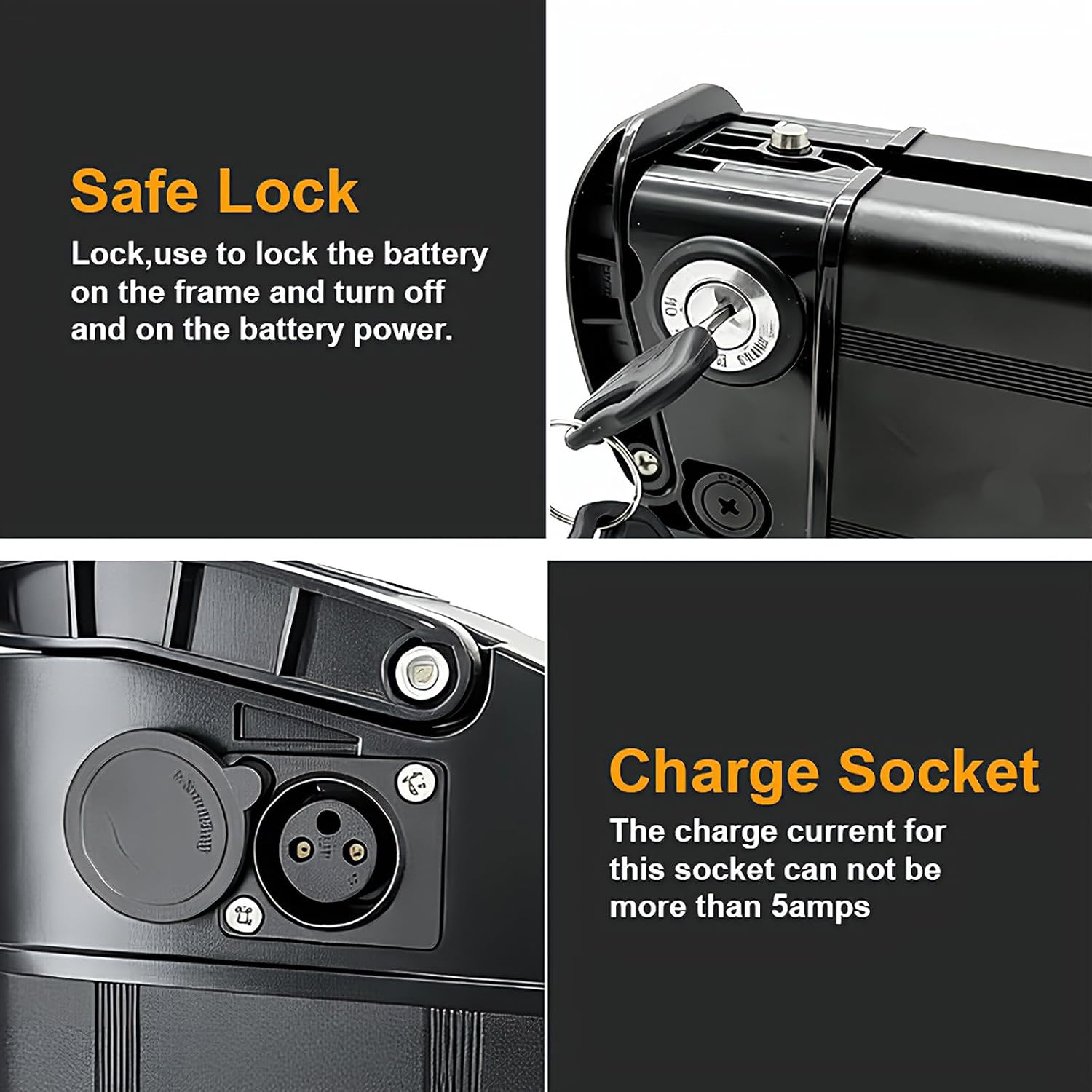
No pack we have covered prints a stronger water claim, and the claim deserves skepticism here for a physical reason: the pack has an exposed charge socket, and the charge-socket card caps that socket at 5 amps. A case that survives under water and an open socket that takes a charger don't obviously belong to the same design. Treat the IP68 line as marketing until somebody dunks one on camera.
The useful part of that card is a fact most listings never print. The charge current for the socket can't exceed 5 amps, which gives you the fastest safe charge this pack can take.
The charger question
Here is the trap on this listing. Our own data row for this pack still says "with Charger" in its title, because an earlier version of the listing promised one. The live page promises nothing of the sort.
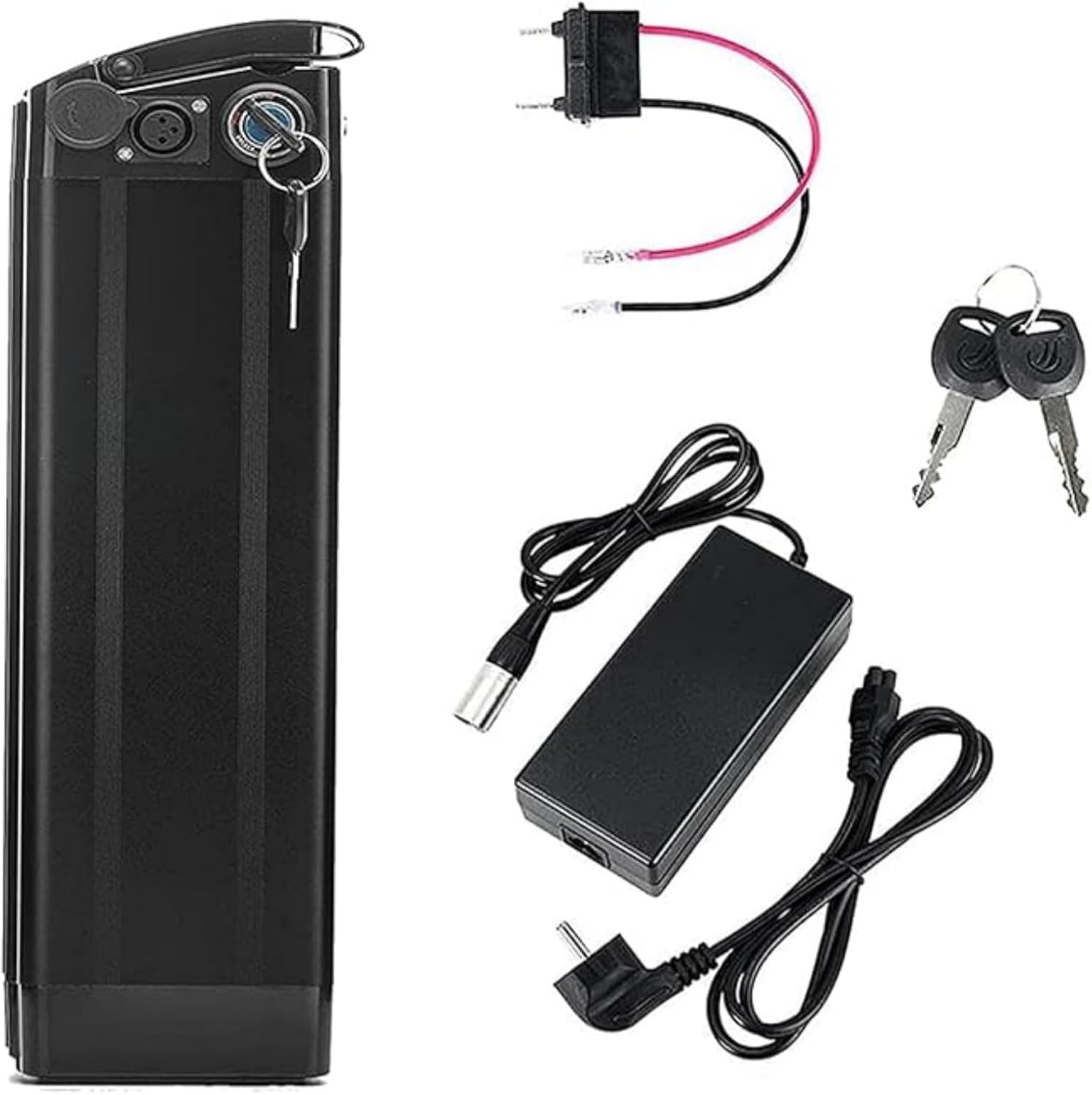
The word charger appears nowhere in the current title or bullets, and the included-components row names exactly one item: a lock.
A buyer who assumes the charger ships in the box may be wrong, so confirm before ordering. If you supply your own charger, the math says 42.0 volts full for a 36V-class pack, which is ten cells in series at 4.2 volts each. At the socket's 5-amp limit, refilling 21 amp-hours takes at least 4.2 hours.
With the common 2-amp charger this tier usually bundles, the floor is 10.5 hours, so a missing charger costs you real time as well as money.
The weight rows, converted
The details table prints a battery weight of 5 kg and an item weight of 11 pounds. Those look like a contradiction, and on most listings in this class they are. Here they agree: 5 kilograms converts to 11.02 pounds. Both rows describe the same pack.
The agreement is the rare direction, and it closes tighter than we expect at this price. A 756Wh pack at 5 kilograms works out to about 0.15 kilowatt-hours per kilogram, the top of what packaged packs weigh once the case, board and wiring take their share.
The printed weight only makes sense with high-grade cells inside and very little slack for anything else. That isn't impossible, but it is the kind of number that earns a check on arrival: put the pack on a scale and see whether it holds 5 kilograms.
The same read applies to the cycle claim. The safety bullet says capacity exceeds 80 percent after 800 cycles, which sits in the upper half of the 400 to 1,200 cycles typical for consumer cells (Wikipedia, Lithium-ion battery). A second cycle figure, 1000 or more, shows up on a card in the gallery, and that card is printed entirely in French.
Two cycle promises in two languages, neither in the specification table, and nothing on the page backs either one.
Frequently asked questions
Does a zero-rating listing mean the pack is a scam?
No. It means the listing is young or has sold too few units to draw reviews, and the seller rank suggests it moves some volume. It does mean you have no independent evidence about capacity honesty or lifespan, so every promise rests on the printed page. Buy from a position of checking, not trust.
Which BMS number should I plan around?
The 25-amp reading, which sustains about 900 watts on a 36V pack. That covers every motor in the printed band except a 1000W unit, and a 1000W motor may hit the current limit under full throttle.
Will it fit my bike's silver fish mount?
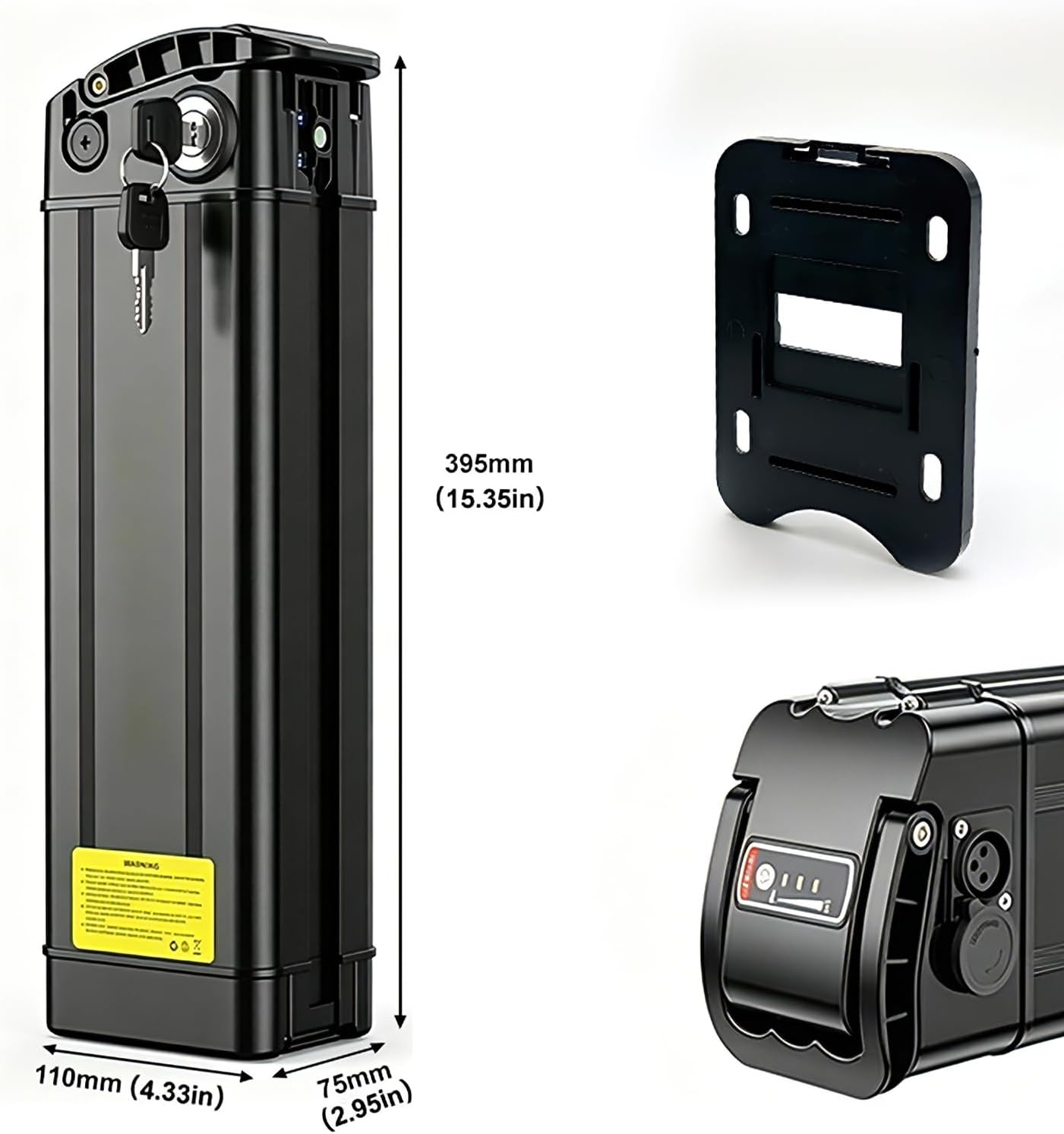
The gallery card prints a 395mm length and 110mm width. Measure the space your frame offers and check the cradle spacing before ordering, because silver fish cases share a shape but not always a footprint. Our 48V 21Ah SDTYYP review covers the voltage sibling of this ladder if you are comparing rungs.
Can it run a 1000W motor?
Possibly, if the board is the 30-amp version the bullet mentions. If it is the 25-amp version, the pack current-limits at 900 watts. Since the page never settles the question, assume the smaller number.
What should I check on arrival?
Weigh the pack against the printed 5 kilograms, confirm the charger situation before your first refill, and meter a full charge down through your first rides. A pack whose page argues with itself deserves a meter more than most.