Most 52V buyers are choosing between 20 and 25 amp-hours, and the trade is always the same: more range means more weight, more money, and a bigger case to mount. The RANSYRI 52V 30Ah pack skips past that trade entirely, promising 1,560 watt-hours, a capacity figure most brand-name packs never reach at any price.
The catch is that nothing on the page has been checked by anyone. This listing has no ratings and no written reviews at all. Every claim you are about to read is the seller's own arithmetic, and some of that arithmetic disagrees with itself.
This review walks through what the capacity is worth, what the weight math says about the cells inside, and the two motor ceilings the listing cannot settle on.
What 1,560 watt-hours costs
At 309.99 for a claimed 1,560 watt-hours, this works out to about 20 cents per watt-hour. That is the cheapest fifth of the 324 packs in our ebike battery comparison table, and the exact position renders in the specs box on that table if you want the live number.
For the capacity, that price is the strongest fact on the page. The RANSYRI 48V 30Ah sibling we reviewed sells in the same band, and most 52V packs near this price carry 20 amp-hours, not 30. Per ride, the difference is real: a 30Ah pack at typical throttle consumption carries roughly half again the range of a 20Ah one.
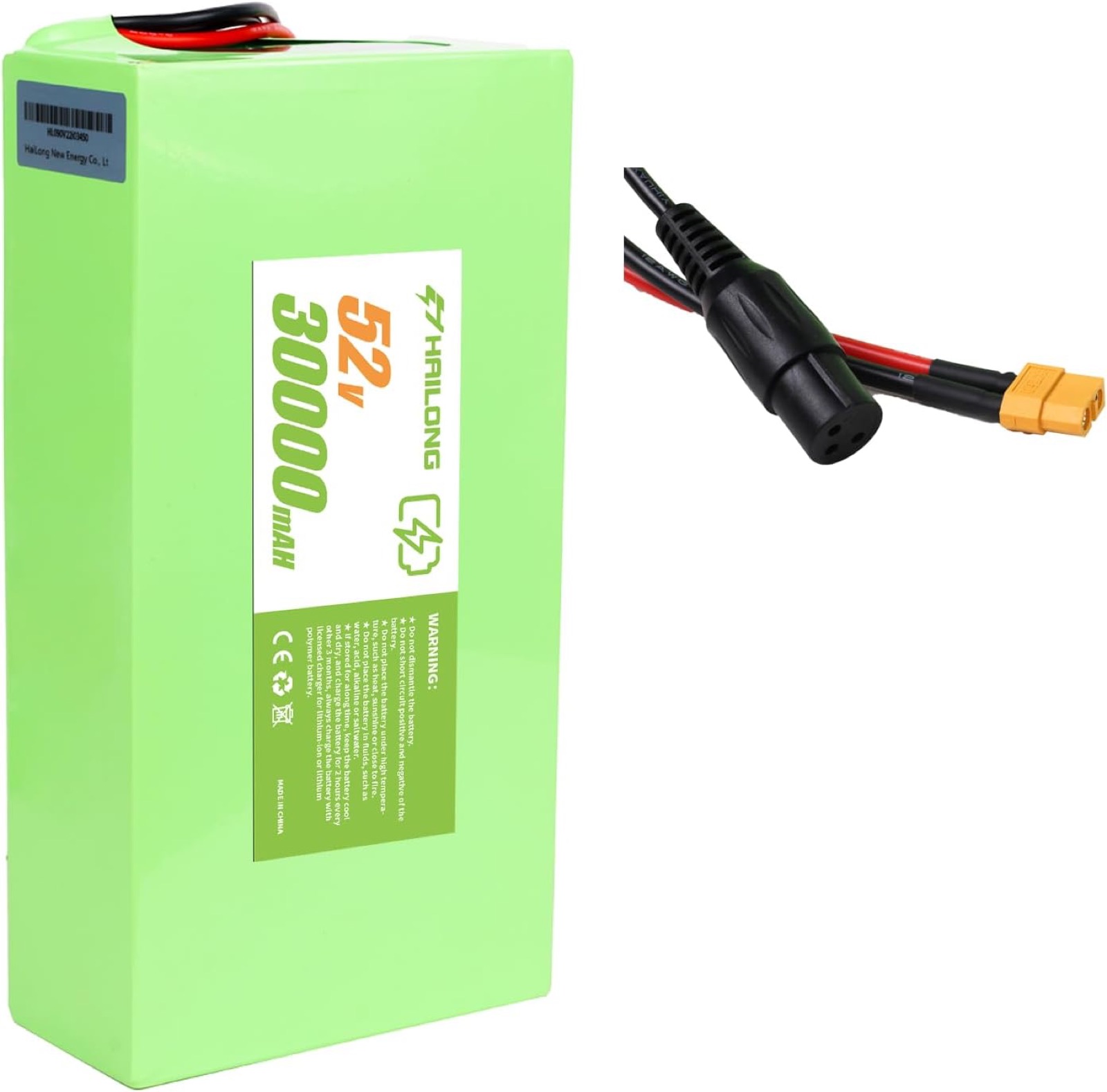
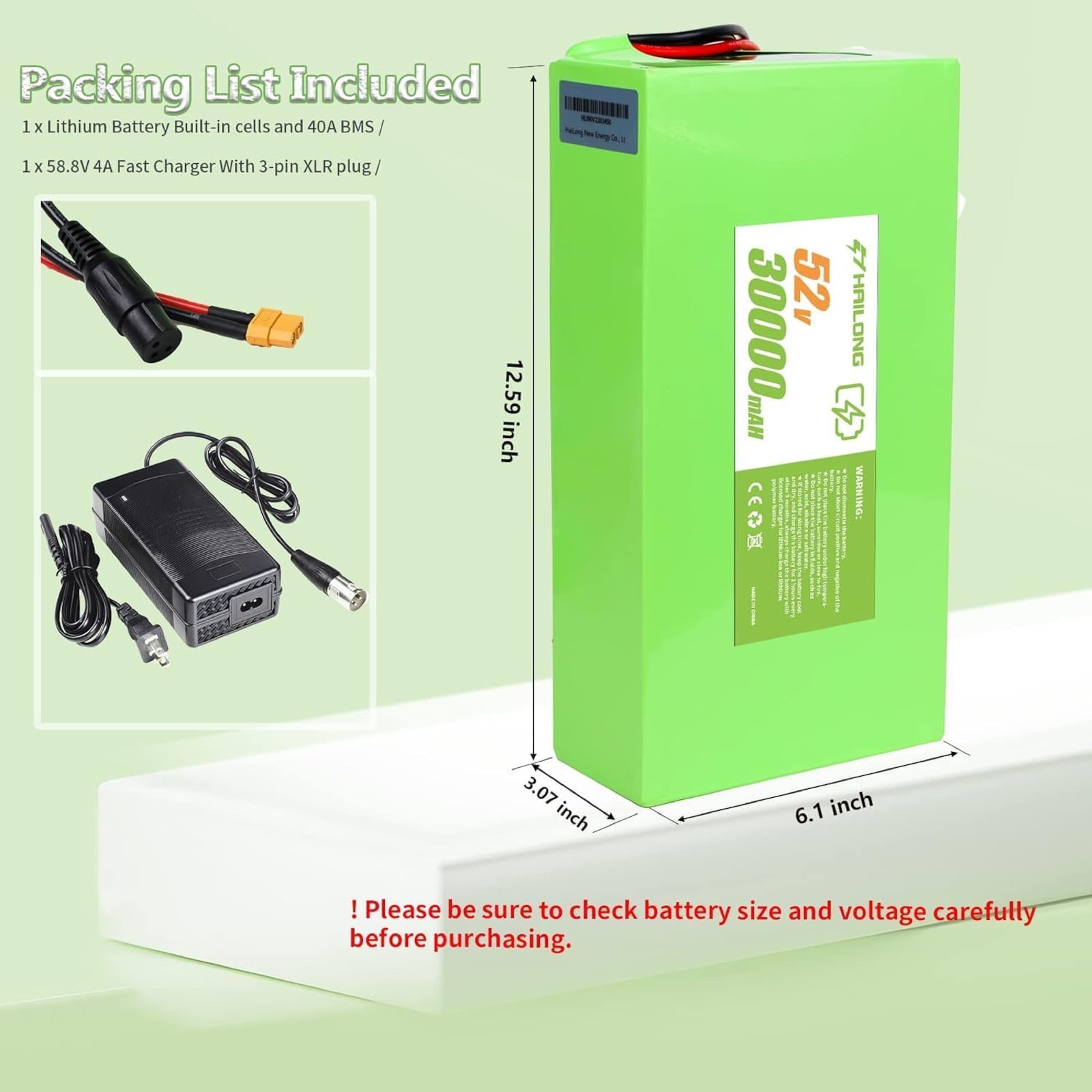
The box is complete. You get the pack, a 58.8V 4A fast charger with a 3-pin XLR plug, and XT60 and T-Plug connectors for the discharge side, plus a one-year warranty row and a 24-7 support claim. A charger in the box is not universal in this bracket, and a 4A unit is faster than the 2A chargers most budget listings include.
What the price does not buy is any evidence. The brand appears in the spec rows but not the title, the model number is a digit string that matches nothing else on the page, and the listing is filed under bike tires in Amazon's own categories. You are underwriting the seller's arithmetic with your own money, so the next sections check it.
A listing with no owner record at all
There is no record here. No ratings, no written reviews, no star widget on the page.
We could not read a review pool at publish time because none exists to read. That makes this the sixth listing we have rebuilt in exactly this state, and the method is the same each time: audit the page's internal consistency, decode the spec rows, and treat the return window as the only test that matters.
Zero-record listings are not automatically bad. Sometimes the listing is simply new.
But the burden of proof moves entirely to the buyer, and the checks you can run from the page become the whole review. On this page, most of those checks pass, one of them is the tightest we have ever printed, and one is a flat contradiction.
Nobody has confirmed the capacity, the range, the charger behavior, or how the pack holds up in month six. The seller's page is the only source, and the price is what you are paid for accepting that.
The weigh-on-arrival math
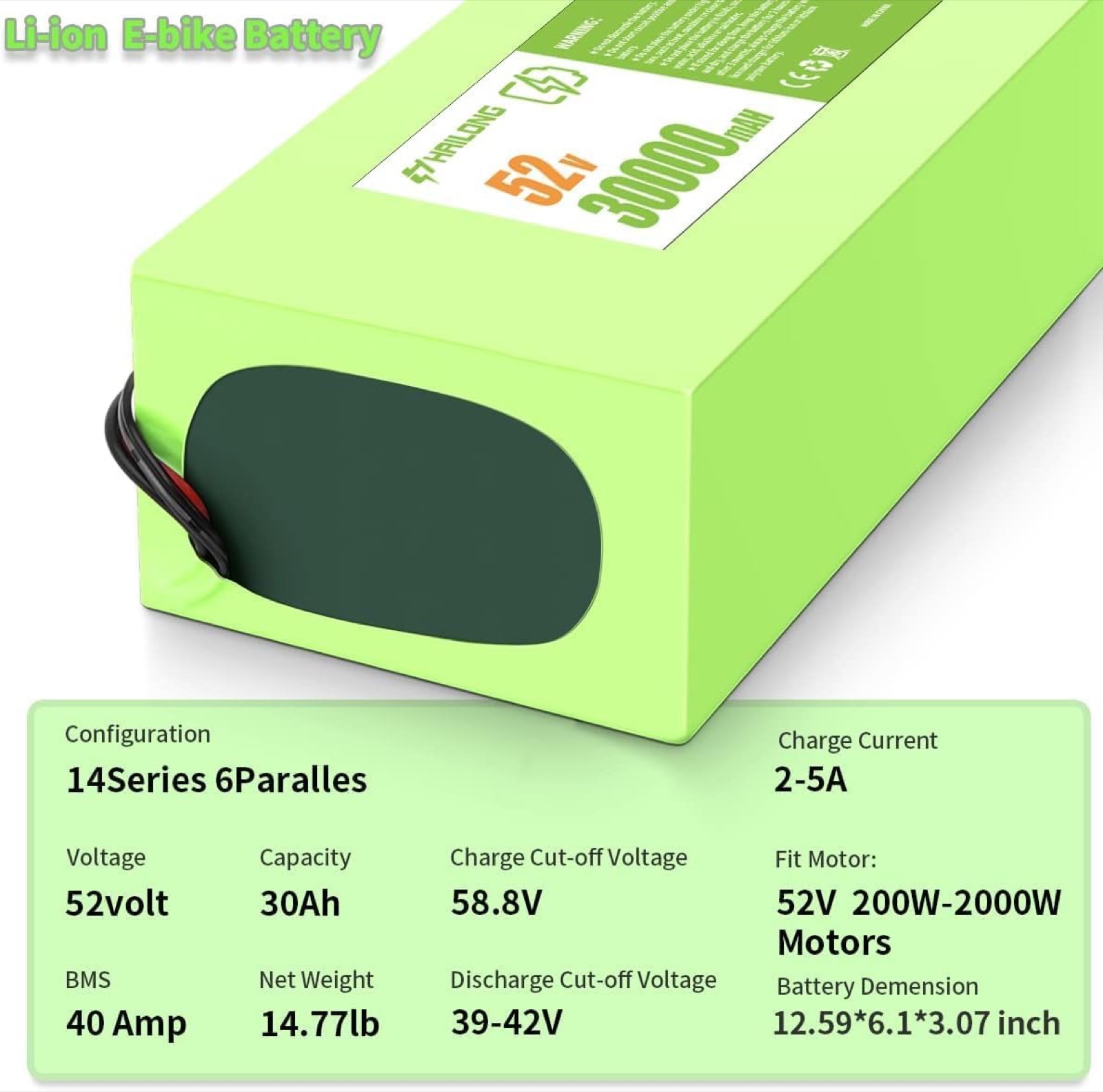
The parameter card prints the cell layout, and it is the most useful line on the page: 14 cells in series, 6 in parallel, or 14S6P. That is 84 cells. The charger voltage confirms the series count, because 58.8 volts is exactly 14 cells at 4.2 volts.
Now the weight. The pack claims 14.77 pounds, or 6.7 kilograms, and the bullet and the card agree. Run the density math and 1,560 watt-hours at 6.7 kilograms reads about 0.233 kilowatt-hours per kilogram at pack level.
Standard lithium-ion cells hold between 0.16 and 0.30 kilowatt-hours per kilogram, and a finished pack always lands lower than its cells because the case, the BMS board, the nickel and the wiring all weigh something. At about 70 grams per cell, 84 cells need roughly 5.9 kilograms before packaging, which leaves under a kilo for everything else in a 6.7-kilogram pack.
That is the tightest weight reading we have printed this month, tighter than the Sinigerel pack we called the plausible edge. It does not make the claim false, because 5 amp-hour cells exist and they sit at the top of the market. It makes the claim expensive to fake your way past, in one direction only: if the cells are ordinary, the pack cannot weigh 6.7 kilograms and deliver 30 amp-hours.
So weigh it when it arrives, meter a full charge if you own a meter, and do both inside the return window.
Two motor ceilings on one page
The listing cannot settle on what this pack can power. The bullet says it supports devices drawing 200 to 1500 watts and tells you to verify compatibility before purchase.
The parameter card says it fits 52V motors from 200 to 2000 watts. That is a 500-watt disagreement on the pack's headline use.
The BMS math gives you the hard ceiling. A 40A board on a 52V bus tops out at 2,080 watts, and both printed claims sit under it.
A 2000W motor draws about 38 amps at full load, just inside the 40A limit with almost no headroom. A 1500W motor draws about 29 amps and leaves real margin.
So the card's number is technically possible and thermally brave, and the bullet's number is the honest one. If your controller draws near 2000 watts, the pack can deliver it on paper, but a 40A board at its ceiling for long stretches runs hot, and nobody has tested this one. If your motor is 1500 watts or under, both printed claims agree and the question disappears.
One quieter oddity in the card: the discharge cutoff prints as a range, 39 to 42 volts. Fourteen cells at 3.0 volts each is 42, so the top of that range is the normal empty point, and the bottom reads like a stretched low-voltage cutoff. Quoted as printed, with no explanation on the page.
Charging, connectors, and the IP65 claim
Charging is the strong part of this listing. The card says 2 to 5 amps, the box ships a 4A charger, and 30 amp-hours at 4 amps is a 7.5-hour floor from empty, so an overnight charge covers it with room to spare. At the card's slowest setting, plan closer to 15 hours.
The 58.8V charger voltage is the correct 14S figure, which is the check that matters most, because a wrong-voltage charger on a 52V pack is a fire risk, not an inconvenience.
The discharge side carries both XT60 and T-Plug connectors in the box, which is genuinely useful, because those are the two connectors you are most likely to meet on DIY builds and conversions, and the charger's 3-pin XLR input is a standard enough plug to replace. Photograph your bike's discharge port before ordering anyway, since the listing names no bike brands at all and its own advice is to check the fit before you order.
The water claim deserves a careful read. The bullet says the PVC shell meets IP65 weatherproof standards, and IP65 is a real, checkable standard: it means dust-tight and protected against low-pressure water jets from a 6.3mm nozzle, not immersion.
A PVC wrap meeting that in practice is plausible, but note what the claim does not cover. Riding through standing water deep enough to submerge the case is outside the rating, and a soft shell has no gasketed seams to fail gracefully. Keep the pack out of puddles and the claim costs you nothing.
The smaller claims get shorter shrift. The card advertises a certified self-discharge rate under 3 percent monthly without naming a certifying body, and the bullet says the pack was rigorously tested for over 1,000 charge cycles, a figure at the top of the band lithium-ion chemistry delivers under gentle lab conditions. On a listing with no owner record, read both as marketing until the pack proves otherwise.
Frequently Asked Questions
How far will the RANSYRI 52V 30Ah actually go?
Range is arithmetic once you pick a consumption figure, and assist level, terrain and rider weight drive consumption far more than the pack does. At about 25 watt-hours per mile, typical for throttle-heavy riding, 1,560 watt-hours is near 62 miles on paper. Gentle pedal assist at 16 watt-hours per mile stretches past 90, and full throttle on a heavy bike at 30 lands near 50.
Discount those by 10 to 20 percent for usable capacity and by the unmetered capacity question, and the honest promise is that this pack, if it is real, out-ranges almost everything else at the price.
Is a 40A BMS enough for my motor?
For motors at or under 1500 watts, yes, with real headroom, since a 1500W motor draws about 29 amps on a 52V bus. For a 2000W motor, the draw sits just under the board's ceiling, which the card claims but the bullet does not. Ask the seller which ceiling applies before you buy if you ride hard.
Will it fit my bike?
It fits systems that want a 52V pack with XT60 or T-Plug discharge connectors and a case measuring 12.59 by 6.1 by 3.07 inches.
The listing names no bike brands, and its own advice is to check the fit before you order, which is the correct advice for a pack this size. Measure your battery bay first, because a 30Ah case is bigger than the 20Ah cases most bikes were designed around.
What warranty comes with it?
The listing carries a one-year limited warranty and a 24-7 support claim. With no owner record behind this pack, test it hard inside Amazon's return window, because the return window is the protection that actually works in this bracket.
Who should skip this pack?
Skip it if you need an owner record, a documented safety file, or a brand-name support path.
The comparison table lists 52V packs with real review histories at higher prices, and our latest ebike reviews cover the rest of the high-capacity field, including the SEENRONGYUAN 52V 25Ah with its own 50A board. Buy this one if the capacity is the point, your motor sits at or under 1500 watts, and you are set up to weigh and meter a pack on arrival.