A 1000-watt brushless gearless rear hub that rotates a 20-inch wheel at 440 RPM while delivering 40 nm of torque and claiming greater than 82% efficiency as well as arriving as a complete accessory set is somewhat of a rare combination.
The QUEWATSA 48V 1000W 20 inch rear hub conversion kit is that, a drop-in kit for small wheeled bicycles that combines the motor, controller, throttle, PAS (pedal assist system) sensor, brake levers and display in one box. Check out the QUEWATSA 20 inch rear hub conversion kit on amazon for the most recent product listing.
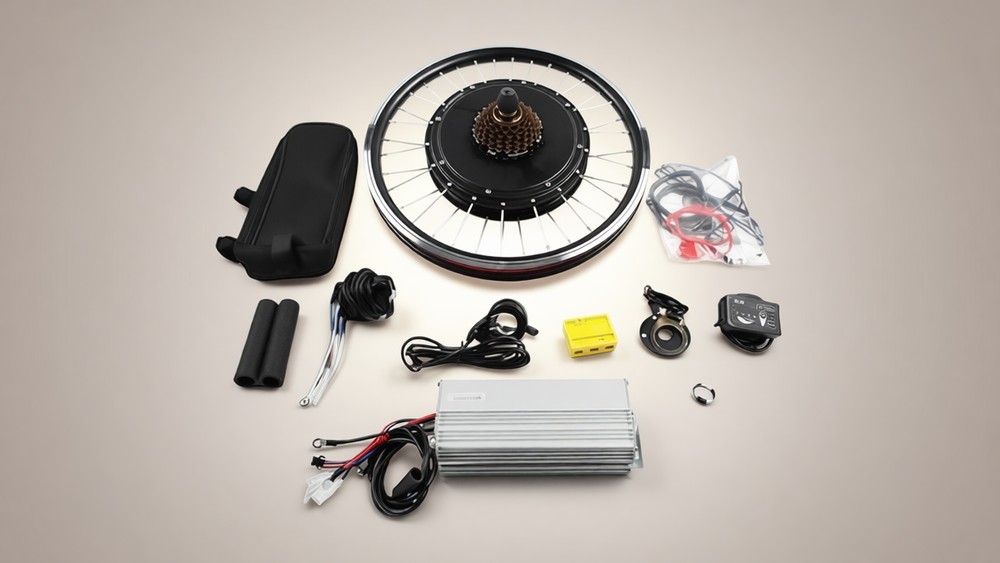
What qualifies this item to receive consideration is that it features a gearless hub in a size often associated with the smaller and weaker geared motors, along with the claim that all necessary accessories arrive within the box.
I would like to mention upfront that I have not personally installed the identical kit, nor do I intend to. Instead, what I can do is evaluate the specifications as provided by the manufacturer and let you know where the figures appear to be accurate versus where they seem to be overly optimistic. The largest caveat here is that this listing has absolutely no customer reviews, a red flag, and a valid reason to proceed with caution prior to spending money.
Specs and Build Quality
The headline specification here is the 1000W rating, a significant amount of power for a 20 inch wheel. The motor used in the conversion is a brushless gearless hub, also referred to as a direct drive, that does not contain internal planetary gears which wear out or create drag, so it operates quieter and is generally more reliable over extended periods of operation. There are tradeoffs. Direct-drive motors are heavier and provide maximum torque at higher speeds rather than from rest.
According to the listing, the motor provides an empty speed of 26.72 miles per hour (mph) or 440 revolutions-per-minute (RPM), 40 nm of torque and can climb 12-degree inclines. With regards to a 20-inch wheel these numbers correlate reasonably well. Smaller diameter wheels tend to make it easier for a hub-motor to rotate them quickly due to reduced inertia. As such, 440 RPM results in approximately 26 mph. Additionally, the claimed 40 nm torque appears reasonable for a direct-drive of its class. However, it lacks the instantaneous torque available via a geared motor resulting in a relatively consistent and progressive force applied throughout acceleration.
As far as the quoted efficiency of greater than 82%, I consider this to be the single specification I should view with skepticism. While every manufacturer publishes peak efficiency values, peak efficiencies occur in a limited window of load and speed combinations. Under varying conditions (stops, hills, headwinds) you will observe average efficiencies below that value, similar to virtually all other hub motors. Therefore, while it may not be false advertising per se, it merely indicates that the motor is designed using contemporary methods.
Quality of construction is difficult for me to evaluate completely since there are no reviews and no detailed photographs illustrating the interior of the motor. Simple mechanical designs result in improved reliability through fewer movable parts compared to geared hubs. The listed load-carrying capacity of 308.64 pounds is generously sized relative to typical 20-inch wheel configurations. Nonetheless, your rim configuration, spoke configuration and frame design are critical factors contributing to how much total payload you can transport.
Installation and Compatibility
While there are several items to highlight regarding installation compatibility, probably the most notable aspect is that this is a complete set. As a first-time builder, this could represent an advantage. Many builders have experienced difficulties during their conversion process realizing mid-project that they require additional components (controllers, sensors, throttles and similar) beyond their original estimate. the QUEWATSA advertises that everything required (motor, controller, pedal assist sensor, brake levers with kill switches, throttle with battery light indicators and all cabling to integrate everything) is contained in the box. You can check the QUEWATSA conversion kit listing to see exactly what ships.
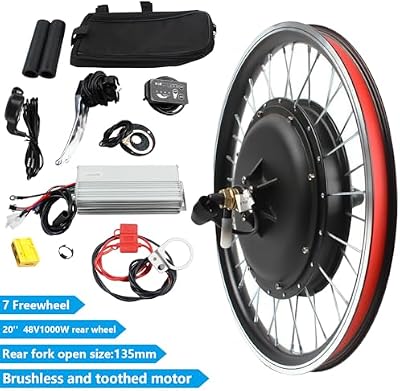
With respect to compatibility, the primary issue to address is ensuring that your rear wheel size aligns with the specifications of this conversion kit. This is not a universal kit. It was specifically developed for wheels with diameters of twenty inches. Therefore, it can be utilized for folding bicycles, miniature bicycles with oversized tires, cargo tricycles and various types of children's bicycles. Before placing an order measure your rear wheel to ensure that your rim size and axle spacing correspond with those of the conversion kit.
If your bicycle has twenty inch wheels and standard drop-outs (the holes in each side of the frame), then this conversion kit was explicitly intended for you. The installation procedure is analogous to installing a traditional rear-hub based on replacing the existing rear wheel assembly with the motorized version. Mount the controller at a location away from moisture or electrical interference. Run cable from the controller to a handle-bar mounted switchbox or display panel.
Mount the pedal assist sensor (PAS) at a suitable location near your pedals. Replace your original brake-lever assemblies with versions containing switches that automatically shut-off the motor when actuated (brake). Although basic hand tools will suffice, expect around three hours of labor. Due to the fact that the motor arrives pre-assembled as a laced wheel assembly, you bypass the most complicated phase of creating a customized wheel (truing).
There are two details deserving special focus. First, although the brake levers with integrated cutoff switches are not an option but instead represent your safety mechanism (that instantly kills the motor upon engaging either brake lever), you must properly connect and test them before taking your first ride. Second, because 1000 watts represents considerable current flow (even more so when operating in short bursts) you should anticipate purchasing a 48-volt battery. Furthermore, if your frame-dropout material is anything except steel, you should seriously contemplate applying a torque-arm directly onto the axle. A motor capable of generating sufficient torque to potentially strip aluminum-frame dropouts.
Who Is This Kit For?
To be frank here, I must be completely candid about this, because this product listing has zero customer reviews, which represents possibly the greatest deterrent. Zero reviews mean zero independently confirmed statements about performance of the motor under actual running conditions, zero confirmed statements about accuracy of stated specifications, zero confirmed statements regarding correct functioning of the PAS sensor, zero confirmed statements regarding proper function of the cabling included in the kit, and so on. New products from manufacturers who lack extensive history or credibility carry substantial uncertainty regarding potential success versus headaches, as opposed to kits which have been thoroughly vetted by customers and therefore offer considerably more assurance.
Therefore, I believe this kit is best suited for someone willing to assume risk, willing to become one of the first to determine, and comfortable troubleshooting connectors or sensors. If you have previously assembled a bicycle, or have patience sufficient to investigate issues related to connectors or sensors then risk will be minimized. However, if this represents your first attempt at building an electric-bicycle and you desire to undertake an uncomplicated and thoroughly documented experience, I recommend beginning with an established kit having an abundance of customer testimonials.
Another major benefit in terms of risk reduction is represented by the complete set claim made by this product listing. By implying that everything needed will be included in one box (motor, controller, PAS sensor, throttle with battery light indicators, brake levers with kill switches), this eliminates substantially all potential risks associated with sourcing individual components separately and reduces possible compatibility problems. In addition, assuming the stated efficiency is substantiated by empirical evidence, an 82% peak efficiency rating for a gear-less hub represents an impressive value. I simply must assign less significance to this value as compared to the total lack of any customer verification.
For the correct purchaser this kit presents numerous advantages. A 1000 watt gear-less rear hub on a 20-inch wheel represents an excellent formula for developing small lightweight folding commuter bikes or small cargo bikes requiring consistent torque output and high top-end speeds. Additionally, the load-carrying capacity implies that it can support loads of grocery carts attached behind it.
If you fall into this category and are prepared to be among the initial reviewers, then this item merits thorough examination. Simply enter into consideration with open eyes. To compare this kit with others, view our electric bicycle conversion kit reviews, or browse the conversion kit comparison table before deciding.
Frequently Asked Questions
Is This Kit Truly a Complete Conversion Kit?
The listing states that it will include all components necessary for converting your bicycle to an electric-bicycle, including the brushless gear-less hub motor, controller, pedal assist sensor, brake levers with kill switches, thumb throttle with battery light indicators and cables for connecting all of these components together. This is clearly one of the strongest aspects of their marketing strategy. Simply verify that your battery is sold separately since it is nearly always sold separately from an electric-bicycle conversion kit.
What Size Battery Will My QUEWATSA 1000W Motor Require?
Since this motor requires 48 volts dc it will need a 48 volt dc battery with sufficient amp-hour capacity to achieve desired range characteristics and discharge rate capability to supply ample current to the motor. Larger packs yield longer range and less voltage drop under heavy load conditions. Budget accordingly for your battery costs, as it usually constitutes one-half or slightly more than half of overall costs for any conversion.
Can My Bicycle Accommodate the inch?
Only if your bicycle has 20 inch wheels with matching axle spacing and dropout widths. This kit has been designed for folding bicycles, miniature bicycles with oversize tires, some cargo tricycles and various types of children's bicycles. Verify your rear wheel dimensions and axle width or dropout type against those described in this listing prior to purchase since this is not a universal fitting kit.
Do Both Pedal-assist Sensor and Thumb-throttle Work Together Properly?
Both pedal-assist sensor and thumb-throttle are incorporated into this conversion kit. Use pedal-assist sensor for relaxed cruising and thumb-throttle for full control over speed and acceleration characteristics. The brake-levers automatically cut power when pulled to provide your safety mechanism prior to riding.
Are Gear-less Hubs Reliable Enough for Daily Commuting?
Gear-less hubs are mechanically simple and possess minimal movable parts making them inherently reliable and quiet relative to geared hubs. They are heavy and produce their highest torque levels at faster rotational velocities rather than at low speeds or from rest.
How Fast Can I Go Using the Kit?
The listing specifies empty speed at 26.72 miles per hour and rotational velocity at 440 RPM on a 20-inch rim diameter. Actual speed values depend greatly on rider weight, wind resistance, tire pressure levels, terrain conditions and similar. As such, actual speed values will likely be less than the empty value figures cited above. You can expect a high-speed commuter pace for most riders on most 20-inch wheels.