A no-name rear hub sitting in the cheapest fifth of the conversion kit prices we track is exactly the kind of listing that makes you gamble, and the Mahugde 48V 1000W hub motor kit is that gamble written down by one of its own buyers. One October text opens with the honest version: few reviews, reasonable price, took a chance, no regrets so far.
The record is thin but it is not empty. The detail page prints 16 ratings at 4.6 stars, the reviews page carries ten texts, and eight of them read like owners who bought the thing and rode it. The top-voted text on the page, though, is one of only two without a confirmed-purchase badge, and it reads like the bullets dressed up as a review.
This review reads the listing against its own parts row, walks all ten texts, decodes the 60V speed report that sits at the center of the record, and checks what the cheap fifth placement actually buys. The live numbers sit in the kit comparison table if you want the full field.
My verdict up front: this is a cheap rear wheel with a genuinely encouraging recent record and one support complaint that matters, and I'd take the recent owners' word over the listing's most-voted text every time.
The listing argues with its own parts list
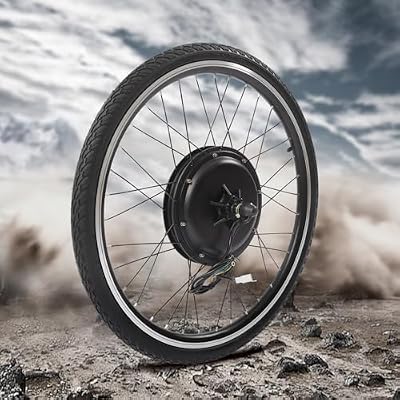
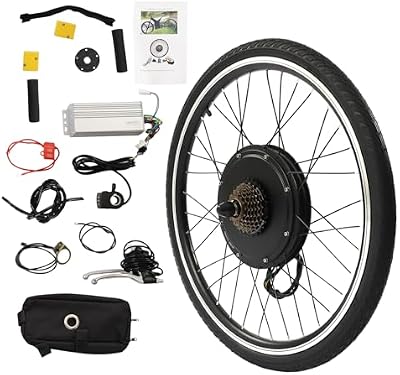
The bullets on this listing make four promises the spec table refuses to repeat: a thumb throttle, a pedal-assist sensor, a controller, and a power-off brake handle that cuts the motor when you brake hard. The Included Components row reads 1* Motor Wheel, and that's the whole list. One of those stories is wrong, and you don't find out which until the box lands.
The smaller self-contradictions pile up around it. Number of Speeds says 1 while Special Feature says Multi-Speed, and the Suspension Type row says Rear on a wheel kit, which is the same template junk row we've watched travel across other kit listings. None of that is information. It's catalog filler generated for a feed.
What the table leaves out matters more. No voltage row, no rpm row, no warranty row, no battery row, and no dropout spacing, so the bullets are the only source for the 440rpm figure, the 45N.m torque number, and the 53km/h top-speed claim. I'd message the seller and get the throttle, sensor, and controller confirmed in writing before ordering, because the parts row is the one place a listing can't rewrite itself after the sale.
What the ten texts actually say
Sixteen ratings print on the detail page and ten texts sit on the reviews page, and the texts are worth taking one at a time because they tell a coherent story. Eight are five-star, two are one-star, and eight carry the confirmed-purchase badge.
The recent texts are the encouraging part. The October 24 buyer installed it without trouble, calls it smooth and quiet, rides long distances regularly, and admits the thin record made them hesitate. October 22 reports 30 mph. October 9 likes the power but warns it takes a little technical know-how. July 2 says easy install and working great, June 1 reports nothing wrong with the hub or electronics after a conversion, and a February owner wrote in Spanish that two months in, their bicycle has become a whole motorcycle.
The failure text is the one to read twice. The October 8 one-star is a confirmed purchase, and its complaint isn't the motor, it's the seller: they call the kit junk, say the seller dodges messages about a defective product, and make the fair point that once you buy all the odds and ends, a normal ebike costs about the same.
The other one-star isn't a report at all. It's a question in Spanish with two helpful votes, asking whether a battery comes with it. That question is the first thing buyers want answered here, and the answer is no, because the parts row names nothing but the wheel.
The most-voted text is not an owner's
The December 18 2025 text sits at the top of the helpful sort with ten votes, and it's one of only two texts on the page without a confirmed-purchase badge. It praises exceptionally reliable continuous torque output, months of relentless use through all weather conditions, and no loose spokes or abnormal noises.
Read it next to the bullets and the source shows. No bike, no battery, no wheel size, no speed, no range, no problem, and phrasing like continuous torque output belongs on a spec sheet, not in a rider's mouth. Set it beside the October 24 buyer, who names their riding habits and their doubts, and the difference in texture is the tell.
Helpful votes measure visibility, not verification. On a thin listing the copy-shaped text drifts to the top because it's the first thing every visitor reads, so I treat the recent confirmed texts as the real record and the top-voted one as marketing copy that got ten people to click helpful.
What 40 mph at 60V means
The most interesting line in the record is four words of arithmetic: one owner put a 60V 20Ah battery on this 48V kit and hit 40 mph. That report is a confirmed purchase, and it decodes cleanly.
Here's the math. If no-load rpm scales with applied voltage, which it roughly does for brushless hub motors, 440rpm at 48V becomes about 550rpm at 60V. On a 26in wheel rolling about 2.1 meters per turn, that's about 69km/h, roughly 43 mph with the wheel in the air. The owner's 40 mph fits under that ceiling, so their report hangs together. It also means they ran the motor 25 percent over its rated voltage, and their 60V 20Ah pack held about 1,200 watt-hours, a serious battery for a serious speed.
The stock numbers agree with each other too. The claimed 53km/h is about 33 mph, and 440rpm gives about 34 mph on a 26in wheel, so the listing's speed claim is the no-load ceiling restated rather than a riding speed. October 22's 30 mph sits under it the way a loaded rider should. The torque figure reads better at the ground than on paper as well: 45N.m at a 26in wheel's radius is about 136 newtons of push, and 1000W draws about 21 amps at 48V.
Where the physics bites is durability. Hub motors sit unsprung, taking every hit the road serves, per Wikipedia's wheel hub motor article, and a 25 percent voltage bump turns up heat along with speed. I'd read the 60V report the way we read the 2900W report on RTUSUML's bare-motor hub: evidence the windings have margin, not permission to plan an overclock of your own.

Cheap fifth of the table, nothing behind it
On price this kit sits in the cheapest fifth of everything we track, which is real value for a 1000W rear wheel with a 4.6-star record. The value has a hole in it, though, and the October 8 complaint points straight at it: there is no warranty row anywhere in the spec table.
That absence turns a support complaint into a structural fact. When a confirmed buyer says the seller dodges messages about a defective part, there's no warranty row promising anything different and nothing in the listing backing the buyer beyond Amazon's standard windows. The recent five-star texts show the odds are decent. They show nothing about what happens when the dice come up wrong.
Two practical notes close this out. A 1000W motor sits above the 750W continuous cap most US states set across e-bike classes, per Wikipedia's e-bike article, so where you can ride it legally depends on local law. The battery you pair with it is the bigger half of the budget either way, and the battery comparison table is where that cost gets sorted.
The install record splits the way these kits usually do. Two buyers call it easy, one warns it takes a little technical know-how, and nobody describes a nightmare. This kit suits a rider with a 26in bike, a battery, and basic wrench skills who wants the cheapest credible 1000W rear wheel in the table, and it doesn't suit anyone who wants a safety net behind the electronics, because the listing doesn't offer one. Check the latest price on Amazon.
FAQ
Does the kit come with a battery?
No. The parts row names one motor wheel and nothing else, no battery and no charger, and the most-asked question on the reviews page is a Spanish text asking exactly that. Budget the battery separately, and our battery comparison table sorts the field by price per watt-hour.
How fast will it go on 48V?
The claim decodes to about 34 mph with the wheel in the air, and the owner reports land under it, with 30 mph from October 22 the only number given. Expect a loaded rider on hills to see less than that.
Is the 60V report a reason to overclock?
It's a reason to believe the motor has margin, not a manual. One confirmed buyer ran 60V and hit 40 mph, and the arithmetic supports their number, but one line by one owner with no thermal data and no long-term report is a floor, not a plan. Running a motor 25 percent over its rated voltage turns up heat along with speed.
What does the record actually support?
Eight confirmed-purchase texts describing easy installs, quiet running, and a stock speed near 30 mph, one confirmed complaint about seller support, and one unverified marketing-shaped text at the top of the helpful sort. That's a decent recent record on a thin base, and the missing warranty row is the honest price of the cheap fifth placement.