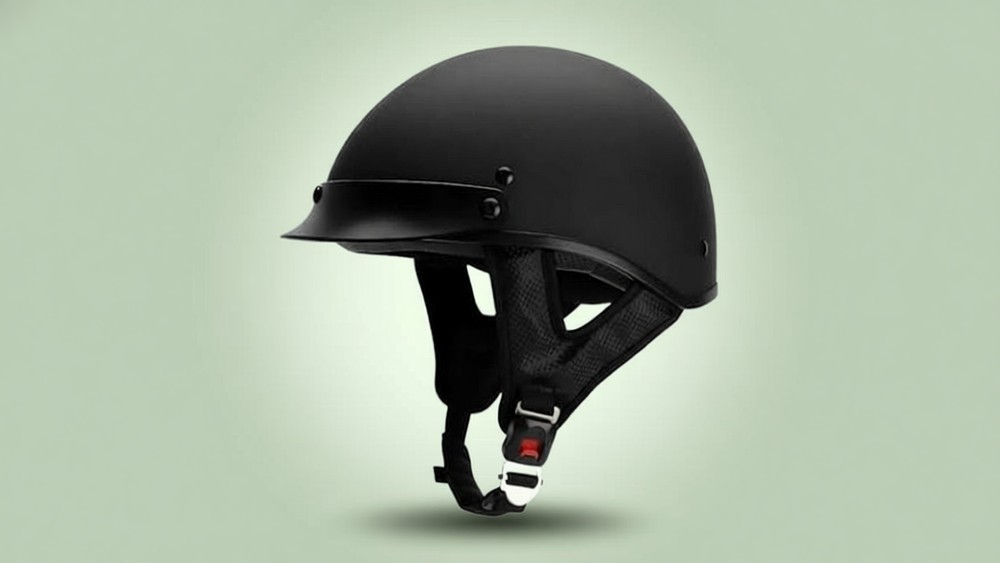
Half helmets live on a single trade. You give up the coverage a full face or even a three-quarter shell provides, and in exchange you get a light, cool, cheap lid that satisfies the law in most of the country. The NeoHelm sits right on that trade, with an ABS shell, a claimed DOT certification, and a price at the cheap end of the 257 helmets we track.
The trade gets complicated by the record. Of the nine texts on the listing, the two fault accounts that say anything specific both land on the same part: the chin-strap buckle.
One buyer has returned all three helmets they ordered over the snap. Meanwhile the listing's own bullet sells that buckle as a highlight.
The short version before the detail. The NeoHelm half helmet costs 35.99 at check time, weighs about two pounds, and carries 4.1 stars from 38 ratings. It is a genuine minimum-coverage shorty with a quick-release buckle, and no warranty row appears anywhere on the listing.
You accept a young, thin record with it: no text covers wind noise, a drop, or more than a few months of use, and two of the four five-star texts read like they were written by the listing rather than by a rider.
The verified record centers on the buckle
Start with the account that carries the most weight. One owner, whose text carries a purchase badge, reports that the snap on the chin strap is junk, calls it something that should be on a toy, and says all three helmets they purchased are going back. Three units means the buyer likely ordered for a family, and the fault repeated across all of them.
A second verified text, gentler in tone, lands on the same part. Its owner calls it a good helmet and adds that the clips are a little funny. Two texts do not make a pattern the way three would, but when both substantive accounts point at one component, and the price is this low, the component deserves your attention.
Here is the contrast that makes it a finding rather than a gripe. The buckle bullet describes an advanced quick-release mechanism, single-hand operation, and rapid access in emergencies.
The listing praises the exact part its own verified record faults. Whatever the truth is, the copy and the record do not agree.
Practical advice follows from that. Work the buckle through a dozen open and close cycles the day the helmet arrives, with the return window still open, and treat any resistance or loose feel as a return reason rather than something to wear in.
Two five-star texts that read like the listing
Four of the nine texts carry five stars, and two of those four wear no purchase badge. Those two unbadged texts share an opening line, and the line is I'm really happy with this, word for word.
The first organizes itself under Build quality and Sizing labels, praises the shell and the straps in listing order, and closes by calling it a great helmet to keep a daughter safe.
The second praises the matte finish, the lightweight feel, DOT approval, true-to-size fit, and open-face visibility, again in roughly the order the bullets use. Neither contains a detail a rider would only know, such as how it behaves at speed or what the cushioning feels like after an hour.
Template copy has a shape, and both texts fit it: the same opener, listing-ordered claims, and no friction anywhere in the account. We count them out of the evidence. That leaves the verified record, which is thin but real, and it is the record the rest of this article stands on.
What the one-line texts settle and what they leave open
The verified one-liners are positive but small. One owner reports a good, comfortable fit. Another says the helmet was as described.
A third ordered two, for a husband and a son, and reports they both love them. These tell you the helmets arrived and someone liked them. They cannot tell you how the buckle or shell behaves over a season.
The remaining verified text is a three-star shape complaint: it looked like a mushroom on your head. That is a style verdict rather than a fault report, and with half helmets the profile is the point, so your own mirror gets a vote here too.
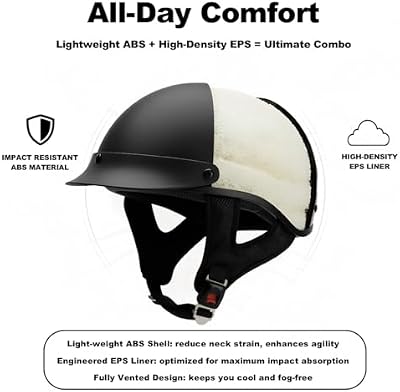
The one-star that is not about the buckle is an out-of-box impression. That buyer opened the box, felt thin plastic and simple foam padding, put the helmet straight back in, and returned it without riding in it.
Take it for what it is: a first-touch judgment, not a crash account. It still carries a purchase badge, so the helmet did ship and the return did happen.
What nobody has covered tells you what you would be buying blind. No text describes wind noise at speed, how the cushioning holds up, a drop, or sizing direction. The listing prints no size chart in its spec table either, so measure your head and check the seller's size information before ordering.
The DOT label and the half helmet trade
The category context matters more than usual at this coverage level. A half helmet, also called a shorty, covers roughly half the head and provides the minimum coverage generally allowed by law in the US. That is the design, not a defect, but it is the reason a full face sits in a different safety conversation.
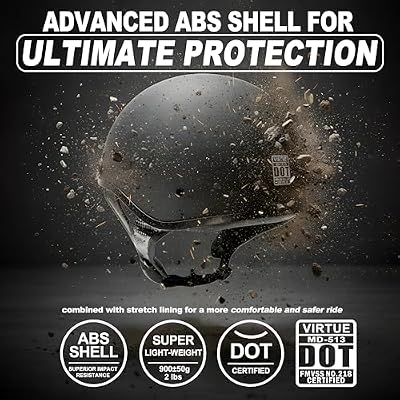
On the certification word itself, DOT approval in the United States is a manufacturer self-certification against FMVSS 218, not an independent test lab's verdict.
The listing's bullet says each helmet undergoes comprehensive testing, but no certification body, standard number, or label photo backs the claim on the page. Check for the stitched DOT label inside the shell when yours arrives, since that marking is where the self-certification is supposed to show up.
The out-of-box impression above connects to one more category fact. Uncertified novelty helmets are often smaller and lighter than DOT-certified ones, and what they lack is energy-absorbing foam, the material that actually protects the brain. A helmet that feels thin and light is not automatically a safe one, which is why the foam density under the shell is worth a feel before you decide to keep this one.
Bottom-of-table price, bottom-of-table record
On price, the NeoHelm sits in the cheapest fifth of the helmets we track, and the motorcycle helmets comparison table renders its live position so you can see the band yourself. Among half helmets specifically, it is one of the least expensive we follow, which is the strongest single fact in its favor.
The honest frame is that the price is real and the record is young. Thirty-eight ratings and nine texts, none with a single helpful vote, means no ranked center exists yet. You would be buying on the specs, the price, and the shape, not on any accumulated proof of how it wears.
If the buckle accounts argue you out of it, the half-helmet field nearby has more record behind it. Our SanQing German-style half helmet review covers a sibling-priced shell whose owners report a highway-speed lift pattern, and the ZGMZLBBD half helmet review covers another budget shorty with a larger verified record.
Frequently asked questions
Is the NeoHelm really DOT certified?
The listing claims it and shows nothing behind the word: no standard number, no certifying body, no label photo. DOT certification in the US is a self-certification against FMVSS 218, so the proof is supposed to be the stitched label inside the shell. Check for it on arrival and treat the bullet's testing language as unverified.
How much of my head does a half helmet cover?
About half. A shorty has the same open front as a three-quarter helmet but no lowered rear, and it is the minimum coverage generally allowed by law in the US. Your ears, the back of your skull, and your chin sit outside the shell, which is the trade you are making for the price and the airflow.
Should I worry about the buckle complaints?
Treat them as the first thing to test. One owner has returned three helmets over the snap, and a second purchase-badged text calls the clips a little funny, while the listing's own bullet praises the buckle. Work it through a dozen cycles on day one with the return window open, and let your own hand decide.
How does it compare to a three-quarter or full face helmet?
It covers less, by design. A three-quarter helmet adds the rear and the ears, and a full face adds a chin bar, which matters because studies credit full faces with the most protection and about 35 percent of crashes show major impact at the chin bar.
A half helmet wins on weight, heat, and price. It loses on coverage, and no text in this record changes that arithmetic either way.
What is the warranty?
There is no warranty row on the listing. The included components line names the helmet and nothing else, and no text in the record describes a warranty claim or a seller response. If a warranty matters to you, ask the seller in writing before you order and keep the answer with your receipt.