Group rides run on compromise. Somebody shouts through a visor at the stoplight, somebody else drops serious money a side on a premium mesh setup, and the budget shelf in between is full of listings that promise both experiences for the price of one.
The words on those listings do a lot of work. Range figures stretch past a kilometer. Batteries claim days of talk time.
And language borrowed from mesh radios sits on products that pair the way Bluetooth always has.
This review walks through what the MAXRUNON D10 actually is, what its numbers mean against the physics, and what ten recent buyers with confirmed orders say after about two months on the road.
The MAXRUNON D10 sells as a two-pack at a checked price of 99.99, and the box holds exactly two units, which makes the honest per-rider math 50. Bluetooth 5.4, a claimed four-rider group, an offline voice assistant that answers to Hi MAX, a 2-year warranty per the spec table and an IPX7 rating round out the spec.
Our intercom comparison table puts that per-rider figure in the pricier third of the 192 intercoms we track, so value is not the headline here. The record behind the listing is the readable part: ten recent buyers, every one with an order-confirmed purchase, eight delighted and two who found real limits.
Keep one wrinkle in mind before the per-rider number charms you. A four-rider group needs two of these packs, about 199.98 in total, and the per-rider math stays at 50 either way. Two riders splitting the first box down the middle is the use most of this record actually describes.
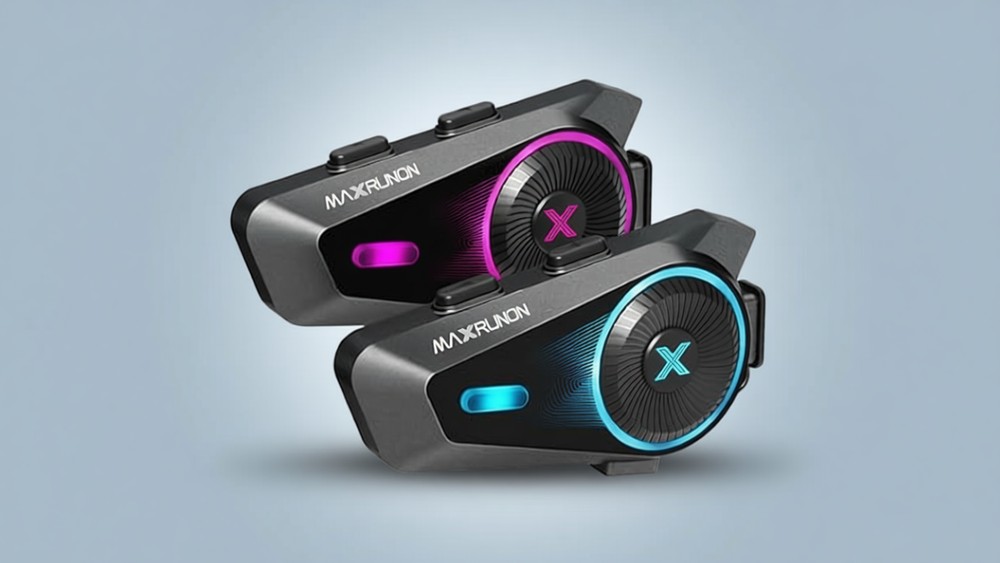
A Bluetooth chain, and a buyer who wanted a mesh
Nothing on the listing or in the spec table claims mesh. The nearest feature is universal pairing, which the listing itself hedges as working with select third-party Bluetooth intercom devices, compatibility may vary by model.
One buyer has reported they haven't gotten the universal group meshing to work, and that line is the closest the record comes to a mesh complaint, because there is no mesh on the D10 to find.
A true mesh relays messages by hopping node to node and reconfigures itself around broken paths, per Wikipedia's mesh networking article, so a group keeps talking when one rider drops out.
Even there, vendors have not agreed on common standards, so cross-brand mesh intercom is not a solved problem anywhere. The D10 does none of it. It forms a Bluetooth group of up to four and relies on the listing's auto reconnect to bring back a rider who has gone out of range.
Two owner details round out the picture. One buyer docked a star because only four members can connect at one time, which is the radio working exactly as specified. And a family upgraded from the older D9 because it would not connect more than two riders, then called the D10 better than they expected for a three-person group with their daughter along.
The 1.6 km figure against Bluetooth physics
The listing ties distances up to 1.6 km, or 0.9 miles, to the same bullet that promises up to four riders at once. That pairing of numbers is the tell.
Wikipedia's Bluetooth article gives the standard's most common mode 2.5 milliwatts of transmit power and a typical range of up to about 10 meters, with stronger radios reaching about 100 meters, and the 40 to 400 meter figures quoted for Bluetooth 5 are radio maximums in open air.
A kilometer and a half does not fit inside those numbers for a single hop. It fits a chain, where each rider's unit hands the conversation to the next one, and the sum of four shorter links gets written up as one distance.
Nobody in the record reports a distance of any kind. The freeway rider confirms music stays audible at speed and says nothing about how far apart the bikes were. So plan around line-of-sight group riding and treat 1.6 km as a chain total in open air, not a promise between the first bike and the last.
Battery claims nobody has metered
The bullet claims a 1000mAh battery good for 17.5 hours of music with intercom, 19 hours of intercom alone, 38 hours of music and 340 hours of standby. The owner record backs the direction, not the digits.
The Harley rider reports using theirs for many hours and still having plenty of battery remaining. A separate buyer likes that the headset shows how much charge is left when it turns off and on. Those are the only battery notes in ten texts, and nobody has put a meter on any of the four figures.
What the listing never states is charge time. There is no hours-to-full figure anywhere on the page, so any charge-time math here would be invented, and the honest answer is that you find out when you plug it in.
Charging while you ride
The listing does say the D10 supports charging while in use, which turns a long tour day into a non-event if a cable lives in your jacket.
Between that, the percentage readout and the standby claim, the battery story reads as practical rather than spectacular. Two months is also early days for cycle-life evidence. Nobody in the record has owned one long enough to report the battery wearing out.
Sound: the split record
Each unit carries 40mm speakers and the listing stacks three noise-reduction acronyms, ENC, DSP and CVC, on top, with clear audio claimed at speeds up to 120 km/h, which is 75 mph. The owner record splits cleanly down the middle.
One Harley rider reports the units get plenty loud while riding, with clear sound and intercom that works well for rider-to-passenger talk. The freeway rider reports hearing music where previous units always failed them. The most critical buyer in the record lands on the other side, reporting the speakers are a bit quiet at full volume while riding a bike.
Both things can be true, because a Harley fairing and a naked bike's helmet turbulence are different noise problems. The safest read for a buyer sits in the critical buyer's own words, a "solid choice if you also cant afford the top name brands."
The button problem
That same critical text opens with "Holy button combos," and that is the honest price of a feature list this long.
Music sharing, group modes, the voice assistant, FM presets and the LED colors all live behind multi-press sequences. Two buyers say the app makes the setup easier, with radio presets and lighting colors called out by name. Learn the app on the couch, not mid-ride.

Frequently asked questions
How far does the D10 really reach?
The listing claims up to 1.6 km across a four-rider group. Bluetooth physics caps a single hop far below that, per the numbers above, and no buyer in the record reports any distance figure at all. Treat it as a chain sum in open air and plan around line-of-sight riding.
Does it pair with other brands?
Universal pairing exists, and the listing itself says compatibility varies by model. The one recorded attempt at cross-unit group intercom failed. Buy these for a group that all runs the same model.
Is it really waterproof?
IPX7 under IEC 60529, per Wikipedia's IP code article, means the case survives 1 meter of fresh water for 30 minutes. The X means dust protection was never tested, which sits oddly beside the listing's claim that it withstands dust. Nobody in the record has reported riding rain with one yet.
How long does the battery last?
The claims run to 17.5 hours of music with intercom, 19 of intercom, 38 of music and 340 on standby, from a 1000mAh battery. The owner evidence is two happy reports and no metering. Charge time is stated nowhere on the listing.
Do you need the app?
The MAXRUNOS app handles firmware updates, voice languages and the LED colors, and music sharing requires both units on firmware v1.0.0.7.
A sharing unit tied to more than one Bluetooth device drops to FM only, per the listing's own small print. Two owners call the app easy. You can ride without it, but updates land there first.
Is it worth the money?
At 50 per rider it sits in the pricier third of our comparison table, and a four-rider group pays about 199.98 across two packs.
What you get for that is a clean recent record, an offline voice assistant and a battery owners say holds up. What you give up is mesh, a metered range figure and any charge-time spec. Riders who want a real mesh on a budget can look at the FreedConn FX Pro instead, and riders shopping pure two-seat value can compare the Moman H2E 2-pack.