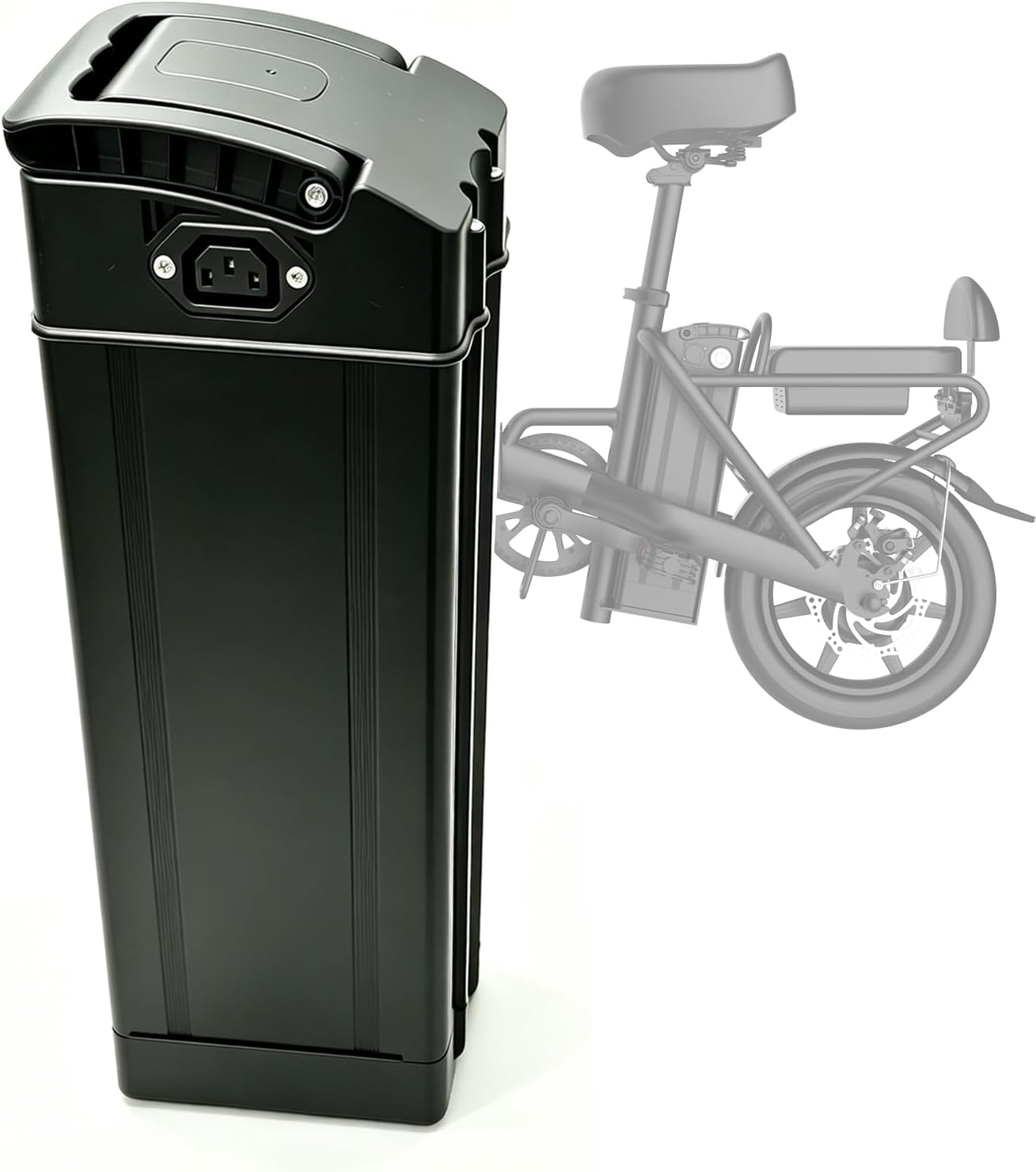
The most common way people buy an e-bike battery is not by choice. The original pack dies, the bike is too good to scrap, and a replacement goes on the credit card the same week. This LZIXYM 48V 13Ah folding battery is that purchase: a 624 watt-hour seat-tube shell with a 20A board and a 3-pin discharge port on top, sold at a price per watt-hour close to the middle of our whole table.
I read the listing, the gallery cards and all four written reviews, and the record tells one story almost unanimously. Two of the four buyers came here because another battery had already failed them, and a third turned the pack into a second battery on a bike that never asked for one. That makes this a review about a rescue pack, and about what you need to check before it becomes yours.
Four texts, two rescue stories and a strap job
The rating reads 4.7 out of 5 from 5 global ratings, and the printed histogram shows 71 percent five-star and 29 percent four-star with no bands below. Those percentages do not divide cleanly into 5 ratings, so I quote them as printed. Four written texts sit behind the average, three of them purchase-badged.
The newest text, from late October, is the clearest. This buyer's own pack died about a week into the bike's life, returning the bike felt like too much hassle, so they bought this battery instead and report it has turned out awesome with no problems since.
A late-September buyer tells the same story from the other direction: their son's bike arrived with a pack that would not hold a charge, and this one went in as the fix. The third account is the fitment story, and I come back to it below.
The fourth text is the one that ranks highest, with both of the helpful votes in the record, and it carries no purchase badge. It describes a fast delivery, a charge, an install and a first ride, and nothing else. I weight the three specific accounts more than the generic one, and the two rescue accounts agree.
What nobody has done yet is owned one for long. Every text in the record falls between early September and late October of this year, so the oldest evidence is about seven weeks old. This is a young record, and it says nothing at all about how the pack ages.
One model number, three storefronts
The details table names the model FP4813R0Z69, and that string is the most useful fact on the page. The same model number appears on the built-in LZIXYM 13Ah shell we reviewed earlier this month, and on the LGNUO and LOCKBUS 13Ah listings before that, all naming the same manufacturer, Dongguan Yizhan Electronics Technology.
One factory, several storefronts, and different price points for the same 13 amp-hours. This listing is the cheapest of them, and it is the only one of the family sold as a folding-bike pack that mounts on the seat tube with the discharge port on top.
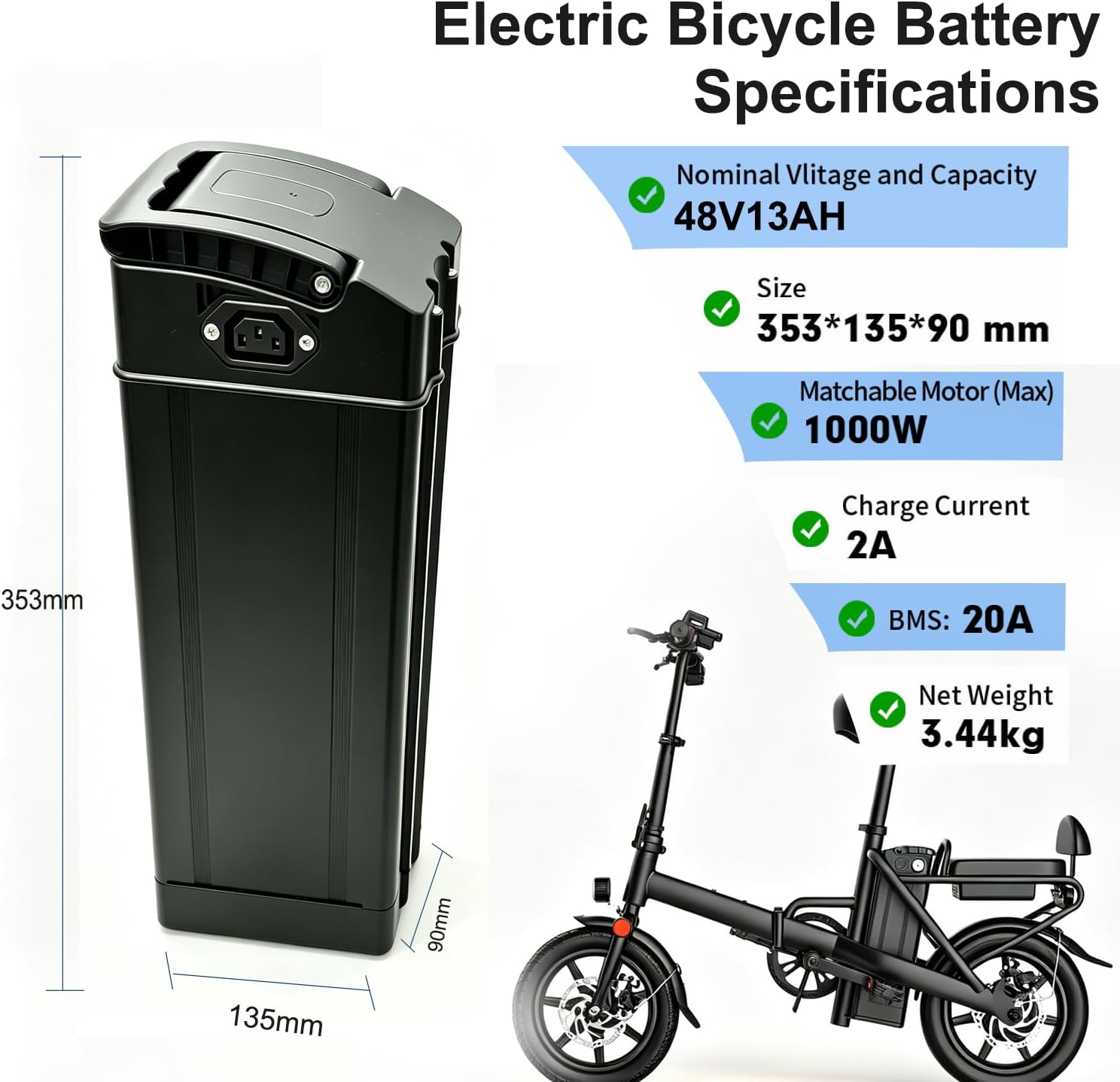
The footprint here measures 353 by 135 by 90 millimeters, which matches the mid-size case in the family rather than the tall built-in one.
The listing's own variant ladder holds one sibling, a 48V 20Ah version we have already reviewed separately. If you need the extra range, that is the bigger case, and this 13Ah shell is the lighter and cheaper rung.
A 20-amp board under a 1000-watt title
The title sells a battery for 0 to 1000W motors, and the parameter card repeats Matchable Motor 1000W as a maximum. The board behind it is 20A, and that is where the arithmetic gets honest with you.
A 1000W motor at 48V draws about 20.8A, just over what a 20A board allows continuously. The board's own ceiling works out to 960W. So the title overstates by about 40 watts, and the practical advice is to plan around 960W: any motor from 250W to 750W draws between 5A and 15.6A and fits with room to spare, while a true 1000W motor sits over the board's limit.
Within the factory family this is the low-power rung. The built-in 13Ah shell runs a 25A board, and the LOCKBUS USB variant runs 40A. If your controller genuinely needs 1000W continuous, the family has stronger shells, and this is not the one.
For what it is worth, the BMS card's protection list is the complete set: overcharge, over-voltage, short circuit, temperature, over-current, over-power and over-load, plus a waterproof case claim on the same card. The board takes its job seriously. It is just smaller than the title suggests.
Fitment is the buyer's job
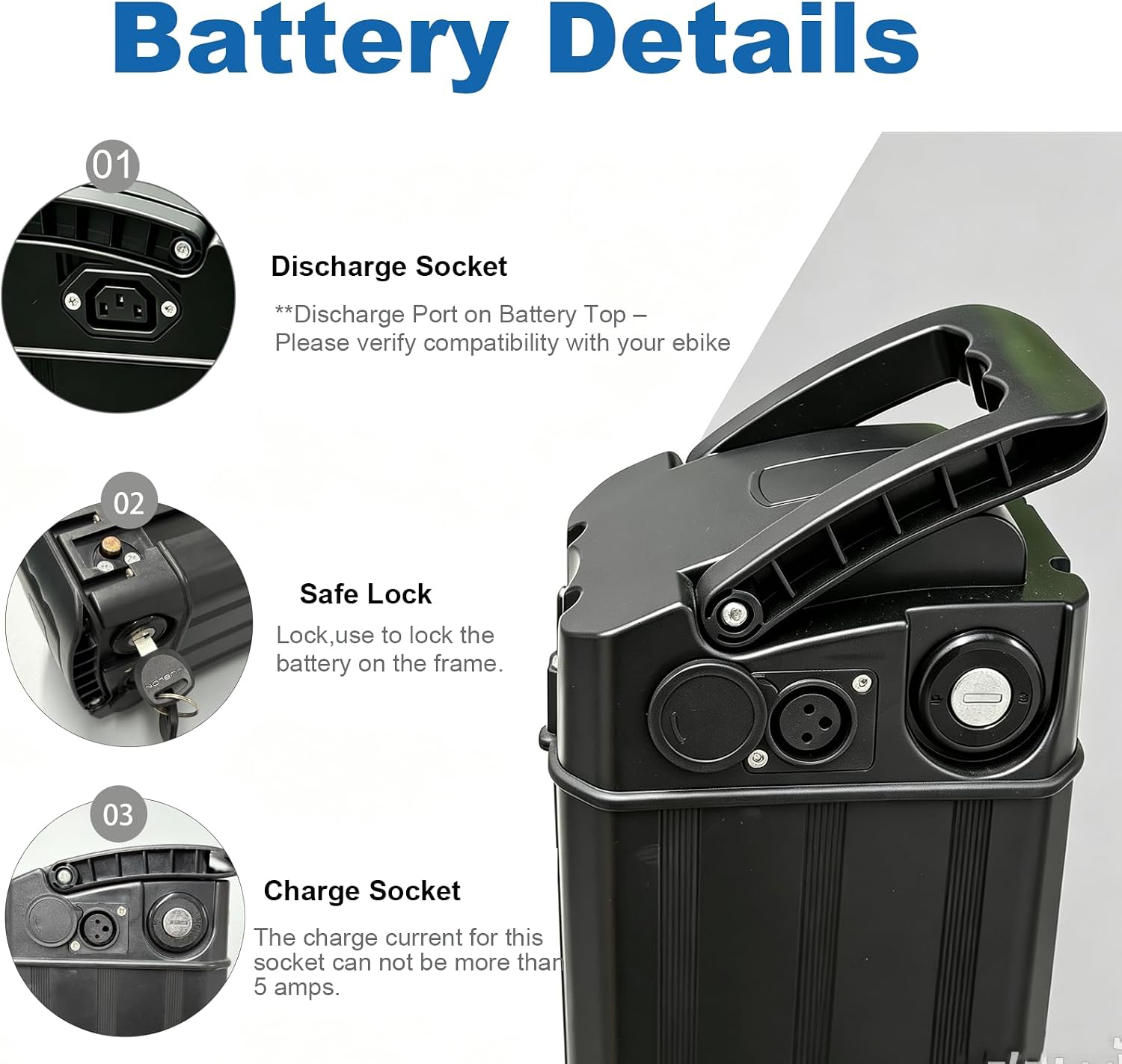
Everything practical about this pack hangs on three checks, and the listing says so itself. The note bullet asks you to confirm voltage, capacity and size before ordering, and the gallery card repeats the warning on the discharge socket: verify compatibility with your bike.
The three checks are the connector, the space and the mount. The discharge port sits on top of the case with a 3-pin plug, not on the bottom like most downtube shells, so your bike's existing connector has to match it or reach it. The case measures 13.90 by 5.31 by 3.54 inches.
The mount is a cradle that bolts to the seat tube, and the listing promises installation in minutes.
The record shows what happens when a check gets skipped. One October buyer reports the pack did not fit their e-bike's base at all, so they strapped it to an Euybike F7 with a Velcro strap and ran it as a second battery, where it has worked great. That is a real success story and also a warning: the cradle expects a matching bike, and anything else becomes a strap-down project.
The keyed safe lock, which holds the pack to the frame against theft, only helps if the cradle fits in the first place.
Charging and the weight check
The charge socket carries a printed limit of 5A, which sets the fastest safe charge at 13 amp-hours in about 2.6 hours. The charger's own amperage is not printed anywhere in the listing text or the cards, so the real floor is unknown until the brick arrives. At a common 2A charger the same job takes about 6.5 hours, so plan on an overnight charge unless the label surprises you.
The weight is the reassuring part. The bullet and the parameter card both print 3.44 kilograms, and they agree.
Wikipedia's standard band for lithium-ion chemistry leaves the bare cells of a 624Wh pack needing between about 2.1 and 3.9 kilograms, so a 3.44 kilogram assembly leaves room for the case, the board and the wiring at the band's middle. Nothing on this page asks you to disbelieve the scale.
On value the pack sits close to the middle of the 324 batteries on our price-per-watt-hour table, and the specs box beside this review renders the live comparison as prices move. The warranty row reads 1 Year with no conditions beyond that.
A rescue pack by evidence, not by design
The decision this listing forces is narrow. If your original 48V pack has died, your controller is 48V, and your bike's connector and mount space match a top-ported 3-pin seat-tube shell, this is the cheapest shell in its factory family and the record's rescue stories say it does the job. If your motor truly draws 1000W continuous, the 20A board says no, and the 25A built-in sibling or the LOCKBUS shells are the stronger picks.
And if you are shopping for a second battery to strap onto a bike that never had one, one owner has proven the pack works that way, but the cradle and the lock are wasted on that plan.
Whoever you are, check three things before the return window matters: the pin count on your connector, the space around your seat tube, and the label on the charger when it lands.
Frequently Asked Questions
Will the LZIXYM 48V 13Ah folding battery fit my bike?
Three checks: your controller must be 48V, your mounting space must clear 13.90 by 5.31 by 3.54 inches, and your discharge connector must match or reach the 3-pin port on top of the case. One buyer found the pack would not fit their bike's base and strapped it to an Euybike F7 with Velcro instead, which worked but defeated the cradle and lock.
How long does the LZIXYM 48V 13Ah take to charge?
The charge socket is capped at 5A, so the fastest safe charge is about 2.6 hours from empty. The charger's amperage is not printed, and at a common 2A brick the same charge takes about 6.5 hours. Read the label when it arrives and plan an overnight charge either way.
Can it really run a 1000W motor?
Not continuously. A 1000W motor draws about 20.8A at 48V and the board allows 20A, which caps at about 960W. Motors from 250W to 750W fit inside the board with room to spare, and the 1000W figure in the title sits just over the line.
Is it good as a second battery?
One owner has run it that way, strapped to an Euybike F7 with a Velcro strap after it would not fit their bike's base. The pack itself worked great in that role. Just know the mounting cradle and the keyed lock expect a matching bike, so a strap-down second battery leaves both unused.
What does the one-year warranty cover?
The details table reads 1 Year with no conditions printed beyond that. No text in the record describes a claim, so the window is untested. Check the pack and run a full charge cycle inside the return window as your real first line of defense.