A 52V pack with 30 amp-hours behind it is about as much range as the aftermarket sells. The LOCKBUS on this page claims 1560 watt-hours of it, a 40A BMS to feed hungry motors, and a price that lands in the cheapest band of everything we track. On paper it's one of the best capacity deals in the category, and paper is exactly where it lives.
Nobody has rated this pack. Not a star, not a word, not once since the listing went up, and I've checked. You'd be the first person to ride it, which means every claim on the page is untested by anyone but the seller.
That doesn't make it a bad pack. It makes it a purchase with a specific shape: you're buying arithmetic and taking the seller's word for the rest.
The spec sheet itself is worth reading closely, because it contains one contradiction the seller never noticed, and because the arithmetic it supports is genuinely good. Here's what the page says, what the math allows, and what to test before a pack this heavy becomes permanent.
The verdict first. What sits on this page is a 52V 30Ah LOCKBUS pack from Huizhou Hengcheng Electronic Technology, listed at 329.99 against the same figure our data held. That works out to about 21 cents per watt-hour for 1560Wh, which puts it in the cheapest fifth of the 301 packs we track, and the full comparison table shows where it sits against every other big 52V option.
The buyer record is zero ratings and zero written texts, confirmed on two signed-in checks. The one line I can write about real-world performance is that nobody has written a line about real-world performance. What you get instead is the spec sheet, so this article spends its words on what the sheet can and can't prove.
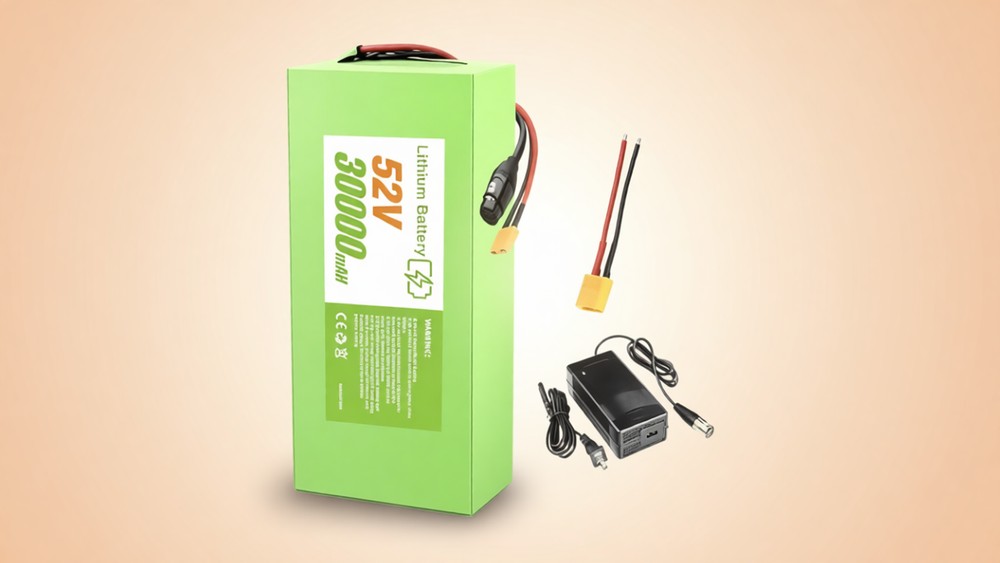
The spec sheet is the whole record
The promises are easy to list. 52V nominal, 30Ah, which multiplies out to 1560Wh.
A 40A BMS, an XT60 discharge connector, and a 58.8V 3A charger in the box. The case is a 12.52 by 6.1 by 3.07 inch rectangle wrapped in PVC, weighing a claimed 29.1 pounds, and the warranty runs one year. The title pitches it at 200W to 2000W systems across ebikes, scooters, ATVs and DIY builds.
Two things jump out of that list when you've read enough of these pages. First, the capacity-to-weight ratio checks out, which isn't always true on budget listings, and I'll do that math below.
Second, there's no cycle figure, no cell brand, no certification mark, and no IP rating anywhere on the page. Nothing here is testable except the weight, the dimensions, and the charger voltage.
And there's no owner record to fall back on. State it plainly: zero ratings, zero texts, nothing to lean on anywhere else. The comparison table is the only place on the internet where this product's value claim has a denominator behind it.
The model field argues with the title
Here's the contradiction. The spec table's Model field reads 48V20Ah.
The listing it sits on sells a 52V 30Ah pack. Those can't both describe what's in the box.
My read is that the title and the charger are the trustworthy pair, and the model field is a copy-paste leftover from a sibling listing.
The included charger terminates at 58.8 volts, which is exactly 14 cells in series charging to 4.2 volts apiece, and that's the definition of a 52V pack. A 48V pack uses 13 cells and charges to 54.6 volts, and no 52V seller ships a 54.6V charger. The charger and the title agree with each other, and the model field stands alone.
Still, this is the kind of sloppiness you verify rather than forgive, because a mislabeled pack is dangerous in one specific direction: charging a 48V pack with a 52V charger overcharges it.
Your test on arrival costs nothing. Plug the charger in, let the pack reach full, and confirm the charge light goes out at 58.8 volts on a voltmeter. If the pack terminates near 54.6 volts instead, you've been shipped the other product, and it goes back.
2080W on paper, nobody behind the wheel
The electrical math is clean. Forty amps at 52 volts is 2080 watts continuous, so the title's 2000W ceiling fits inside the BMS limit with a little room to spare. A 30Ah pack pushed at 40 amps is running at about 1.3C, which is a moderate draw for a pack this size and leaves margin on long climbs rather than eating into it.
That's the ceiling on paper, though. With no buyer record, not one person has reported running any motor on this pack, let alone a 2000W one. The arithmetic says the BMS allows it.
Whether the cells hold up under that draw in month six is a question the listing cannot answer, because nobody has asked it yet.
The waterproof claim needs the same skepticism. The word waterproof appears twice in the bullets, and there's no IP code anywhere on the page.
An IP rating is what turns a sealing claim into something testable, because IP codes define exactly what dust and water exposure a case survives and at what pressure. A bare waterproof with no code is a promise no test can fail. Treat the PVC wrap as splash protection and keep the pack out of puddles until the seller prints a number.
Range and charge, with the arithmetic shown
Range first, denominator out in the open. At 20 watt-hours per mile, gentle pedal-assist on flat ground, 1560Wh carries you roughly 78 miles.
At 35 watt-hours per mile, heavy throttle, hills and speed, it carries you roughly 45. That band is the honest version of the old claim on this page, which handed a pedal-assist figure to throttle-only riding and then added a hundred-mile promise on top of it. Nothing in this pack's record supports any real-world figure, because there is no record.
Charging is slow, and the old page's 5-6 hour figure doesn't survive the arithmetic. The included charger pushes 3 amps into 30 amp-hours, a tenth of a C rate, so a bulk charge from empty takes roughly 10 hours. By watt-hours it's about the same: 176 watts of charge power against 1560 watt-hours of capacity is around 9 hours.
Plan on an overnight charge and treat the charger's own pace as part of the deal, because that's what you'd be doing even if the listing admitted it.
The weight check passes, which deserves a note because it often doesn't on listings like this. 1560 watt-hours in 29.1 pounds, about 13.2 kilograms, works out to roughly 118 watt hours per kilogram, and a finished ebike pack built from name-brand cells lands in the 90-to-160 band. The claimed weight and the claimed capacity are consistent with each other, which is the cheapest lie detector a listing offers.
First in line, with a test plan
The value case is real even with the record empty. About 21 cents per watt-hour for a 1560Wh pack is a price the comparison table shows almost nothing else beating in the 52V class, and big packs usually carry a premium per watt-hour rather than a discount.
If the cells are honest, this is among the best capacity-per-dollar buys we track. If they're not, you own 29 pounds of disappointment, and the one-year warranty is the only path back. Check the current price before you commit either way.
So buy it as a first-in-line purchase with a test plan attached. Weigh the box, because the density math above gives you a number to compare against.
Confirm the 58.8V termination, because the model field already lied to you once. Then meter a full discharge, and Battery University explains why that step outranks every other check: capacity, internal resistance and self-discharge are the only real indicators of a pack's state, and a full charge can mask a weak pack behind a healthy-looking voltage.
If you'd rather not be the test case, the sibling LOCKBUS 48V 20Ah pack has an owner record you can read before spending, at a smaller capacity. And if DIY mounting, connector adapters and an overnight charge cycle all sound like part of the fun rather than friction, this pack's spec sheet makes a case no rating would improve.

FAQ
Will this pack fit my bike?
Not on any standard mount. It's a rectangular PVC case with no bracket, no downtube shape and no bottle form, so plan on a rear rack, a cargo box, or an enclosure you build.
The case measures 12.52 by 6.1 by 3.07 inches, so measure the space first. At a claimed 29.1 pounds it's also heavy enough that rack choice matters.
Can I run it with a 48V controller?
Usually, and it depends on your controller's low-voltage cutoff, not the charger. A 52V pack charges to 58.8V, which many 48V controllers tolerate, but some don't, and riding a 52V pack down into a 48V cutoff range wastes capacity you paid for. Check your controller's voltage window before ordering, because the pack itself doesn't care.
What connector does it use, and what if my bike is different?
The discharge connector is XT60, which is rated well above this BMS's 40A ceiling. If your bike runs a different plug, you need an adapter or a re-terminated cable, and neither is included. The listing also mentions an XT60 connector in the box alongside the pack and charger.
How long will the pack last?
Nobody knows, and the listing won't help you. There's no cycle figure, no cell brand, and no certification on the page. Consumer Li-ion is typically specified at 300 to 500 full cycles before capacity fades toward 80 percent, per Battery University, and that's the honest planning band for an unbranded pack until yours proves otherwise.
What should I check on arrival, in order?
Weigh it, charge it, meter it. The weight tells you whether the density claim holds.
The charge tells you whether it terminates at 58.8 volts or turns out to be the 48V pack the model field describes. The metered discharge tells you whether 30Ah is real. All three fit inside a return window, and all three turn the seller's word into your own data.