A 52V pack rated at 25Ah sits at the top of what most hobbyist builds can use. 1300 watt-hours is multi-day commuting territory, and the motors people pair with packs this size, 1500W and 2000W hubs and big Bafang mid-drives, pull current that ordinary 30A packs cannot feed.
Two discharge ratings sit on the same page, one in the bullets and one in the spec table, and only one of them can feed a 2000W motor. Weight gets two figures too, and neither leaves room for the capacity claim to be true. Meanwhile the certification heads the title with no certificate number behind it.
What follows takes those contradictions one at a time, checks the claims against published norms, and works out what a record of nine ratings, three of them written, can actually tell a buyer. It can't tell much, and that's worth knowing before the order button.
The Leonidas 52V 25Ah pack sells at 299.99 under model S039-3, built by Shenzhen Lian Pai Yuan, with only 5 left in stock when I checked.
On price per watt-hour it sits in the cheaper third of the 301 batteries we track, and that part of the pitch is real. The comparison table shows where it lands, and it is one of the better prices per watt-hour in the 52V group.
The title has changed since we first recorded this listing. The old one led with Bafang and Voilamart compatibility. The live one leads with two claims the page never documents: UL2271 certification, and cells it spells L*G 21700 in the title while the bullets spell out LG.
Between those, the 50A-against-30A clash, and the two weights, the page disagrees with itself often enough that the cheap price stops being the interesting part.
The interesting part is which numbers survive contact with a meter, and the sections below work through them in order of how much they'd cost you if they're wrong.
The listing cannot pick a weight, and neither figure is small news
The spec table gives the same pack two weights. One line says Item Weight 15.4 pounds, which is about 7.0kg.
Another says Battery Weight 5kg, which is about 11 pounds. Both sit on one page for one product.
The arithmetic says what each figure would mean: at 7kg, 1300 watt-hours works out to about 186 watt-hours per kilogram, and at 5kg it's about 260.
The ebikes.ca batteries guide states a complete lithium-ion ebike pack, cells plus BMS plus case plus wiring, runs about 110 watt-hours per kilogram, with lithium polymer pouches topping out near 160.
At either weight, this pack would have to store energy beyond what complete packs reach. That doesn't tell you which line is wrong, and it doesn't have to. It tells you the capacity figure, the weight figures, or all three deserve a scale and a meter inside the one-year warranty window, before the window closes.
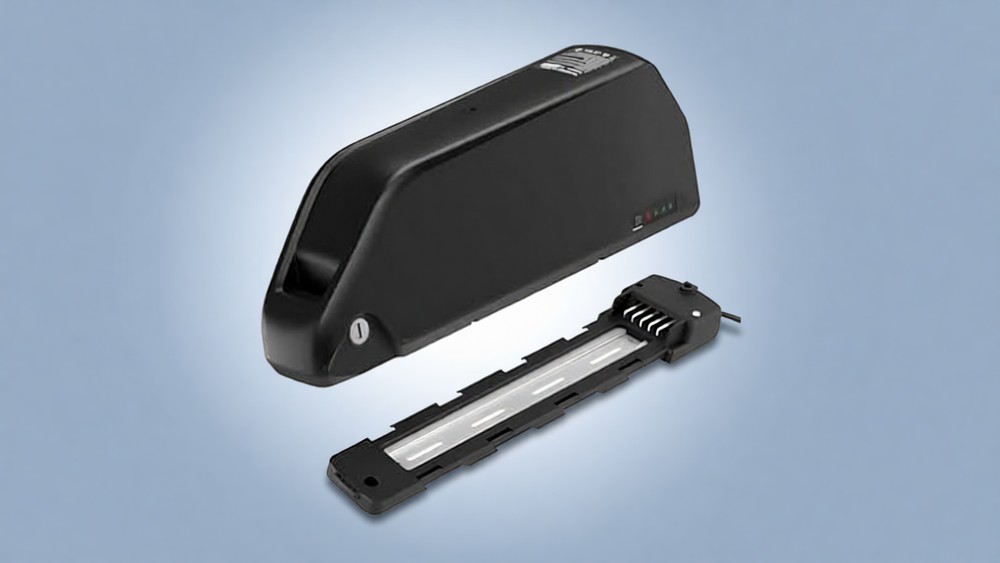
The block itself is 14.4 by 3.7 by 6.1 inches, which is a large rectangle rather than a shaped tube or shark case, so measure the frame space too. A pack this size fits some downtubes and no bottle cages, and the listing's compatibility list talks about motor kits, not frame fit.
A perfect score resting on three sentences and a four-year gap
The battery holds 5.0 stars from nine ratings, a 100 percent five-star histogram with nothing at any other level. It looks perfect until you count the words: three written texts, six silent raters.
The texts span June 2022 to August 2026, and nothing at all sits between November 2022 and August 2026. That's one text roughly every year and a half, on a listing whose title and bullet set have changed along the way.
All three are purchase-confirmed, so the record has no unconfirmed-purchase problem. What it has instead is a sample of three sentences carrying a perfect score.
The loudest is also the oldest: the November 2022 text, written in Spanish, is the only one with a helpful vote, and it's about installation. The buyer has found the install confusing at first because it was their first electric bike, and notes the pack comes with its adapters.
Nothing in it describes range or power. The June 2022 text praises durability and says the pack ended the rider's range worries, with no numbers behind either claim. The August 2026 text, the most recent, is nine words long.
So the honest summary of the record is that nobody has reported a range figure, metered the capacity, or described a wet ride. A buyer is reading three sentences, and two of them predate the current title by years.

UL2271, L*G cells, and 1000 cycles: three claims the page does not document
The title says UL2271 Certified. The page names no laboratory and no certificate number, so there is nothing a buyer can check, and a certification claim you can't verify is a sentence, not a certification. If that claim matters to you, ask the seller for the certificate before you order, and treat silence as an answer.
The cell brand gets the same treatment twice over. The bullet says built-in LG cell, which is the seller's claim with nothing on the page behind it. The title writes L*G 21700, an odd spelling that reads like a deliberate dodge of the brand name, sitting next to a plain LG in the bullets of the same listing.
Either way, no cell model, no cell count, and no series-and-parallel layout appears anywhere, so there's nothing on the page a buyer could confirm on delivery.
The cycle claim is the one with a published norm to check against. The title says 1000+ cycles. Battery University's BU-808 puts the manufacturer norm for consumer lithium-ion at 300 to 500 full cycles, with shallower discharge stretching the count a great deal.
Light use and partial cycling can beat the full-cycle figure, but the listing presents the number with nothing behind it, and the one-year warranty is the whole backstop.

What it fits: 2000W ambitions, an XT60, and no charger on the page
The motor window is the claim where the two amperage figures matter most. The bullets say a max constant discharge of 50A and name motors from 100W to 2000W. The spec table says Amperage 30A.
At 52 volts, 50A is about 2600W continuous, which covers the 2000W ceiling with room. 30A is about 1560W, which does not. If you're running a 1500W or 2000W motor, one of these numbers has to be wrong, and only the seller can say which, so get the answer in writing before you order.
Compatibility is claimed for Bafang, Tongsheng, and Voilamart AW kits, and the discharge side ends in an XT60 on both male and female sides, a common plug for kits in this class. Our dichou 52V 25Ah review covers another pack in the same capacity class, and the fit question there is the same one: the kit's connector and the frame's space decide the install, not the watt-hour figure.
Charging is where the page gives up entirely. No charger amperage appears anywhere, and the included-components field names only a lock. The bullet's entire charging instruction is to switch the battery on and wait for the charger's red light to turn green, which describes a charger without specifying one.
So charge time can't be computed from the listing, and whether a charger ships at all is worth a message to the seller.
Range is arithmetic only, because no owner has reported a number. On the ebikes.ca consumption bands, 1300 watt-hours runs about 65 to 93km power-hungry, 108 to 144km with typical pedaling, and 162 to 217km with minimal assist. Treat those as bands, not promises, and meter the first few rides yourself.
Frequently Asked Questions
Is it really UL2271 certified?
The title says so and the page names no laboratory or certificate number, so there's nothing to verify. Ask the seller for the certificate and who issued it before you rely on the claim, and treat the pack as uncertified until an answer arrives.
Does it use LG cells?
The bullet says built-in LG cell and the title spells it L*G 21700. Either way it's the seller's claim, with no cell model or layout published, so there's nothing a buyer could check on delivery. The one-year warranty is the practical backstop.
Will it run a 2000W motor?
The bullets say yes at 50A, which is about 2600W at 52V. The spec table says 30A, about 1560W, which does not cover a 2000W motor. Get the seller to commit in writing to which figure governs before you order a high-power build.
Is a charger included?
No charger amperage appears anywhere on the page and the included-components field names only a lock. Confirm with the seller that a charger ships and what its output is, and if you're buying your own, match the 58.8V full-charge voltage a 52V pack needs.
How far will it go?
No owner has reported a number, so it's arithmetic: about 65 to 93km power-hungry, 108 to 144km with typical assist, and 162 to 217km with minimal assist on the ebikes.ca bands. Meter the capacity inside the one-year window and you'll replace those bands with your own figure.