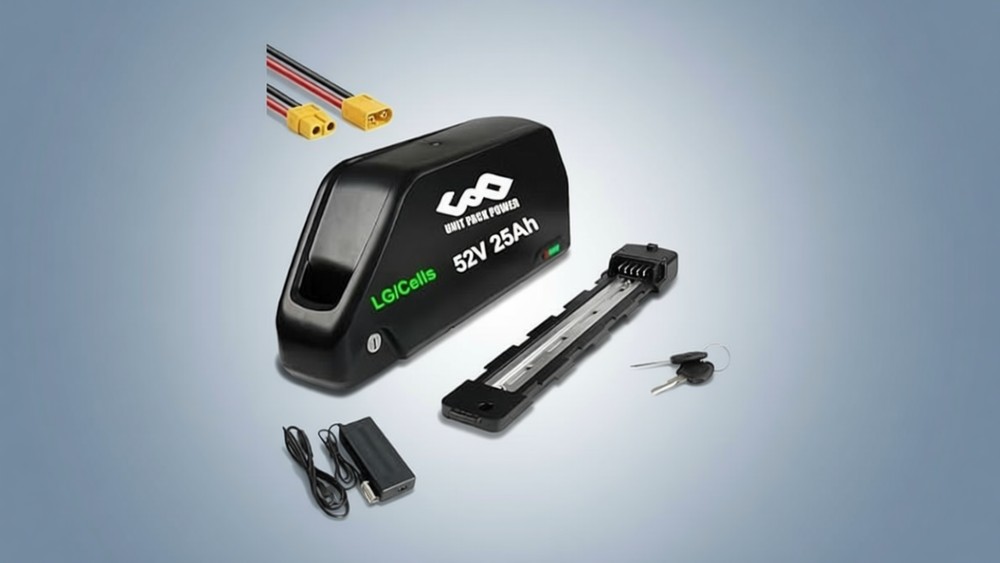
The Hailong case is the shape most replacement ebike batteries come in, which is why shopping for a new pack turns up a hundred near-identical listings with different logos on them. This one claims more than most: 52V, 25Ah, 1300Wh, and a 50A BMS at a price that lands in the middle of the market. On paper that is a lot of battery for the money.
The catch sits on the page itself. That 25Ah bullet opens by saying the battery is built with 5Ah. Weight in the spec table comes in at 5 kg, too light to hold 1300Wh, and the title claims a safety certification the listing never documents.
When a page contradicts itself this fast, every other number on it becomes a question.
There is one buyer report, and it is useful: a full charge takes 6 to 8 hours on the 3A charger, which matches the big number and not the small one. This review works through the contradictions, checks the capacity claim against the scale and that report, and prices the pack honestly per watt-hour.
The UPP-branded 52V 25Ah pack sold under the DICHOU byline claims 1300Wh in a Hailong case for mid-band money, and the price would be fair if the listing kept its own numbers straight. It doesn't: the capacity bullet contradicts itself five to one, the stated weight strains the stated capacity, and the certification claim carries no paperwork.
One positive buyer report and the charge math argue the big number is real, so treat this as a pack to verify on arrival, with the scale and the charge clock run inside the return window.
A listing that argues with itself
The listing claims this is a 25Ah pack, and one bullet beside it says the battery is built with 5000mah, a five-to-one contradiction sitting inside a single sentence. You can't know how much charge you actually get when the page fights itself this early. Both numbers can't be true, and nothing else on the page settles which one is.
The spec table also says this 1300Wh pack needs one AAA battery to run, which is the kind of spec junk that slips into listings nobody proofreads. Branding switches between UPP in the title and DICHOU on the byline, with Shenzhen Lian Pai Yuan Technology named as the manufacturer underneath. No certificate, no document number, and no certifier page back the safety claim in the title.
That title claims UL2271 certification by SGS, a standard covering batteries for light electric vehicles, and the listing shows none of the paperwork behind it. When a page can't keep its own specs straight, every number on it becomes a claim to check rather than a fact to use. Compare it against the rest of the field in our battery comparison table.
The scale is the cheap test
The spec table lists the pack at 5 kg, and 1300Wh at 5 kg works out to about 260 watt hours per kilogram at pack level.
The 160-300 band quoted for lithium-ion describes bare cells, before a case, a BMS and wiring add their mass, so a finished pack should sit below that band rather than at its top edge. The stated weight strains the stated capacity, and Wikipedia's lithium-ion page is where the band comes from.
One buyer has noted the pack took six to eight hours to charge on the 3A charger, and that arithmetic matters: 3A for six to eight hours is 18 to 24 amp hours delivered. A genuine 5Ah pack would fill in under 2 hours. The charge-time evidence backs the big number.
Still, weigh the pack the hour it arrives and time the first full charge. Both tests take minutes, the listing has already spent its benefit of the doubt, and together they settle which number is real. A pack that arrives much lighter than 11 lb, or that fills in two hours, is not the pack the title describes.

What the one buyer report settles, and what it cannot
One reviewer has noted a clean fit on a Dakeya Da06, a spare bracket left in the box, and a pack that has moved from backup to daily duty after an upgrade from a 52V 23Ah unit. The 6-8 hour charge estimate matches the 3A charger's arithmetic for 25Ah. That's the entire record: one rating, one text, from April 2026, with purchase confirmation on it.
The gaps are the usual ones for a record this thin. Nothing speaks to longevity, real range, water exposure, or failure behavior, because one rider on one pack for a few months can't cover those. No text meters the capacity on a scale, times a charge against the clock, or says what the cells do in cold weather.
So you're betting on the listing's arithmetic and one positive text, and that's a bet you should only take if you plan to verify it on arrival. The scale and the charge clock are how you do it cheaply.
Fifty amps and the 1500 watt title
The electrical claims decode cleanly. A 50A BMS at 52V is about 2600W continuous on a fresh pack, above the 1500W motor ceiling in the title, so that pairing is honest. It's also over three times the 750W federal definition for a consumer ebike in the US, which puts the headroom in off-road and throttle-heavy territory rather than street-legal commuting.
Charging runs through a 58.8V 3A charger, about 176W, and 25Ah at 3A is about 8.3 hours from empty. That matches both the bullet's 8-hour promise and the buyer's 6-8 hour estimate, which is the rare case where this listing's numbers agree with each other.
Middle-of-the-road money for an unproven number
This pack works out to about 24 cents per watt-hour at the claimed 1300Wh, close to the middle of the 301 batteries we track. The live figure renders in the specs box, and the battery comparison table shows where it lands against everything else. The price is fair only if the capacity is real, and that's the open question this listing created for itself.
The one-year warranty runs against an 800-1000 cycle claim and a 5-year life expectancy, and BU-808 puts consumer lithium-ion at 300-500 cycles charged the standard way. The promise runs about twice the standard figure and well past the coverage. A buyer who wants a proven record pays a little more per watt-hour for a listing that survives its own spec table.
Frequently Asked Questions
Is the 25Ah rating real?
The weight says no and the charge report says yes. 1300Wh at 5 kg is about 260 watt hours per kilogram at pack level, which strains what a cased pack can hold, while 6-8 hours on a 3A charger is 18 to 24 amp hours delivered, far more than 5Ah.
Weigh the pack and time the first full charge on arrival, because 5Ah fills in under 2 hours and 25Ah takes about 8.
What motor can it feed?
A 50A BMS at 52V is about 2600W continuous, above the 1500W ceiling in the title and over three times the 750W US consumer definition. Check your local rules before building around that headroom.
How long does a full charge take?
About 8.3 hours from empty on the 3A charger, which matches both the listing's 8-hour promise and the one buyer's 6-8 hour estimate.
Will it really last 800-1000 cycles?
The listing claims 800-1000 cycles and a 5-year life expectancy. BU-808's consumer baseline is 300-500 cycles at full charge voltage, and the warranty covers 1 year.
Will it fit my bike?
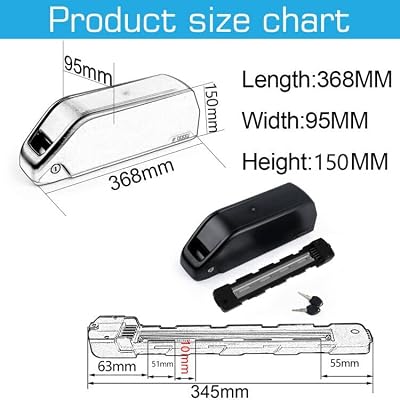
It's a Hailong/Shark downtube case measuring 368 x 96 x 155mm, with a keyed slide mount and a spare bracket in the box. Match the case dimensions and your system's voltage before ordering, because the fit is on you. If it isn't the right fit, the battery comparison table sorts every option we track.