The promise is a group of ten riders talking without anyone playing ride leader and re-pairing phones at every fuel stop. That promise now comes attached to a price that used to buy a basic two-rider Bluetooth clip, and the JESIMAIK H6 is one of the intercoms making it. Its extra trick is physical.
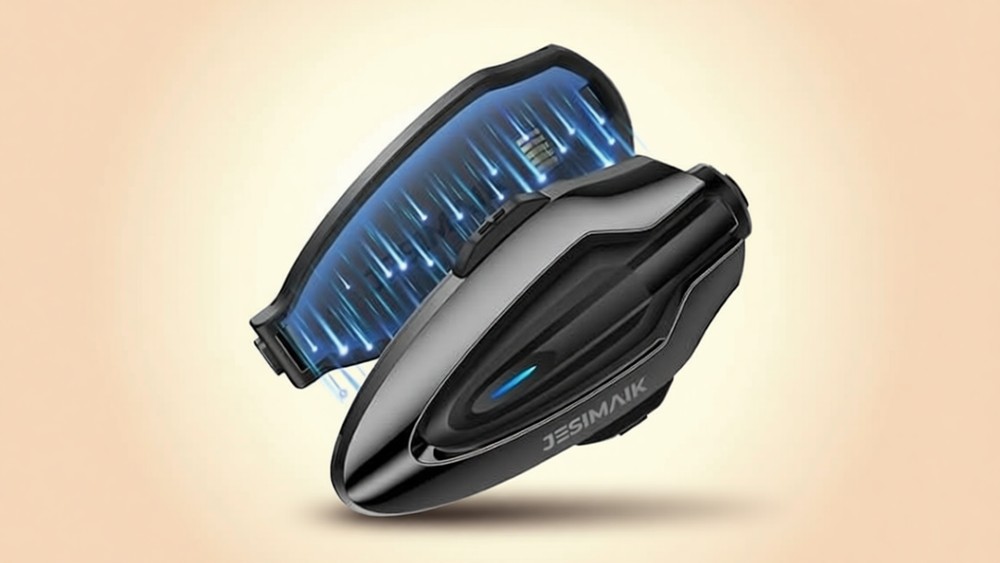
A magnetic mount lets you pull the whole intercom off the helmet in about a second when you park, and snap it back on when you leave.
Buying one means reading a review record that is only weeks deep. The texts are recent, the rating count is small, and most of the enthusiastic ones carry no proof of purchase behind them. That's not a reason to walk away, but it changes how much weight each signal can carry, and this review sorts them.
What follows is what the record supports. Where the magnet mount earns its place, why this listing never states a range in meters, what owners have found when they rode with it, and which of the percentage claims on the page deserve your trust.
The short version is this. The H6 sits in the cheapest fifth of the 192 intercoms we track on price per rider, and the two-year warranty printed in its spec table is more than some budget listings state anywhere.
The magnet mount works as described and no owner has reported it letting go. The microphone is the weak point, one owner has had a speaker fail on only the second use, and nobody can tell you the mesh range because the listing never claims one. Check the current H6 price on Amazon before you read on.
A young record, and how to read it
The average is 4.2 stars from 46 ratings, and the shape underneath is lopsided in a specific way. Five-star ratings take 59 percent, four-star 19, three-star 8, two-star 14, and one-star takes nothing at all.
A zero in the one-star column is unusual. On any listing with enough buyers, something arrives broken or gets lost in shipping and collects a one-star. With only 46 ratings, though, the zero can also mean the angry buyers have not arrived yet, and there's no way to know which explanation is right from the histogram alone.
The texts help more than the histogram. Ten of them carry substance, and I count five of the seven five-star texts with no badge showing Amazon confirmed the purchase. A few of those read like the listing translated into prose, which is a pattern worth discounting at any price.
The most useful text in the record is one of the negative ones. It carries the badge, it names a specific mechanical catch you will read about below, and it describes a decision to stop using the H6 entirely. On a young record like this one, a confirmed purchase that walks through what went wrong tells you more than any amount of praise without one.
The magnetic mount is the reason this one exists
Budget intercoms mostly differ from each other by decimal places. This one differs by a magnet. The mount holds the intercom to the helmet and releases it in about a second with one hand, so the anti-theft routine is to pull the whole thing off and put it in your pocket when you park, instead of leaving a gadget clipped to a shell in a public lot.
The same trick solves a second problem, because the mount claims to fit full-face, modular, half-face and open-face helmets, and moving the H6 between helmets is a matter of lifting it off one and pressing it onto the other. For a household that shares gear, or a rider who switches helmets across seasons, that's the feature doing the work.
The buttons get their own design pass. They sit in four directions around the face of the H6 with an anti-mistouch layout, so a gloved thumb presses the edge it meant to press and does not hang up a call while fumbling for music.
The catch comes from the one owner who has quit the H6, and it's worth reading in full.
The H6 attaches with a sticky pad, the box includes exactly one pad, so placement is a one-shot decision with no undo. That owner has also found the path out of music sharing and back to normal pairing fiddly enough that they pulled their unit off the helmet for good, while their wife kept hers, which ended the talking between them.
The lesson is not that the H6 fails. It's that the mounting and the software both assume patience at setup, and the one pad leaves no room for a second guess.
A listing that promises no distance at all
The strangest thing on the page took me a second pass to notice. The listing advertises ten-rider mesh, dual Qualcomm chips, music sharing, and 98 percent signal stability, and it never once states how far the intercom reaches. No meters, no feet, no miles, nothing.
That absence is almost refreshing next to the category norm, where budget listings print numbers from 800 meters up.
But it leaves you with nothing to check the H6 against, so the question becomes what the hardware can plausibly do. The H6 runs Bluetooth 5.2, and standard Bluetooth transmits at low power, typically reaching under 10 meters to a phone and about 100 meters in the best case, while the extended modes that stretch to 400 meters trade data speed for distance (Wikipedia).
Mesh changes the shape of the problem rather than the physics. The real benefit of a mesh group is that a rider who drops out of range and comes back is reconnected automatically, instead of the whole conference collapsing and needing a manual re-pair. That's worth having on a group ride, and it's a different thing from a guarantee of distance.
No owner in the record has reported a distance in any direction, so nothing confirms or falsifies the hardware either way. Until somebody measures it, treat the H6 as a unit for groups that ride close, and ask the seller for a number in writing before you bet a group tour on it.
What the owners actually found
The microphone is the weak point, and one owner has pinned it down precisely. They report that people on the other end hear a voice that sounds weird and distant even with the boom microphone almost touching the mouth, that listeners can hear every breath, and that a pair of AirPods handled calls better.
That account is one of the ones with the purchase badge, and it rates the microphone at three stars while giving the rest of the hardware a passing grade.
Speed hurts the audio too. An owner riding with a group heading to Biketoberfest calls the sound acceptable but a little gaspy when the group moves fast on the highway, which is the classic budget-intercom failure at wind noise.
Smaller annoyances show up inside the positive texts, which is the fair way to read them. The equalizer resets every time the H6 powers on, so the owner who wants Rock instead of Bass re-picks it by button memory each ride. Even the gaspy highway account came from a group that still called the headsets durable, functional, and good value for Biketoberfest.
The durability signal is the one to watch. One owner has reported a right speaker that blew out on only the second use, and an update to the same text says the manufacturer is providing a replacement at no cost after the owner emailed an address from the company site, even after offering to cover shipping. A speaker failing that early is a bad sign about consistency.
The free replacement, with no argument, is the two-year warranty term in the spec table being honored.
Against that, three owners describe an easy installation, a dune-riding group reports every function working through multiple trips, and one buyer says the battery life was the biggest surprise of the whole purchase, lasting much longer than their brother expected.

The claims to discount, and the one that holds
Three numbers on the page deserve your skepticism, and they fail for the same reason. The seven-layer noise reduction system is said to block 95 percent of wind and engine noise.
The dual chips are said to keep 98 percent long-distance signal stability. The speakers are said to be 27 percent slimmer than ordinary models. None of these figures names a test, a denominator, or a unit, which is the standard grammar of a marketing claim, and you should file all three under it.
The battery figures nobody has tested
The listing promises 23 hours of intercom time, 25 hours of music, and 450 hours of standby from the 900mAh cell, charged in an hour over USB-C. No owner has run a measured test of any of those numbers, and one owner reports only that the batteries lasted through a long stretch. Nothing contradicts the claims, nothing confirms them.
What actually holds
The water rating holds. The H6 carries IP67, which decodes to dust tight plus immersion in a meter of freshwater for 30 minutes (Wikipedia). The rating below it on the scale, IPX6, covers jets and rain but not submersion, so IP67 adds a real margin on paper.
No owner has reported riding in rain yet, so the paper is all there is.
The other thing that holds is the paperwork. The spec table prints a two-year warranty and an ANATEL certification number, and the speaker replacement above shows the term is not decorative.
Common questions
Does the magnetic mount hold at speed? The listing says it stays secured against high-speed wind and bumpy-road vibration, and no owner has reported the H6 coming loose. The record is thin enough that this is a claim with no counter-evidence rather than a proven one, but nothing in ten texts points the other way.
Is it worth the price? On price per rider it sits in the cheapest fifth of the 192 intercoms we track, and the owner record backs the value up more often than not. Weigh the weak microphone and the one sticky pad against that. Check the current price on Amazon.
Can it pair with a Cardo or a Sena? The listing claims smooth pairing with most mainstream third-party intercoms. No owner in the record has described a cross-brand pairing working, so treat the claim as untested and assume group members may each need the same brand. Our JESIMAIK R16 Pro review covers the sibling unit with the same pairing question attached.
How is the microphone? It's the weakest part of the H6. One owner with a confirmed purchase reports distant-sounding voice, audible breathing, and a plain statement that their old AirPods did calls better. Plan on the boom microphone positioned tight to the mouth and test a call before a group ride.
Will it survive rain? The IP67 rating covers dust and up to 30 minutes in a meter of freshwater, while the IPX6 rating below it on the scale stops at jets and rain. No owner has tested it in a storm yet, so the rating is the evidence.
