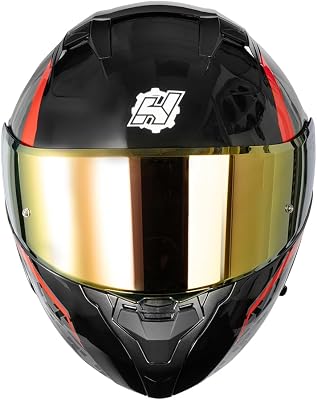
The HAX Amatista modular is a flip-up helmet with a dual visor, sold at 59.99 when I checked against a typical price of 67.99, and the owner record splits cleanly down one line: the time of day you ride. Day riders praise the fit, the hinge, and the price, and one bought a second helmet. Night riders ran into the shipped tint, and the record shows how hard it is to fix.
The record is young and mostly verified. Ten written texts sit under 258 ratings averaging 4.1 stars, every text carries a purchase marker, and the oldest is about two and a half months old at the time I scraped. Short records reward close reading, so this article stays close to what the texts say and flags the two claims the page makes about itself that the texts never touch.
One of those claims is the certification line, and it deserves its own section. The other is the clear visor the night riders needed, because the search for one is the most useful warning in the whole record.

The record splits by what time you ride
The day side of the record is strong for the money. One owner who says they have owned a lifetime of helmets calls it an amazing modular for the price, reports a perfect fit in a Large, praises the visibility and the easy hinge release, and liked the first one enough to buy another. Another owner expected the usual budget tradeoffs and instead found quality close to a far more expensive lid, and recommends it.
The strongest safety signal in the record is also on the day side, though nobody should read it as a test. One owner wrecked at 45 mph and reports the helmet held up. That's one account of one crash, and it says nothing about the next one. It still counts for more than any bullet point, because it's the only line in the record that stress-tested the shell.
The night side is where the texts turn. One owner found both visors loose enough that bumps knocked them down, and after a month called the helmet kind of unusable in the dark because both visors slap down and blind the rider. A second owner states it flatly: the tinted visor is dangerous at night, and riding dark roads with a tinted shield in front of you is a problem the buyer should solve before the first night ride, not after.
A third text lands between the two camps. That owner likes the quality and wishes the helmet came with a clear lens as well for night riding. Read together, three separate texts touch the same fault from three different angles, and none of them found the fix on their own.
The clear visor hunt
The most detailed text in the record is a failure report, and it's worth walking through because it's a map of every dead end. That owner tried Amazon first and bought a replacement listed as compatible, which was not. They tried the HAX website and found nothing. They tried the brand's chat, which runs on WhatsApp, and WhatsApp didn't recognize the number. They emailed and got no response.
So the fault runs deeper than the tint itself. The record shows no owner finding a clear replacement anywhere, through any channel, and the brand's own support paths failing at every step. On a dual-visor helmet the internal drop-down tint is meant to be a bonus. When both layers are tint and no clear shield exists, the dual-visor design turns into a no-option helmet at night.
If you ride after dark, do the check before you order rather than after. Confirm that a clear outer shield exists for this exact model, that it's in stock somewhere you can actually buy it, and that the seller will accept a return when the night ride proves the point. A helmet you can't use in the dark isn't a bargain at any price.
What the approval line says, twice
The title says the helmet is DOT/ECE approved. The bullet says the shell and liner meet or exceed DOT safety standards, and stops there. The spec table carries no E-mark row. Two claims on one page, and the smaller one is the one the bullet backs.
What DOT means here
DOT compliance in the United States is the manufacturer's own certification. The maker tests against FMVSS 218 and attests to the result, and no independent laboratory checks the sample. That doesn't make the label meaningless, but it does mean the standard's floor is enforced by the company selling the helmet.
What ECE would add
ECE approval works the other way. An independent laboratory tests samples before the helmet can carry the E-mark, which is the type-approval system used across Europe. The check that settles the question on any helmet is physical: look for the E-mark stitched or labeled on the helmet itself. Nobody in the record mentions the ECE half of the title either way, so the buyer's own eyes are the only verification on offer.
Arrival condition, a crash, and a pasted reply
Two texts describe helmets that arrived damaged, and they are different failures. One owner ordered this exact model twice, and both helmets arrived with the plastic rim that holds the internal liner snapped off in the same spot, leaving the padding pulling out of the shell every time the helmet came off. A second owner received packaging destroyed in delivery with the helmet itself unharmed. Two arrival faults across ten texts is a small cluster, but one of them repeated across two separate orders, which is the part I would weigh.
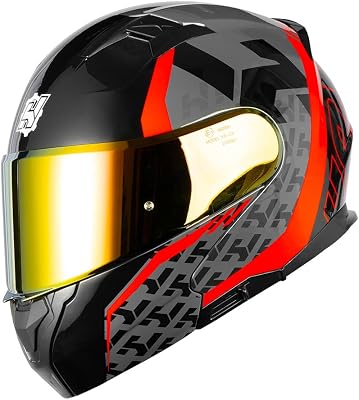
The record also contains a text that's not really a review at all. It opens with a line asking to be sent the helmet brand and model so a polished review can be written for it, then continues as a finished rave praising a matte black finish and a mirrored visor. This page sells a Wind Red colorway, and reviews are shared across colorway variants, so part of the record describes a helmet this page doesn't sell. Discount it.
What survives that discount is a short but usable picture. Fit runs true for at least one owner, the mechanisms work, the crash account is positive, and the complaints concentrate on visors and arrival condition rather than on the shell or the hinge.
Price, weight, and the stock left
At 59.99 against a typical price of 67.99, the Amatista sits in the cheaper third of the 257 helmets we track. The live position renders in the specs box, and the comparison table shows what the rest of the modular class costs before you commit. For another budget flip-up, our 1Storm modular review covers the obvious alternative.
The scale reads 4.79 pounds. The liner comes out for washing, which matters more over a season than any single spec. The warranty is one year from the manufacturer. One caution on availability: the page said only 9 left in stock when I checked, so treat the current price and stock as a snapshot rather than a standing fact.
Frequently asked questions
Is a clear visor available for the HAX Amatista? No owner in the record found one. The detailed account tried Amazon, the HAX website, the brand's WhatsApp chat, and email, and hit a dead end at every step. Confirm a clear shield exists and is purchasable before you buy if you ride at night.
Is the HAX Amatista safe? The title claims DOT and ECE approval, and the listing text only backs the DOT claim, which is maker self-certification. One owner crashed at 45 mph and reports the helmet held up. Look for the E-mark on the helmet itself if the ECE half of the title matters to you.
Does the fit run true? The clearest data point is one owner with a perfect fit in a Large and no complaints about sizing anywhere in the record. Ten texts is a small sample, so order from a seller with a workable return window.
Is the one-year warranty any good? The listing promises one year from the manufacturer. No owner in the record reports using it, and the same record shows a support path that failed one owner completely. Weigh that before counting on the warranty rather than the return window.