A 72V conversion kit is a commitment before you ever touch a wrench, because the motor is the cheap part once you price a pack that can feed 2000W and the wiring that has to carry its current.
What makes this kit harder to judge than most isn't the spec sheet, it's the record, because eighteen ratings and eight written texts sound respectable until you notice the longest ownership account on the page runs about two weeks.
This review walks through what that record actually supports, the three places the listing argues with itself, what the speed numbers do and don't say, and the current math you should finish before you order a battery.
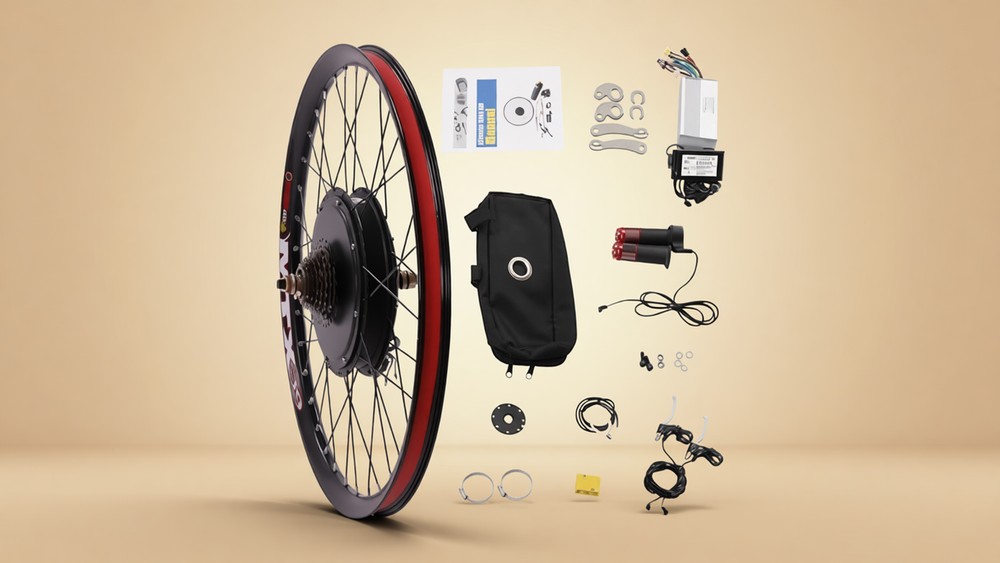
Here's the short version: the GOSHET 27.5 inch 72V 2000W rear hub kit is a mid-priced kit with one genuinely deep owner report behind it, seven quick texts around it, and a speed record that stops well short of what 2000W implies. The listing can't keep its wheel size, its item count or its parts list straight, and you supply the 72V battery yourself.
For steep hill riding away from traffic the record is encouraging, and for anything else I'd look at the same brand's 26 inch fat tire kit or read our Lariden 72V 2000W comparison first.
A record built on one deep text and seven quick ones
Eighteen ratings put this kit at 3.8 stars, and the split runs wide, with 61 percent five stars against 22 percent one star, nothing at all in the two-star band, and small shares at three and four.
Eight texts carry words, and seven of them are five stars. Six of those come from confirmed purchases, one five-star text doesn't, and the lone one-star text doesn't either. It's a July 2026 complaint about paying the price of a whole bike for a kit, and it points the next reader at Walmart. That's the entire negative written record, and it says nothing about how the kit behaves.
The text buyers have found most helpful, 11 votes, is from May 2025 and it's the deepest account on the page.
The owner reached 40 mph with a 72V 20Ah battery, and warned the next buyer that a torque arm might be needed to keep the motor from ripping the frame. They also built a regen braking setup of their own that they say tripled the braking force. It's a short-period review by its own admission, maybe two weeks of riding.
Nobody has written down a range figure, a real top speed, a wet-weather report, or anything about how the kit behaves in the months after. The honest summary of this record is one owner's two-week delight surrounded by quick thumbs-up, and that's more than many kits get, but it isn't a durability story.
The listing argues over its own wheel size
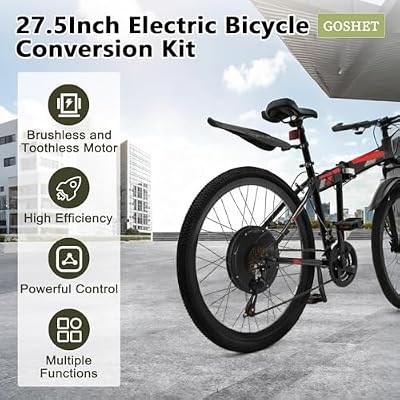
The spec table lists Wheel Size at 27 inches in one row and Rim Size at 27.5 inches a few rows down, which shouldn't be possible on a single wheel and matters directly when you're matching a kit to a frame you already own.
The contradictions don't stop there. Number of Items reads 12 while Unit Count reads 1 Count, and the first bullet promises handles and a controller bag while Included Components lists exactly one bicycle conversion kit.
None of this is fatal on its own, but a listing this careless about its own rows makes you verify everything. The fit question is the one that costs real money if it's wrong.
Fit matters more than usual because one owner has mounted this kit on a 29-inch Schwinn rim, which is bigger than either number in the spec table. That's encouraging about the motor's flexibility and useless as fitment advice, since a 29-inch rim with disc mounts isn't every frame. Measure your rim and your dropout spacing, and confirm what actually ships with the seller before you order.
What the speed record actually says
The listing advertises 560rpm, and on a 27.5-inch wheel that arithmetic works out to roughly 46 mph. That's a no-load ceiling, and no rider, hill and battery in this record has come close to it.
The human record sits below that ceiling everywhere. One owner has reached 40 mph on 48V and said they're not sure what 72V adds.
The deep-report owner topped out at 40 mph on a 72V 20Ah pack on a straight flat road, and the July 2025 text claims 50 uphill on that Schwinn. That's the whole speed record, and it comes from three owners.
Two caveats ride along with the fast reports. The torque-arm warning exists because a hub motor this size puts real twisting force into the dropouts. That's a known property of the design, since hub motors are the simple, durable and affordable end of e-bike drive systems and less suited to high speeds, per Wikipedia's wheel hub motor page.
A different owner describes a spark at the battery connection that has kept wearing out plugs, the only electrical fault anyone has written down.
Plan the build around thirty amps
At 72 volts, 2000W draws about 28 amps continuously, so the battery you buy needs a BMS and wiring rated past that with headroom, and any fuse in the line needs the same respect.
The kit doesn't include a battery, and one owner budgeted a few hundred more for a suitable 72V pack, which is the real money line of this build.
GOSHET's bullet copy skips the battery entirely beyond a note that the voltage must match, and the spec table stays silent on capacity, so the pack decision is entirely yours. If you're pricing one, our tagged search for 72V ebike batteries on Amazon is a starting point, and our own battery table sorts packs by cost per watt-hour.
Street legality is the other current question. The three-class e-bike scheme used across US states caps a legal e-bike at 750W continuous (Wikipedia), and a 2000W kit sits far outside every class, so where you can ride it legally comes down to your state's moped and off-road rules rather than e-bike law.
Worth it for hill country, if you supply the battery
Every positive text in this record circles back to the same use case, which is steep terrain, from the hilly-commute owner who needed help up slopes pedaling couldn't cover to the mountain rider and the 50-uphill claim.
That focus is the honest sales pitch. On flat ground at legal speeds a 750W class kit does the same commute for less battery money, and the 2000W rating goes untested in this record anyway. The price sits close to the middle of the conversion kit table, so you're paying a mid-kit price for hill-climbing headroom and a 72V habit.
For hill country on private land, with a 72V pack already in the budget and a torque arm on the shopping list, the record supports this kit. For anything flatter, cheaper or street-bound, I'd read our 26 inch fat tire GOSHET build or the Lariden 72V comparison and compare records before spending.
FAQ: the 72V pack you supply, the arguing wheel-size rows and the three-class 750W cap
Does the GOSHET kit include a battery?
No. The listing never claims one, one owner budgeted a few hundred more for a suitable 72V pack, and the current math says that pack needs to deliver about 28 amps continuous with headroom to spare.
What wheel size does it actually fit?
The spec table argues with itself, listing 27 inches in one row and 27.5 in another, and one owner has fitted the kit to a 29-inch rim. Measure your rim and dropout spacing, and confirm fitment with the seller before ordering.
Is a 2000W kit street legal?
In most US state schemes, no. The three-class e-bike definition caps continuous power at 750W, so a 2000W kit falls outside the classes, and its legal use comes down to local moped or off-road rules.
How fast have owners actually gone?
40 mph comes up twice, once on 48V and once on a 72V 20Ah pack, one owner claims 50 uphill, and nobody has reported a higher stock speed. The 560rpm claim works out near 46 mph as a ceiling.
Do I need a torque arm?
The deepest owner report says you might, warning that the motor's force could damage a frame without one. The listing never mentions torque arms and no other text confirms or contradicts the advice, so treat it as one owner's precaution rather than a spec.