Two thousand watts at 72 volts on a bicycle frame is a serious proposition, and the price on this one does not reflect that seriousness at all. The gaebeoih 2000W 72V rear hub motor kit arrives as a laced 27.5 inch rear wheel with a brushless gearless motor, controller, display, and the handlebar hardware. It is a lot of power for the money. It is also more power than most donor bicycles were ever designed to handle.
What Comes in the Box
The kit is sold as complete, which in conversion terms means the wheel, the controller with its bag, the display, and the handlebar controls all ship together. That matters because piecing a conversion together from separate listings is how people end up with a controller that will not talk to their display and a throttle with the wrong connector.
The wheel and rim are aluminum, which keeps rotating weight sensible and resists corrosion better than steel. A gearless direct-drive hub has no internal clutch or planetary gears to wear out, which is the main reliability argument for this motor type. Fewer moving parts, less noise, and no gear whine at speed.
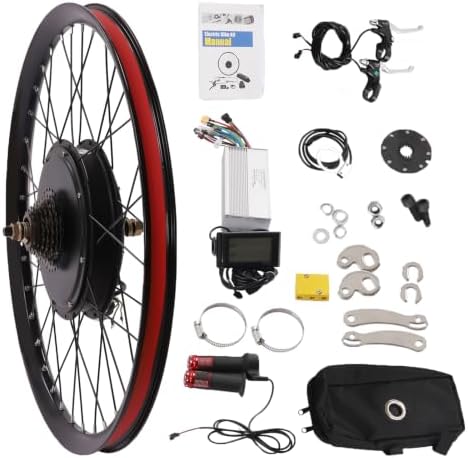
The wheel is described for 29 inch bikes with a 27.5 inch rear, and it is set up for 9-speed. Confirm your dropout spacing and your cassette before ordering. A rear hub that does not match your frame spacing means spreading steel dropouts or returning the wheel, and neither is a good afternoon. Our comparison table covers other kit formats if this one does not match your frame.
The Numbers That Actually Matter
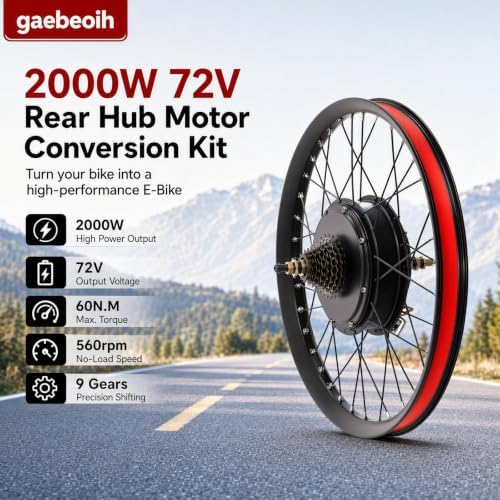
560rpm and 60Nm of torque is the interesting pair. High rpm with modest torque describes a motor built for speed rather than hill climbing, which is exactly what a direct-drive hub does well. On flat ground it will pull hard and hold high speed comfortably. On a 15 percent grade from a standing start, it will heat up while a geared hub of half the wattage walks away.
That is the tradeoff nobody mentions in the listing. Direct-drive hubs make their power at speed. Stall one on a steep climb and you are dumping current into a motor that is not spinning fast enough to cool itself, and the consequence chain ends with cooked windings and a wheel you have to rebuild. Keep your momentum and this motor is happy for years.
The nine speed settings and cruise control run off the LCD display, which also shows speed, mileage, and fault codes. Fault display is more valuable than it sounds. When a conversion misbehaves, the difference between a code on a screen and a dead bike with no information is an hour of your life with a multimeter.
The Part the Kit Does Not Include
Battery. A 72V system needs a 72V pack, and that is not a common shelf item at ebike shops. It is also the single largest cost in the build, frequently more than the kit itself. Budget for it before you order the motor, not after.
Brakes are the other thing. Two thousand watts will push a converted bike well past the speeds its original rim brakes were designed for, and a bicycle that accelerates faster than it stops is a genuinely dangerous machine. Hydraulic discs with a motor cutoff switch are not optional at this power level, whatever the listing implies about a bolt-on installation.
Torque arms belong on this list too. Direct-drive hubs at high power will spin inside aluminum dropouts and chew them open, and the failure mode is the axle rotating and tearing out the motor cable. Two torque arms, properly fitted. I can't test this kit personally, but that failure is well documented across the whole category of high-power hub conversions, and it is not something to gamble on.
Who Should Build This
Somebody with a steel or heavy aluminum frame, disc brakes already fitted, a plan for a 72V pack, and the patience to route wires properly. The manual is described as detailed, and the parts are all in the box, so the mechanical work is within reach of anyone who has replaced a bottom bracket. The judgment work is harder than the wrenching.
The wrong buyer is the person who wants to convert a lightweight road bike into a commuter. That frame was designed around a rider producing 200 watts. Bolting 2000 watts to it changes what the machine is, and the frame, the brakes, and the tires all need to change with it. Our hands-on reviews cover gentler 500W kits that suit lighter frames much better.
The simple rule for high-power conversions is that the motor is the cheap part. If your build budget only covers the kit, wait until it covers the brakes and the pack too. You can check current price on Amazon while you plan the rest.
Frequently Asked Questions
Does this kit include a battery?
No. The kit covers the motor wheel, controller, display, and handlebar hardware. You supply a 72V pack rated for the current the controller draws, and that pack is typically the most expensive part of the whole build.
Will 2000W fit my bike frame?
Only if the dropout spacing matches and the frame is strong enough. Aluminum dropouts on a light frame are the classic failure point at this power level. Use two torque arms regardless of frame material, and think hard before converting anything built for road riding.
Is a gearless hub better than a geared one?
For speed and durability, yes. For hill climbing and low-speed torque, no. Direct-drive motors run quiet and have almost nothing to wear out, but they generate heat when stalled on steep grades. Pick based on your terrain, not on the wattage number.
What does the LCD display show?
Speed, mileage, voltage, and fault codes, plus control of the nine assist levels and cruise control. Fault codes are the genuinely useful part, since they turn a mystery breakdown into a specific component to check.
Is this legal to ride on public roads?
In most places, no. Class-based ebike regulations typically cap motor output around 750W and limit assisted speed, and a 2000W 72V build sits far outside that. Check your local rules before you build, because insurance and liability follow the same lines.
How hard is the installation?
Mechanically it is a wheel swap plus cable routing plus mounting a controller bag, which is a few hours for someone comfortable with bike tools. The manual is included and the connectors are pre-matched. The difficulty is in the supporting work, meaning brakes, torque arms, and battery mounting.
Serious speed for very little money, in a package where the parts actually match each other and the display gives you real diagnostics. The motor's high-rpm character punishes steep climbs, and the kit's low price disguises how much you still need to spend on brakes, a 72V pack, and torque arms. Build it with eyes open and it delivers.