Fifteen hundred watts on a 26 inch wheel is the sweet spot where a converted bicycle stops being a bicycle with help and starts being something else. The dkfgtna 26" 48V 1500W rear wheel conversion kit pairs a gearless hub motor with a five-level pedal assist system, an LCD display, and cruise control. The claimed top speed is 55km/h. The part worth reading closely is what "gearless" does to your hill performance.
Gearless Means Quiet, and It Means Something Else Too
A brushless gearless hub has no internal reduction gears. The stator drives the wheel directly, which is why the listing leads with low noise. It is genuinely quiet, close to silent under steady power, and the only sound you get is tire roar and a faint electrical whine at speed.
The other consequence of no gears is no wear items inside the motor. Geared hubs use nylon planetary gears that strip eventually, usually at the worst possible moment on a climb. This motor has bearings and windings and that is essentially it, so the failure modes that kill cheap geared hubs do not apply.
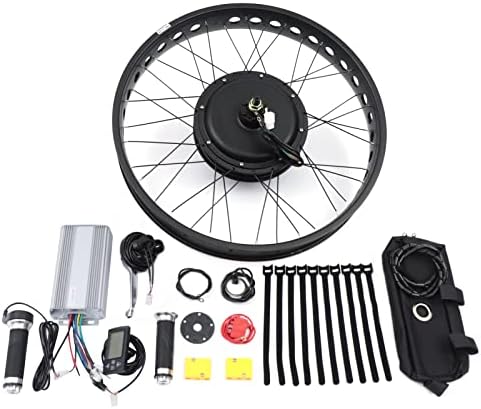
The cost shows up on hills. At 500rpm rated speed, this motor is built to spin. Direct-drive hubs make their efficiency at speed and their heat at low rpm, so a long steep grade at walking pace is the one situation where a smaller geared motor outperforms it. Momentum is your friend on this kind of build. Our comparison table shows how geared and gearless kits compare across the range.
The Display, PAS, and Cruise Control
Five levels of pedal assist is the standard arrangement and it works well when the sensor is set up properly. Most kits at this price use a cadence sensor rather than a torque sensor, which means the motor responds to whether the cranks are turning rather than how hard you push. The practical difference is a slight delay when you start pedaling and a slight delay when you stop.
The LCD covers speed, mileage, voltage, and fault display. Voltage on screen is more useful than a battery bar graph, because it tells you what your pack is actually doing under load instead of a guess based on a percentage. Watch it sag on a climb and you learn more about your battery in one ride than a week of reading forum posts.
Cruise control is the feature I would expect to divide riders. On a long flat road it saves your throttle hand. In traffic it is a hazard waiting to happen, and any cruise function on a two wheeler needs a brake cutoff that kills it instantly. Verify that your brake levers include cutoff switches, and if they don't, fit them.
Materials, Fit, and the Work You Still Have To Do
The listing describes aluminum, iron, copper, and magnet steel construction, which is a roundabout way of describing a normal hub motor. Aluminum shell, steel magnets, copper windings. That is fine and unremarkable. What matters more is that you confirm this 26 inch wheel matches your frame's dropout spacing before ordering.
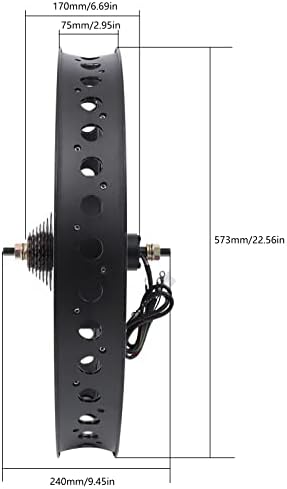
No battery is included, which is standard for conversion kits and still catches first-time buyers. A 48V pack capable of feeding a 1500W motor needs a BMS rated well above 30A, and pairing a big motor with a small pack is the most common mistake in this whole category. The consequence chain is short and predictable: undersized BMS, cutout on the first hard climb, dead bike on a hill.
Torque arms are the other item. High-power direct-drive hubs generate enough reaction force to spin an axle in aluminum dropouts, and once that starts, the motor cable tears out. Two torque arms, fitted properly, on any build at this power level. I can't test this specific kit personally, so I'm going by what the physics demands rather than what the listing promises.
Who This Kit Is For
Riders converting a sturdy 26 inch mountain bike or cruiser for flat-to-rolling terrain, who already have disc brakes and who understand that the kit price is not the build price. On that kind of bike, this motor turns a heavy commuter into something quick and nearly silent, and the maintenance burden afterward is close to zero.
It is the wrong choice for steep mountain commutes, for lightweight frames, and for anyone who needs the finished bike to stay within legal class limits. A 55km/h capable machine is not a Class 2 ebike anywhere I know of, and building one means accepting that it belongs on private land or roads where that is permitted. Our hands-on reviews cover lower-output kits that stay inside the rules.
You can check current price on Amazon. Just price the battery, the brakes, and the torque arms in the same sitting so the total is honest.
Frequently Asked Questions
Does this kit come with a battery?
No. You supply a 48V pack, and it needs a BMS with enough current headroom to feed a 1500W motor without tripping. Undersizing the battery is the most common reason these builds disappoint.
Can it really hit 55km/h?
On flat ground, with a healthy 48V pack, a light rider, and no headwind, that figure is plausible. Add a hill, a heavier rider, or a sagging battery and the real number drops. Treat top speed claims as best-case laboratory conditions rather than a promise.
How does it handle steep hills?
Not as well as a geared hub of similar power. Direct-drive motors lose efficiency and build heat at low rpm, so a long steep climb at slow speed is their weakest situation. Carry momentum into the hill and it copes fine.
What is the difference between cadence and torque sensing?
Cadence sensing detects that the pedals are turning and applies a preset assist level. Torque sensing measures how hard you press and scales assist accordingly, which feels far more natural. Kits at this price almost always use cadence sensing, and the result is a slight lag at start and stop.
Do I need torque arms?
Yes. At this power level the axle can rotate in aluminum dropouts, which destroys the dropout and rips out the motor wire. Two torque arms is the standard recommendation across the high-power conversion community and it is cheap insurance.
Will my rim brakes be enough?
Almost certainly not. A bike capable of 55km/h needs disc brakes and brake levers with motor cutoff switches. Upgrading the brakes should happen before the first ride, not after the first close call.
Quiet, low-maintenance power at a price that makes the whole build achievable, with a display and cruise control that add real daily convenience. The gearless design trades hill-climbing ability for durability and silence, and the kit leaves battery, brakes, and torque arms entirely up to you. Good value for a flat-terrain commuter build, wrong tool for a mountain.