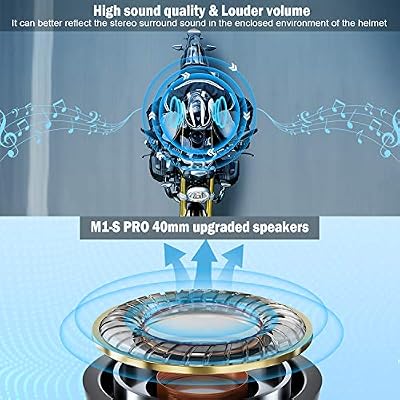
The cheapest way into a three-rider Fodsports setup is the M1-S PRO 3-pack, which sells three full M1S Pro headsets for 189.99 when I checked. That works out to 63.33 per rider, and no single listing in the family gets close to that figure. The catch sits next to the price: this is one of the thinnest owner records on our whole table, 2 ratings and a single written text, and that one owner never took the headsets on a ride.
The old version of this article repeated the listing's numbers. What the record actually supports is smaller and more useful than a spec restatement. The price math is real. The firmware situation is real, and one owner's account of it matters more than anything else on the page. The group and range claims rest on nothing in the record at all.
So this is a guide to buying a good deal on unproven hardware. I walk through what the pack costs against its own siblings, what the one owner caught that the listing never mentions, and what to check before a group ride depends on three of these talking to each other.
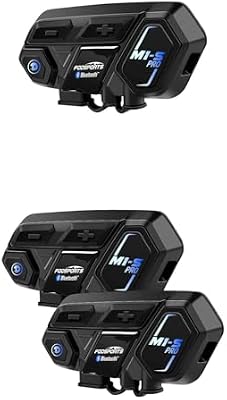
Three intercoms at sixty-three dollars each
The single-unit M1S Pro sells for 75.59 now and sits at a typical price of 83.99. Three singles at that typical price come to about 252, so the pack saves roughly a quarter against the obvious alternative. The 2-pack sits between, at 148.49 or 74.25 per headset. The pack is the cheap way in, and it is not a small discount.
Put the pack next to the rest of the family and the value gets sharper. The M1-S Air single costs 63.99 in our recorded data, so the 3-pack costs less per headset than the entry model in the same brand, while carrying the Pro's group claims. The M1-S Plus 2-pack runs 171.99 with upgraded speakers. Fodsports has stacked this family so the pack does the heavy lifting on price.
On price per rider the 3-pack sits close to the middle of the 192 intercoms we track. That is a fair place for hardware with these claims, and the table shows the live position next to both siblings. What the price does not buy is evidence. At 2 ratings, the record behind this deal is thinner than almost everything it sits beside.
The firmware split one owner caught
The entire owner record is one text, posted in April 2026, backed by a purchase. The owner set the headsets on modular helmets at home and reported that they seem to work, with a caution that they might be a little quiet. They put that on microphone gain, guessing the low gain comes from the noise filtering doing its job. Controls read as fairly simple, and the battery went untested because the headsets never left the house.
Two practical notes came out of that house test. The manual covers the buttons and nothing about fitting the headsets to a helmet, so a first-time buyer goes looking online for setup help, which is exactly what this owner did. And the microphone choice matters before you install anything: the family ships a hard mic for open-face helmets and a soft mic for full-face ones.
The last sentence of that text is the one I would underline. The owner reports receiving two different firmware versions, calling the multi-unit package V3.0 and a separately bought single V2.0. Fodsports' own single-unit M1S Pro listing states the consequence: older V2.0 and newer V3.0 headsets can fail to auto-connect after pairing, and the rider has to press the intercom button to connect manually. Mixing pack units with existing singles is a real scenario, and the failure mode is printed on the sibling listing.
The same single-unit bullet adds what V3.0 brings: the FODSPORTS Connect app, voice prompts in 7 languages, and Siri support. So the firmware letter is not cosmetic. It decides whether a rider gets app setup and whether a group reconnects on its own or waits for a button press at every stop.
Two group sizes and two distances in one family
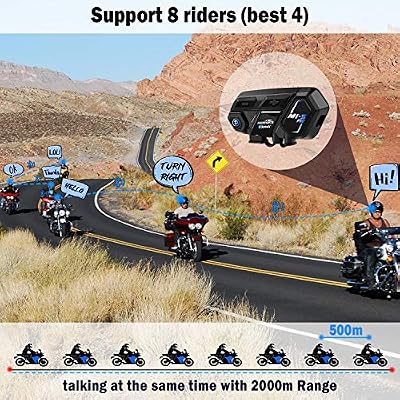
The pack's title says up to 8 riders. The single's title says 10 riders, and its bullet says the 10-rider group needs the V3.0 upgrade. Same hardware, two group figures, and the bigger one carries a condition the pack's title never mentions. A buyer who plans around the number on the box should know the box is the smaller of the two claims.
What the 2000-meter figure rests on
The listing bullet promises about 2000 meters of group range in a straight line with no obstacles, and Bluetooth 5.0. Standard Bluetooth runs on tiny transmission power, reaching around 10 meters typically and near 100 meters in the best case, and Bluetooth 5's long-range coded modes top out between 40 and 400 meters (Wikipedia). A 2000-meter figure therefore rides on the vendor's own range modes and on open terrain, not on the Bluetooth standard printed in the same bullet.
Nobody in the record has measured anything. The one owner text never rode, so there is no distance report, no rain report against the any-weather claim, and no account of a group of headsets working together at all.
The 500-meter pair number is the planning figure
The most useful number on the listing is the one that gets least attention. The same bullet says the maximum effective distance between two motorcycles is about 500 meters. That is the figure a pair of riders should plan around, it is the vendor's own number rather than a marketing ceiling, and it still assumes open terrain.
The 20-hour working-time claim on the 900mAh battery has the same shape. The title adds usable-while-charging, which would cover a long day plugged into the bike, and the battery claim has no owner test behind it. These are claims to verify on your own rides, not facts to repeat.
What to check before you buy three
A thin record shifts the work onto the buyer, and the checks here are cheap compared with a group ride that fails.
Ask which firmware ships. The owner text reports a pack on V3.0 and a single on V2.0 on one owner's setup. If you already ride with older M1S Pro units, confirm the new pack's version and expect the manual-connect quirk if the letters do not match.
Pair all three in the driveway. Before the first ride, pair every headset, drop one out of range, and bring it back. If a headset does not reconnect on its own, press the intercom button and see how long the manual routine takes. That one test tells you more than the group claims do.
Pick the mic before you mount. Hard mic for open-face helmets, soft mic for full-face. The owner text suggests the noise filtering keeps the mic gain low, so check the volume against your own helmet and earplugs while you are still parked.
Test the cross-brand claim on a short ride. The title promises universal connection with other brands, and no owner text tests it. Try it with whatever the rest of the group wears before anyone depends on it.
Price the singles before you commit. The pack's math holds at the prices I checked, but this family reprices often. A quick look at the single-unit M1S Pro review keeps the comparison honest, and the comparison table linked above tracks the per-rider figures for the whole category.
Frequently asked questions
Is the 3-pack actually cheaper than three singles? At the prices when I checked, yes. Three singles at the typical 83.99 come to about 252 against the pack's 189.99, and the 2-pack rung sits between at 74.25 per headset when I checked it. The pack is the cheap entry, and it is the only way to buy this family at an Air-single price per headset.
What is the real range? Plan around the bullet's own pair figure, about 500 meters between two motorcycles in open terrain. The 2000-meter group figure needs the vendor's range modes, a straight line with no obstacles, and a group mode nobody in the record has tested.
Does it connect to other brands? The title claims universal connection, and no owner text confirms it. The family's own listing warns that V2.0 and V3.0 units can need a manual button press to connect even within the brand. Test cross-brand pairing before a group depends on it.
Is the battery as good as the listing says? The claim is a 900mAh battery with a week of standby and up to 20 hours of working time, plus use while charging. The one owner who wrote about these headsets never tested the battery, so the claim stands unconfirmed either way.
Who should skip this listing? A rider who needs the group claim proven before spending should start from the comparison table and pick a unit whose record shows working groups. A trio or a small club on a budget that is willing to run the driveway checks has the clearest case for the pack, since the worst case stays a cheap return rather than an expensive mistake.