The dual-voltage trick and the hard case are real, but the public track record consists of only two buyers who split one star and five stars, while one person reported a dead pack on arrival. Since the listing is currently unavailable on Amazon, you can't buy this pack, and you shouldn't trust its quality yet. Unproven hardware like this can leave you stranded if the internal components fail mid-ride. It's a risky gamble.
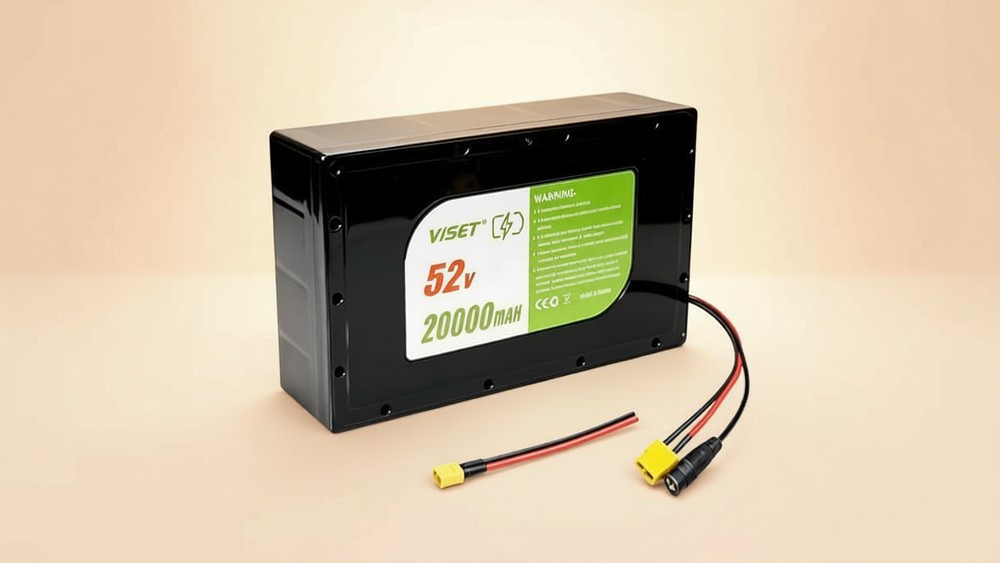
The two buyers who own it disagree completely
The only field data on this pack comes from two purchases that could not disagree more, because one person found a dead brick while the other found a tool that works. One buyer measured zero volts at the main XT60 connector out of the box, tested with a multimeter, and got into a refund dispute. The other reports good power and good capacity and recommends it, with one warning: there is no on/off switch. Two data points are not a statistic, but 50 percent dead on arrival is also not nothing, and the refund fight is a service signal on its own.
Neither review touches long-term durability, which is the real question for a no-name pack, since we do not know how the cells hold up after a hundred miles of riding. If you get a pack that does not work, you are stuck fighting for a refund while your bike sits in the garage without any way to move. It is a total gamble on the quality control of a factory that we can't see or touch.
Since there is no switch, the BMS will drain itself slowly even when the pack is idle, so you have to check the charge level often to avoid damage. If you forget to do this, you might find the pack flat right when you actually need to go on a long trip. This lack of basic control means you are constantly managing the health of the cells instead of just riding. It's a lot of work for a part that claims to be simple.
Compare it against the rest of the field in our battery comparison table.
What a 30A BMS actually lets you run
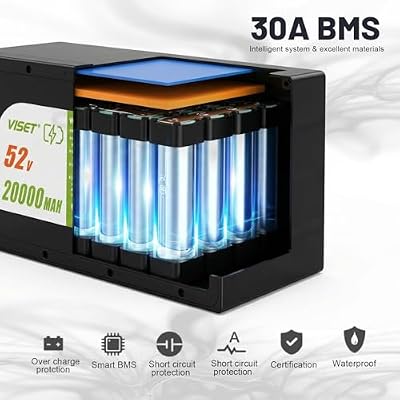
The listing claims compatibility with 200W-14000W motors, but the math shows that a 30A BMS simply limits how much power can actually flow to the motor at any given time. Since 30A at 52V is about 1,560W continuous on a fresh pack, and 30A at 48V is about 1,440W, both numbers fall as the pack sags. Nothing near 14000W runs through a 30A BMS, so that big figure is just listing inflation while the BMS number is the one that matters. Setups that genuinely fit are roughly 250W to 1000W nominal, though the headroom shrinks on long climbs late in the discharge.
Lithium packs deliver their highest voltage right after charging, which means the BMS current limits bite hardest on hills or at low state of charge rather than on a fresh pack. If you push a 1,000W motor with a high peak draw, you might hit the limit and have the pack cut power right when you need it most. This happens because the BMS protects the cells from drawing too much current, even if the motor wants more. You're betting that your motor draw stays within these bounds to avoid a sudden slowdown on a hill.
A hard case pack trades some energy density for impact protection compared to soft packs in this amp-hour class, but it cannot change the internal electrical limits. Since the pack has no on/off switch, it drains the BMS slowly even when idle, so a storage charge around half and a periodic top-up matter more. If you ignore these limits, you'll find the bike struggling to maintain speed once the voltage drops below the threshold. It's better to know the real ceiling before you head out on a long trip.
What 1,040Wh gets you
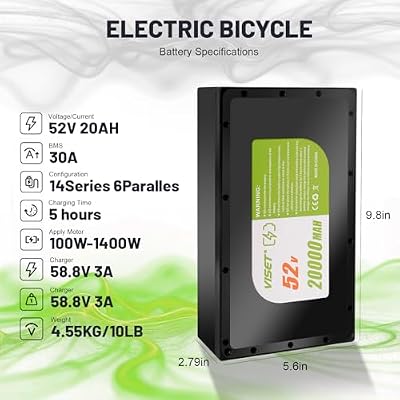
The 52V by 20Ah pack holds 1,040Wh of energy, which translates to about 936Wh once you account for the ninety percent depth of discharge used to protect the cells. Moderate pedal assist on flat ground usually uses between 24 and 29Wh per mile, while mixed terrain with hills pushes that to 32 through 40Wh. Full throttle riding draws even more, about 48 to 56Wh, which puts your moderate-assist range near 36 to 43 miles and throttle-only riding closer to 19 to 22 miles. You should always plan your trips around the lower end of those numbers so you don't end up stranded far from home.
Cold weather can trim your range by 10 to 30 percent because lithium cells struggle when it gets freezing, and extra weight on the bike cuts those numbers even further. If you carry heavy gear, the consumption goes up by 5 to 8 percent for every extra 10kg on flat ground, and it gets much worse when you hit a climb. These band figures are general knowledge for this category, not specific measurements of this pack, but they show what you can realistically expect on a long ride.
Since this pack lacks an on/off switch, the BMS drains energy slowly even when the bike is sitting idle, so you should keep the charge around half during storage. You'll need to do a periodic top-up to make sure you still have enough juice when you finally decide to head out. The hard case trades some energy density for impact protection, but it helps keep the cells safe if you're hitting rough trails. It's a trade-off that makes sense if you want the pack to last through several years of heavy use.
The details that separate this pack from better documented ones
Since this pack lacks an on/off switch, the internal BMS drains the cells slowly while it sits in your garage, which means you must manage the charge very carefully. You should keep the battery at half-charge and top it up every month or two so that it stays healthy. If you skip these steps, the pack might go dead before you even need to use it for a ride. This slow drain is a chore for people who just want to plug in and forget it.
The listing argues with itself on weight because the bullets say ten pounds while the spec table claims eight point three six pounds, which makes it hard to know what you are actually getting. Neither of those numbers may match the shipped pack, when you pull it out of the box. Weight matters when you calculate how the bike feels, or how much range you lose on hills. It's confusing when the math is so off.
While the title says the pack is waterproof, the bullets only claim the case prevents direct water contact, so you should treat it as splash-resistant and keep it away from deep puddles. You should measure the pack voltage at the XT60 with a multimeter, before you connect anything to the bike. This is exactly what the unhappy buyer did, when their battery arrived with no power left. Checking the volts first saves you from wasting time, on a pack that might be totally dead.
Who should still consider it, and who should not
If you're a DIY builder who wants the dual-voltage trick for a future controller upgrade, owns a multimeter, and can test on arrival, this pack might work for you. It fits someone using it in a scooter or mobility build where the hard case earns its keep because the PVC shell protects the cells from impacts. You'll need to check the voltage right away since one buyer has reported a dead pack that arrived with no power at the main wire.
This battery doesn't fit anyone who needs a pack this week because the listing is currently unavailable with no restock date set. It also won't work for anyone unwilling to accept a 50/50 record on the only two public data points since the feedback is split so evenly. You should check the comparison table for packs with deeper review histories at similar watts per dollar before you spend your money.
If you buy this, you have to manage the storage carefully because there is no on/off switch and the BMS drains slowly even when the pack sits idle. You should keep the charge around half and do a periodic top-up to avoid losing energy over time. If you ignore these steps, you might find yourself with a flat pack when you finally need to go on a long ride.
Frequently Asked Questions
Will this work on my 48V bike?
Yes it works by design because the internal pack runs both 48V and 52V voltages for different systems. You should check the connector and your controller's upper voltage limit before installing.
Is a 30A BMS enough for a 1000W motor?
On paper at nominal voltage it is enough, but it gets tight at full throttle and on climbs as voltage sags. The BMS will cut power if the motor demands too much current.
How long does it take to charge the battery?
The manufacturer listing states it takes 7 to 8 hours to reach a full charge from an empty state. You should plan your rides around this long window of charging time.
Can I leave the battery attached to the bike?
You can leave it on the bike, but there's no on/off switch to stop the internal drain. Store it around half charge and top it up periodically to maintain cell health.
Where can I buy this specific pack?
It is currently unavailable on Amazon, so you must check the seller's own store for stock. Note that the two-review history is the entire public record for this pack. If it isn't the right fit, the battery comparison table sorts every option we track.
You can check the current listing on Amazon for price and availability.