Folding e-bike owners shopping for a spare 48V pack usually meet the same wall: a shelf of near-identical cases from brands nobody recognizes, all priced within a few dollars of each other, all promising more than the page can prove. The hard part is not finding a candidate. It is deciding which lines on the page describe the pack you are actually buying.
The CXZCXZ 48V 10Ah makes that decision unusually concrete, because the page argues with itself in writing. Its title, its size bullet and its parameter card all say 10 amp-hours, and one bullet alone says 20.
Two motor bands appear on the same page and they do not match. This article walks the page line by line, separates the template noise from the printed specifications, and computes the range figure the listing never gives you.
The short version: the parameter card is the trustworthy part of this listing, and the bullets are the part to ignore.
The CXZCXZ 48V 10Ah folding battery carries 480 watt-hours at 149.99, which sits below the middle of the 324 packs in our comparison table on price per watt-hour. You are paying a mid-tier price for a small-capacity pack, and the record behind it is thin: two ratings, two five-star texts, both from September 2026. The card's numbers all reconcile, which is more than most listings in this class manage.
Two texts, both five stars
The record holds two written accounts, and they are not equally useful. The purchase-badged text, from September 16 2026, describes a buyer who bought their e-bike the month before, found the original battery did not last long enough, and picked this pack up as a second battery. They report switching packs midway through rides, and they close with "It works great thank you". That is a range-extension purchase working as intended.
The second text, from September 10 2026, carries no purchase badge and reads differently. It praises the battery life, claims range to ride all day, and ends by wanting a second unit to have two.
Nothing in it names a bike, a distance or a problem solved, and that shape is the one we treat cautiously on this tier, because it matches the way promotional text reads rather than the way a specific purchase reads.
So the honest record is one substantive account and one text that could be anything. Two five-star ratings are a start, not a verdict, and nothing here balances a failure report because none exists yet.
One page, two capacity stories
The capacity contradiction is the strangest thing on the page. The title says 48V10Ah in its own closing parenthesis.
The size bullet repeats it: capacity 10AH. The parameter card prints 48V10AH. Then the specifications bullet says this "powerful 48v electric bike battery has a strong capacity of 20ah".
Every signal except that one bullet says you are buying a 10Ah pack, which stores 480 watt-hours at 48 volts. The stray line is almost certainly the ladder template showing: the same listing family sells a 20Ah rung, and someone copied the bullet across without editing it. A buyer who reads only bullet three would expect twice the capacity the card promises.
The motor lists drift the same way. The title prints 250W, 350W, 500W, 700W, 900W and 1000W. The bullet prints 250W, 350W, 500W, 750W and 1000W, dropping 700 and 900 and adding 750, with no explanation.
When a page disagrees with itself about which motors it serves, the honest ceiling comes from the BMS, which the next section covers.
The parameter card closes on every line
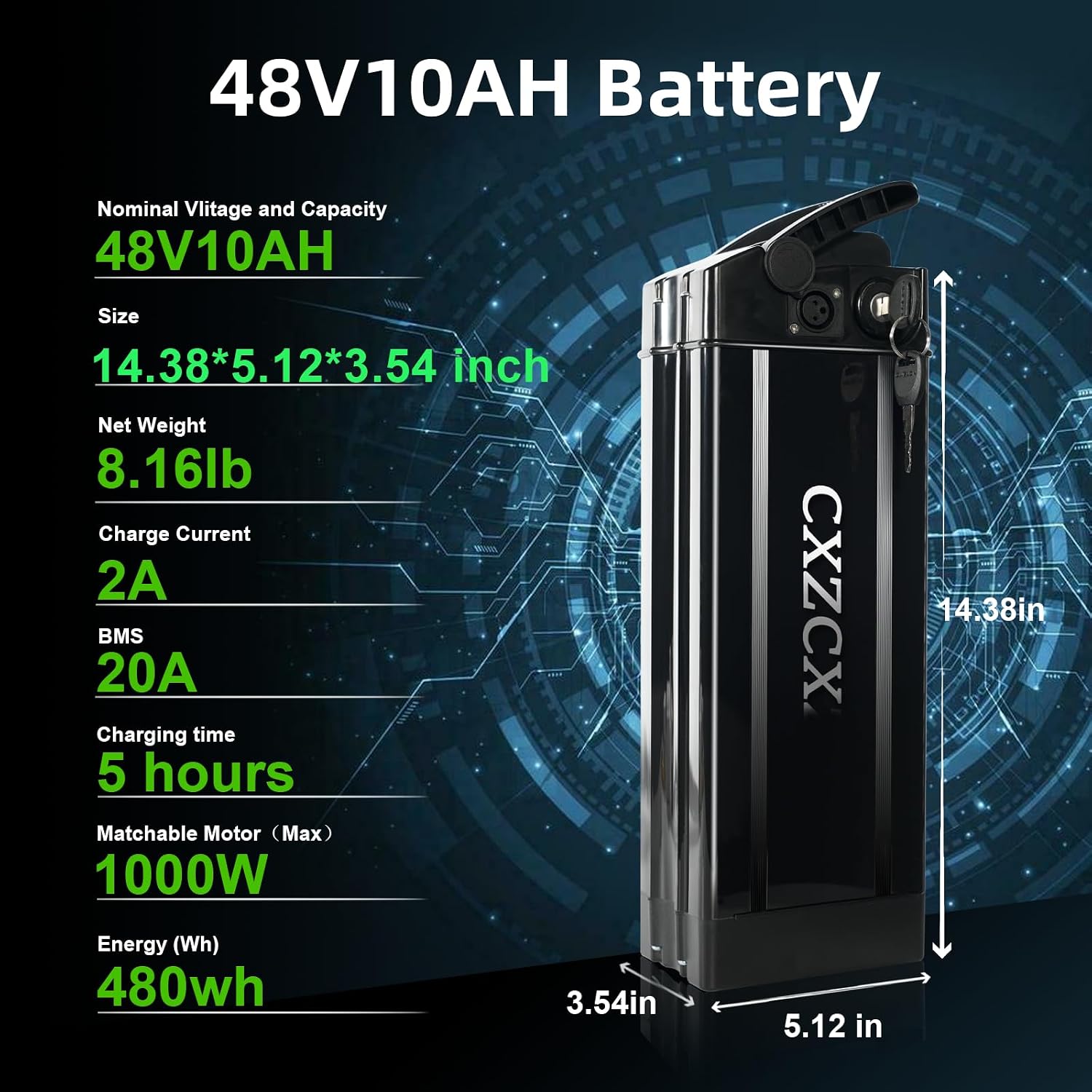
The card in the gallery is the most trustworthy object on this page, because every number on it survives checking. It prints 48V10AH, 14.38 by 5.12 by 3.54 inches, a net weight of 8.16 pounds, a 2-amp charge current, a 20A BMS, a 5-hour charging time, a 1000W maximum motor, and 480Wh of energy.
Start with the charge time. Ten amp-hours divided by the 2-amp charger gives a 5-hour floor, and the card's printed charging time is exactly 5 hours.
Listings in this class usually print a charge claim rounded below what the arithmetic allows. This one rounds honestly.
The BMS ceiling checks too. Twenty amps continuous at 48 volts sustains 960 watts, which sits just under the card's own 1000W motor maximum. A buyer with a 1000W motor is inside the limit with almost no margin, so treat 960 watts as the sustained figure.
The weight closes with room to spare. 8.16 pounds is 3.70 kilograms, and 480 watt-hours at that mass works out to about 0.13 kilowatt-hours per kilogram, comfortably inside what packaged packs weigh once the case, board and wiring take their share.
The details row prints 8.6 pounds, half a pound above the card, and that heavier figure closes too. Either number is plausible, which is not always true on this tier.
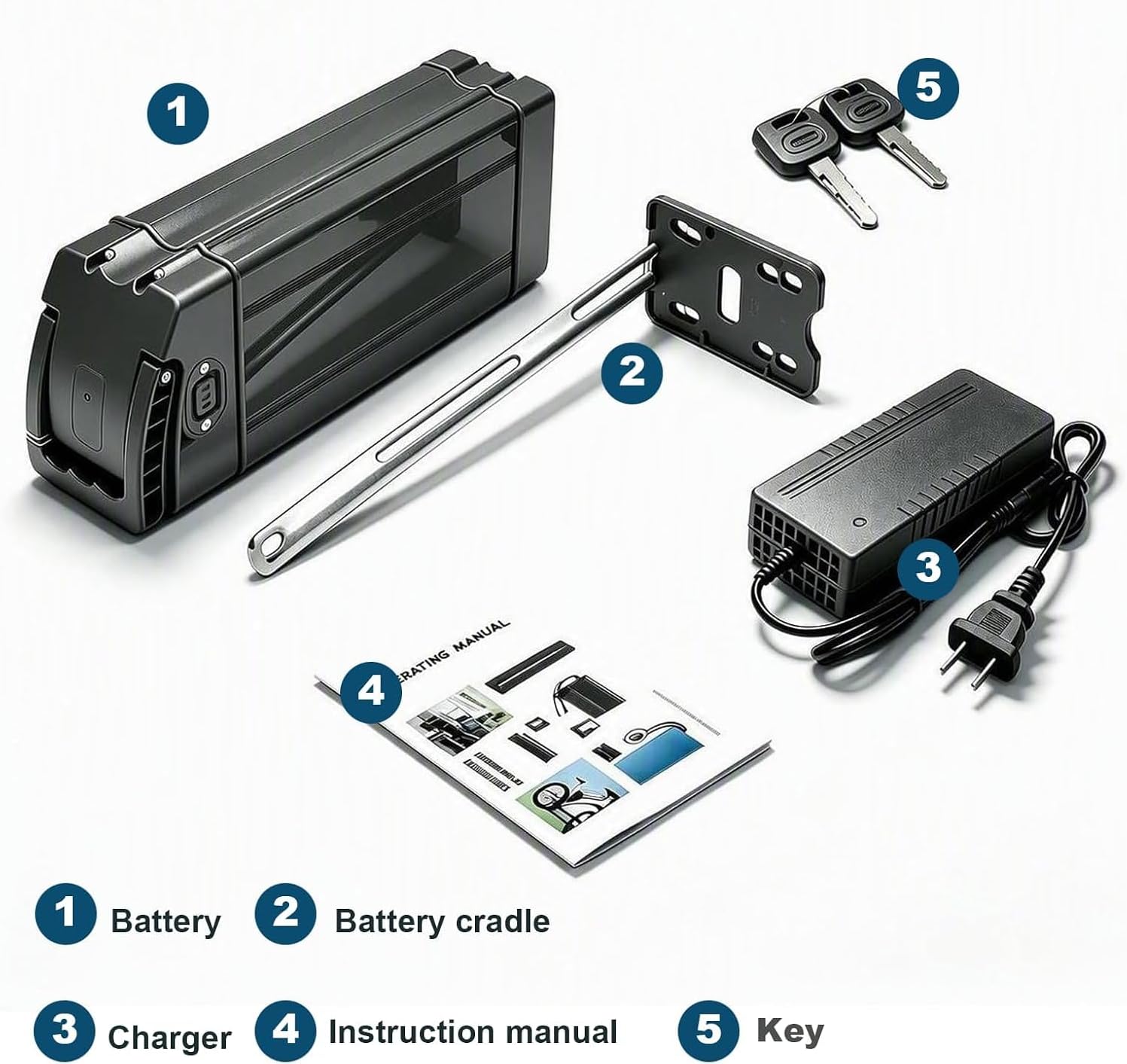
The box-list card confirms the charger ships in the box, matching the ladder label that names this rung "with charger". That card lists the battery, the cradle and charger, a manual, and a key.
Choosing between the rungs
This pack shares its case with the rest of its ladder. The printed footprint, 14.38 by 5.12 by 3.54 inches, is identical to the 13Ah rung we have already covered, so a buyer upgrading within the ladder keeps the mount and the cradle.
The interesting difference between those two rungs is the board. The 13Ah CXZCXZ review covers the rung whose card prints a 25A BMS, while this 10Ah rung prints 20A in the title and the card together. The bigger rung of the same case is also the stronger pack, and the 13Ah listing costs ten dollars more.
For most buyers that makes the 13Ah the better value, and this 10Ah makes sense mainly when the budget is fixed or the bike's original pack was small to begin with.
The ladder also holds a 20Ah rung we have not covered, so buyers wanting the big case should read both cards rather than assuming the boards match.
Range, computed
The listing never prints a range claim, which is honest of it, but a buyer still needs the number. A 480 watt-hour pack on a typical pedal-assist draw of 20 to 25 watt-hours per mile delivers roughly 19 to 24 miles per full charge. Riding full throttle raises the consumption figure and shortens that range accordingly, and a hilly route does the same.
If your rides live inside that envelope, the capacity makes sense. If you bought your folding bike expecting 40-mile outings, this pack doubles nothing, and the purchase-badged owner's approach is the better template: keep the original pack with you and switch midway.
Frequently asked questions
Does the charger come with it?
Yes. The box-list card names the battery, cradle and charger, manual and key, and the ladder label for this rung says "with charger". It is a 2-amp charger, so a full refill takes about five hours.
Should I believe the bullet that says 20 amp-hours?
No. The title, the size bullet, the parameter card and the energy figure all say 10Ah and 480Wh. The stray 20ah line matches the 20Ah rung elsewhere on the ladder and appears to be unedited template text.
Can it run a 1000W motor?
At the limit. The 20A BMS sustains 960 watts, which sits just under the printed 1000W maximum. A 750W or smaller motor runs with real margin.
Is the five-star record trustworthy?
It is thin. Two ratings and two texts, both five stars, both from September 2026.
One is purchase-badged and specific, the other unverified and generic. Treat the record as a start, not proof, and lean on the card arithmetic.
Will it fit my folding bike?
The case measures 14.38 by 5.12 by 3.54 inches and mounts in a cradle. Check the space your frame offers and the discharge connector, which is a T-Plug, before ordering. The cell chemistry is standard lithium-ion (Wikipedia, Lithium-ion battery), so any 48V charger with the right connector and a 54.6-volt output suits it.