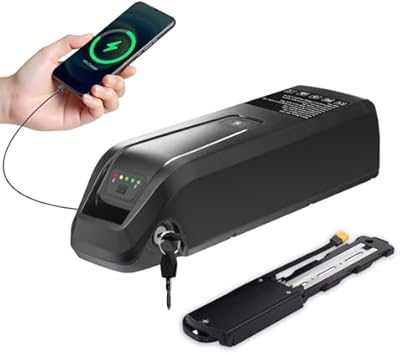
Small packs price worse per watt-hour than big ones across our whole table, and this listing wasn't an exception. The Bydrena 48V 10.4Ah captured at 0.29, above the 960Wh tier we track at 0.24 to 0.28, so a buyer paid a premium for less energy. What the money bought instead was a short downtube case, low weight and a USB port for a phone or GPS.
Underneath the pricing, the spec sheet held together better than most dead listings do. A title claiming coverage for 250W to 1000W motors got honest backing from the 30A board, since 1000W draws about 20.8A at 48V against a 1440W ceiling. At the plug, the XT60 and 5-pin base sit at the top of their connector class.
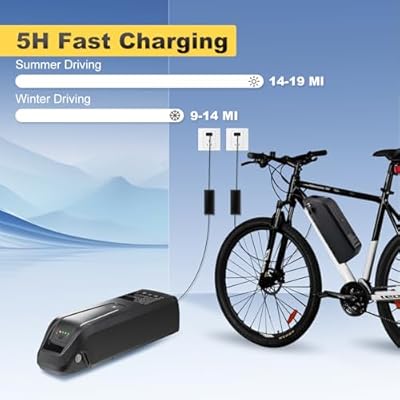
Charging holds up as well. A 2A charger needs 5.2 hours to fill 10.4Ah from empty, and the listing said five to six hours, so the claim covers its own floor exactly.
The record was three five-star ratings, no texts, and then the listing left Amazon. That's a thin file to buy on. Below, the premium math, the connector limits and what a frozen record can still settle.
A premium price for a small pack
Our comparison data tracks 324 packs by price per watt-hour, and this one captured at 0.29, a below-average position in that table. The exact spot renders in the specs box on the comparison table, where the whole market sits on one screen. In words: this wasn't a bargain, and the number says so plainly.
The pattern behind the number is bigger than one listing. The 960Wh tier prices at 0.24 to 0.28 across our data, and the powervault 48V 20Ah review covers a pack that captured at the bottom of that band while carrying the same 30A board. Capacity gets cheaper per unit as packs get bigger, so the small end pays more for less energy. That's the deal this listing offered, and it was normal for its size class rather than a ripoff.
What the premium actually bought
The physical extras were real. A 10.4Ah case is short enough to sit low on a downtube without crowding a bottle cage, the whole assembly weighs little enough to carry up a staircase, and the USB output kept a phone or GPS unit alive through a ride. None of that registers in a per-watt-hour ranking, but all of it matters on a short-trip commuter, which is the bike this pack was built for.
A buyer who valued range over convenience could do better with the same money, and the comparison table makes that trade visible on one screen. A buyer who wanted the lightest reasonable pack with phone charging got what they paid for.
The board covers its own claim
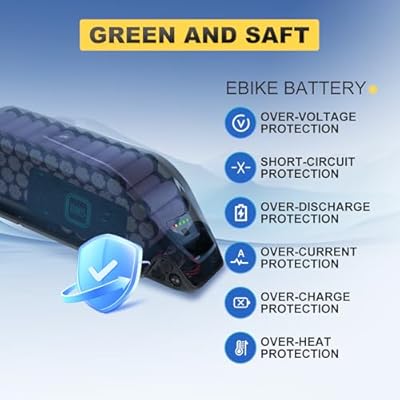
The title claimed coverage for motors from 250W to 1000W, and the recorded 30A board makes that check honest. Thirty amps at 48V is 1440W of continuous output. A 1000W motor draws about 20.8A at 48V, so the claim's top runs with roughly a 44 percent margin under the board, and even the full claim band fits inside it. Listings in this tier usually fail that check somewhere, so a claim that survives deserves the note.
The powervault 48V 20Ah review walked through the same 30A board on 48V in detail, down to which motor sizes fit comfortably. The short version here: a 1000W system sits well inside the limit, and a 250W motor barely loads the board at all.
Where the connector class tops out
The 5-pin base plate matters for replacements. Per the connector guide at BatteryDex, 4-pin and 5-pin Hailong baseplates don't interchange, and the 5-pin class serves controllers up to about 30A, so this board sat at the top of its connector class. Anyone matching a replacement pack needs the same 5-pin base, not just a Hailong-looking case.
The discharge side was never the limit. An XT60 plug is rated around 60A, far above the 30A board, so adapters and plugs had headroom even at full draw.
The charge estimate survives its floor
The recorded charger was 2A, and 10.4Ah at 2A is 5.2 hours from empty. The listing claimed five to six hours, so the claim covers its own floor with room for the slow tail while the pack's balancer finishes the job. Charge-claim arithmetic fails constantly in this market, and this one didn't.
Overnight charging covers the full span easily. What the small capacity doesn't buy is a fast lunch-break top-up on a 2A charger, so riders planning two charge-dependent trips in a day should plan around the wall clock rather than the socket.
Range on a small pack
The em3ev 48V guide anchors a 960Wh pack at 30 to 40 miles on throttle alone and 50 to 65 with a light pedal assist. Scaled down by half, this pack lands at roughly 16 to 21 miles on throttle and 26 to 34 with a light leg. Cold weather, hills and high assist levels pull a real ride toward the bottom of those bands.
That arithmetic matches the pack's intended job. A commute under ten miles each way fits the assist band with charge to spare, and a short mountain loop does too. Long tours and big climbs belong on bigger packs, and the per-watt-hour table says those bigger packs price better anyway.
Three ratings and no words
The record on this ASIN is three five-star ratings with no review texts captured. Our data row carries the 5-star average and no count beyond that, and the listing has since left Amazon, so the record can never grow. Three happy buyers is a nice start and statistically nothing, and no owner consensus can be read into it.
The frozen record leaves one question permanently open: how the cells age. Lithium-ion packs typically manage 400 to 1,200 full cycles per the Wikipedia lithium-ion battery article, but a cycle claim is a listing's word, and this record offers no buyer evidence behind it or against it.
No weight was ever recorded either. Complete packs usually land between 0.18 and 0.21 kWh per kilogram, so a 499.2Wh pack of this shape should weigh somewhere near 2.4 to 2.8 kg. Treat that as an expectation, not a spec.
With the listing gone, browse live 48V packs with a USB output and run the same checks against whatever successor inherits the design. Our review archive covers packs across every voltage and price band.
Common Questions
Will it fit my bike?
The pack used a Hailong-style downtube mount with a 5-pin base plate, and the recorded case measured 14.47 by 3.74 by 3.5 inches. Measure the clear space on your downtube and check whether your mount takes a 5-pin base, since 4-pin and 5-pin plates don't interchange.
How long does a full charge take?
About 5.2 hours at the minimum from empty on the recorded 2A charger, with the listing's five-to-six-hour claim holding up against that floor. Most riders charge before empty, so real sessions usually finish inside the claim.
Can it charge a phone?
Yes. The USB output ran through a step-down converter inside the case, and the top-mounted power switch let a rider cut the standby drain when parked. Flip the switch off between rides or the converter sips from the pack all week.
How far does a charge take you?
Roughly 16 to 21 miles on throttle alone and 26 to 34 with a light pedal assist, scaled from the em3ev anchor for this pack's size. Hills, cold and high assist settings pull a real ride toward the bottom of the band.