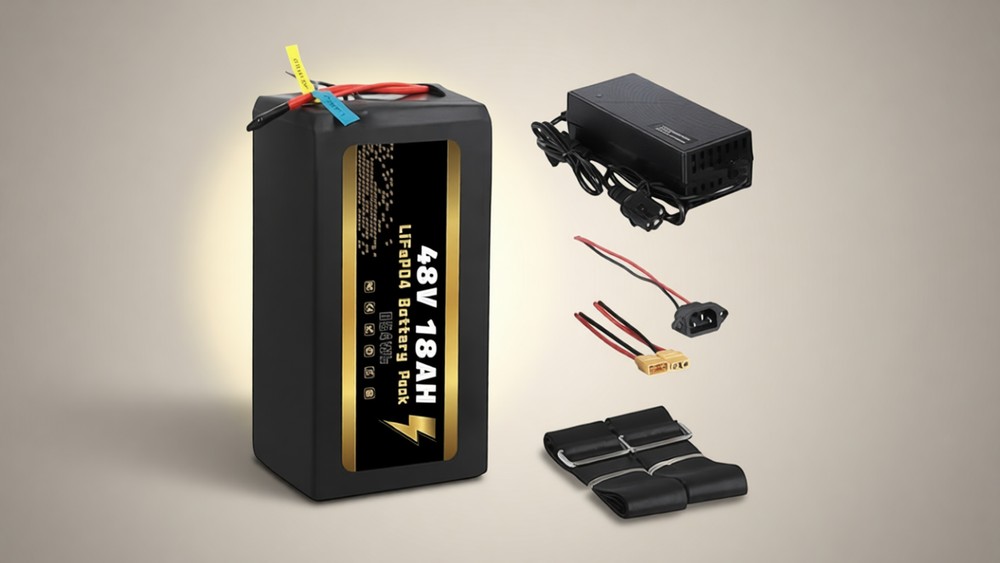
The BtrPower 48V/52V 15Ah LiFePO4 pack is the safe-chemistry pick at a mid-table price: LiFePO4 cells that resist runaway overheating even when punctured, a 40A BMS that budget LiFePO4 rarely carries, and cycle claims of 1500 to 2000 against the 500 to 800 typical of NMC. The honest catch: this listing had zero customer reviews at our scrape, so the buy rests on specs and the brand's record from its other packs. Apartment dwellers and indoor chargers win here, and weight-critical builds should look at NMC.
What LiFePO4 buys you over NMC
Safety is the reason this cell type exists. LiFePO4 cells resist runaway overheating even when punctured, which changes what happens in a crash, and a worst failure makes fewer toxic fumes than NMC. No lithium cell type is abuse-proof, but the margin here is far wider, and that margin is what you're buying with the extra cost over cheap NMC packs.
The cycle-life case grows over years. LiFePO4 typically reaches 1500 to 2000 cycles before it fades to 80 percent charge. NMC packs land at 500 to 800. For a daily rider charging every night, that gap is the gap between swapping a pack every couple of years and swapping one every five or six. The first price gap looks small in that frame, which is the honest way to compare the two chemistries: not price at checkout but price per year of service. On that math LiFePO4 usually wins, and the safety cushion comes along without extra charge.
The trade is weight: LiFePO4 is heavier per watt-hour than NMC, and a rear rack takes that without complaint while a weight-critical build does not. Choose based on where the pack lives.
The flat drain curve, and why your gauge lies
LiFePO4's voltage hardly moves across most of its charge, so a charge bar sits near full for miles, then falls suddenly near the end. Battery guides are blunt about this: voltage is a poor guide of remaining charge in the 20 to 90 percent range for this cell type. The behavior is normal, not a fault, but it changes how you plan.
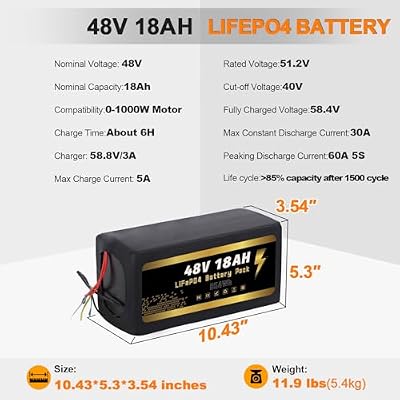
The honest arithmetic: 720 watt-hours nominal, about 580 to 620 watt-hours usable after depth of discharge. At 15 to 20 watt-hours a mile on pedal assist, that is 29 to 41 miles. Throttle-only at 25 to 30 watt-hours a mile gives 19 to 25 miles.
The practical habit: ride the first week to learn where the drop lands on your routes, trust the odometer over the bar, and plug in earlier than the gauge suggests. The sudden tail catches riders who wait for the red light, and the last hill before home is where that mistake gets expensive.
One more gauge note specific to this pack: the BMS's low-voltage cutoff arrives abruptly at the end of the flat curve, so the gap between one bar and none can be a single mile rather than a gentle warning zone. Riders converting from NMC packs notice this most, because NMC gauges fade gradually and LiFePO4 gauges do not. The fix is a habit change, not technical: pick a mileage to charge from based on your first week's data and stick to it.
The 40A BMS, soft-pack cells, and the charger rule
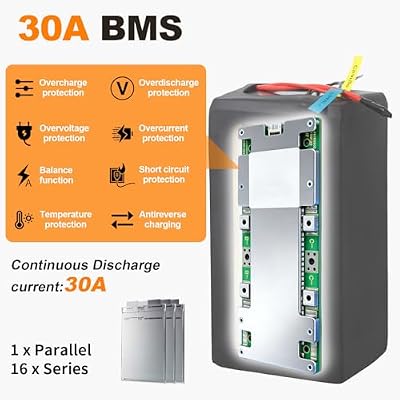
A 40A BMS is unusual at this price. Budget packs of this cell type run 25 to 30A. At 48V-class voltage it covers most 500W to 750W hub motors without clipping, and the seller's motor limit is about 960W. A 1000W motor may hit the BMS limit on steep grades, so high-power builds should size up.
The cells are soft-pack polymer rather than cylindrical, a format with EV background and no heavy-metal toxicity. The practical result is a pack that fails differently from round cells and weighs less in the same case size, partly offsetting the cell type's weight cost.
The charger rule is absolute: use the included LiFePO4 charger, because a generic 48V NMC charger charges to a different voltage target and can damage the cells. The pack's 16S layout expects a 58.4V full charge, and a charger built for NMC's 54.6V profile would leave the pack undercharged every time at best. Keep the included brick with the pack, and treat a lost charger as a reason to buy the correct replacement rather than a reason to make do.
The case dimensions, 10.43 by 5.3 by 3.54 inches, fit most rear racks and standard trays, but the soft-pack construction has one handling note: the case is less rigid than hard-shell cylindrical packs, so mounting should shield the case from pinch points rather than clamping it hard. A rack bag or strap mount suits it better than a tight metal cradle. This is the same handling logic EV packs follow, and it costs nothing at install time.
Who should buy it, and who should spend differently
Buy it if you charge indoors or store the bike inside your home, you want a pack that outlasts several NMC replacements, and your motor is 750W-class or under. The safety cushion and cycle life are why you pay mid-table money instead of cheap-NMC money.
Spend differently if weight matters more than safety cushion, because NMC packs are lighter for the same watt-hours. Spend differently if you run a 1000W-plus build, because the 40A BMS ceiling will clip climbs. And spend differently if a review history is what you buy on, because this listing had none at our scrape, while the brand's 30Ah LiFePO4 sibling carries the longer history and our review of it covers the bigger charge. The battery table shows where this pack sits on price per watt-hour today.
Frequently Asked Questions
What range should I plan on?
Roughly 29 to 41 miles on pedal assist and 19 to 25 on throttle alone, from about 580 to 620 watt-hours you can use.
Is it the same voltage as a standard 48V pack?
Yes. The 16S LiFePO4 layout gives 51.2V nominal and 58.4V full, which works with standard 48V controllers.
Can I use any charger?
No. Use the included LiFePO4 charger. A generic 48V NMC charger charges to the wrong voltage target and can damage the cells.
Why does my gauge read full so long?
LiFePO4's drain curve is flat, so voltage hardly moves across most of the charge and voltage is a poor charge guide. Trust the odometer over the bar.
Is LiFePO4 really safer?
It fights runaway overheating even when punctured and makes fewer toxic fumes in a worst failure. No cell type is abuse-proof, but the margin is far wider than NMC's.