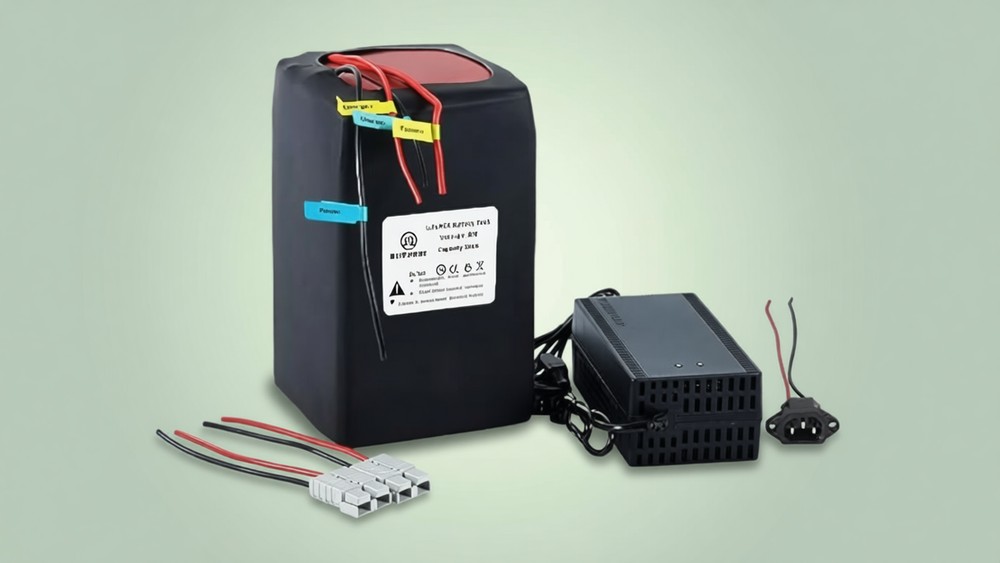
The BtrPower LiFePO4 pack is built for riders who measure ownership in years rather than rides, because the chemistry lasts thousands of cycles and the 50A BMS supports genuinely powerful builds. It sits in the cheapest fifth of our battery table by price per watt-hour, unusual for this chemistry. The costs are real: eighteen pounds, a slow 5A charger, strict cold-weather rules, and one buyer report of a unit that never reached full voltage. High-mileage commuters and big builds win here, and weight-sensitive riders should look elsewhere.
48V or 52V? The label is marketing, the cells are the same
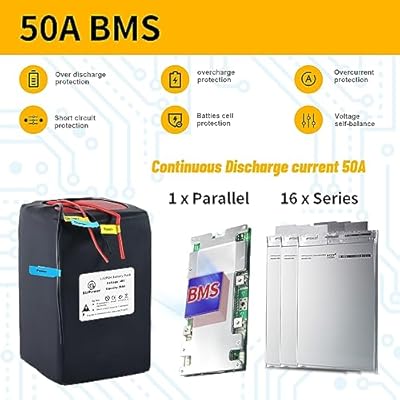
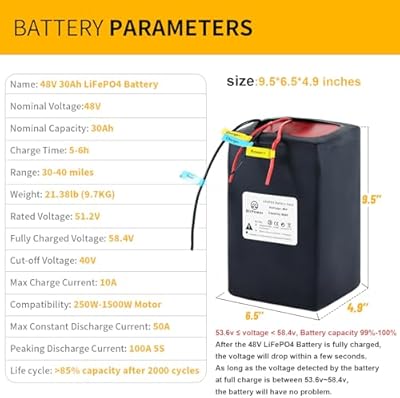
The dual-voltage listing sounds like a feature, and it is really a naming convention. Inside this is a 16S1P LiFePO4 pack, sixteen cells in series, nominally 48 volts. It charges to about 58.4V when full. Some sellers market the identical 16S construction as 52V because the plateau voltage sits higher than a 13S NMC pack, and both labels point at the same cells. There is no switch and no dual-mode electronics.
What matters for your build is the voltage window your controller accepts. A controller built for 13S NMC packs tops out near 54.6V full, and a 58.4V LiFePO4 full charge can exceed its ceiling and trip protection or damage electronics. Check the controller specification for its maximum input voltage before you order, and buy the label that matches your system. The cells do not care what the listing says.
If your system cannot take the full charge voltage, the failure modes are annoying rather than subtle: charging cut-offs, BMS trips, or a pack that never reaches full. None of that is a defect, it is a mismatch, and it is avoidable with five minutes of reading your controller's spec sheet.
Range math, and the flat-curve display trap
Start with the pack: 48 volts times 30 amp-hours is 1440 watt-hours nominal. Depth-of-discharge limits put usable energy at roughly 1150 to 1250 watt-hours.
Consumption next. Pedal-assist riding at 15 to 20 watt-hours per mile gives you 57 to 83 miles. Throttle-only at 25 to 30 watt-hours per mile lands between 38 and 50 miles. BtrPower's own claim of 30 to 40 miles without pedaling sits inside that throttle band, which makes it one of the more honest range claims in the category.
The LiFePO4-specific trap is the discharge curve. This chemistry holds its voltage remarkably flat for most of the cycle, then falls off a cliff near empty. Displays that estimate charge from voltage read high for hours and then drop suddenly, so the bar that says half-full at lunch can be nearly empty by dinner. Plan trips around watt-hours consumed or a coulomb-counting display rather than the voltage bar, because the cliff gives you almost no warning.
LiFePO4 trade-offs: the weight, the cold, the lifespan payoff
Eighteen pounds for 1440 watt-hours is normal LiFePO4, and it is heavier than an equivalent NMC pack by a meaningful margin. That matters if you carry the battery upstairs, lift it into a car, or bring it inside every night. The weight is the chemistry, not bad engineering, and no amount of shopping around changes it within this cell type.
Cold rules are stricter too. Capacity drops noticeably below freezing, and charging below 0C without reduced current causes permanent damage to the cells. A winter rider needs a plan: bring the pack to room temperature before charging, and expect shorter range on the coldest days. A frozen pack should thaw before it sees a charger, full stop.
The payoff is lifespan. LiFePO4 typically delivers 2000 to 3500 real-world cycles against 500 to 1000 for standard NMC packs, and it tolerates deep discharges and full-charge storage that age NMC chemistry quickly. For a rider putting serious miles on a commuter, the heavier pack is the cheaper one over four years, because you buy one instead of two or three.
The 50A BMS, and what it unlocks
A 50A continuous ceiling at 48V supports roughly 2400W of draw, which is far past any stock ebike controller and into DIY high-power territory. This is the pack's real niche: a 1000W or 1500W build that would bottleneck on a common 30A BMS runs without the pack limiting the controller.
One caution from buyer experience applies at first charge. A documented BtrPower LiFePO4 buyer reported a pack that topped out near 56.6V instead of the rated 58.4V and never reached full. The check is simple: note the voltage your pack reaches on its first full charge, and raise any undershoot with the seller while the return window is open. It takes one glance at a display and catches the failure mode early.
The included 5A charger is honest about being slow. A 1440Wh pack fills in roughly six to eight hours from empty, so overnight charging is the natural rhythm. A faster charger is a separate purchase if your schedule needs it.
Who should buy it, and who should spend differently
Buy it if cycle life is money in your riding, because 2000 to 3500 cycles changes the cost-per-mile math for a daily commuter. Buy it if you run a powerful controller that starves on 30A packs, because the 50A BMS does not bottleneck. Buy it if you want the most stable chemistry in the segment and accept the weight as the price.
Spend differently if you carry the pack daily, because NMC saves pounds for the same energy and your back will notice. NMC packs play exactly that trade, saving weight at a lower cycle count, and the current 48V 30Ah LiFePO4 listings show where the price sits today. Spend differently if you ride freezing winters without a warm place to charge, because the cold rules are unforgiving. And spend differently if you want the lightest possible build, because LiFePO4 will never win that contest. The live price-per-watt-hour comparison across chemistries is on the battery table.
Frequently Asked Questions
Is this battery 48V or 52V?
It is one 16S1P LiFePO4 pack sold under both labels. Check your controller's maximum input voltage against the 58.4V full-charge figure, and buy the label that matches your system.
How far can I go on one charge?
Roughly 57 to 83 miles on pedal assist and 38 to 50 on throttle alone, from about 1150 to 1250 watt-hours of usable energy.
Why is the battery pack so heavy?
LiFePO4 chemistry stores less energy per pound than NMC, and eighteen pounds for this capacity is normal for the chemistry. The weight buys the long cycle life.
Can I charge this battery in the winter?
Not while it is frozen. Charging below freezing without reduced current causes permanent damage, so bring the pack to room temperature first.
How long will the battery last?
Expect 2000 to 3500 real-world cycles, several times a typical NMC pack, which is the entire reason to choose this chemistry.