Buying one intercom instead of a pair changes what you should be checking. A two-pack purchase is mostly about two people who always ride together. Any single unit has to earn its place in a mixed world of Senas, Cardos and whatever your friends already own.
The ASMAX F1s makes that check awkward. Its listing says the pack talks across brands, with a compatibility caveat in brackets, yet no buyer in the recorded reviews has confirmed pairing it with anything except another ASMAX. Happiest single-unit buyers use it solo: calls, navigation and music, with no group to join.
This review walks through what the written reviews cover for the single unit, where the battery and button complaints land, and what the cross-brand claim is actually worth before you spend single-pack money.
An ASMAX F1s bought solo makes the most sense for a rider who wants calls, navigation and music on one helmet, and the happiest single-unit buyers use it exactly that way. If you are buying one to join friends riding Senas or Cardos, the cross-brand claim is the part nobody has confirmed, and you will not get their mesh group either way. For a pair, the 2-pack version is the one to compare against.
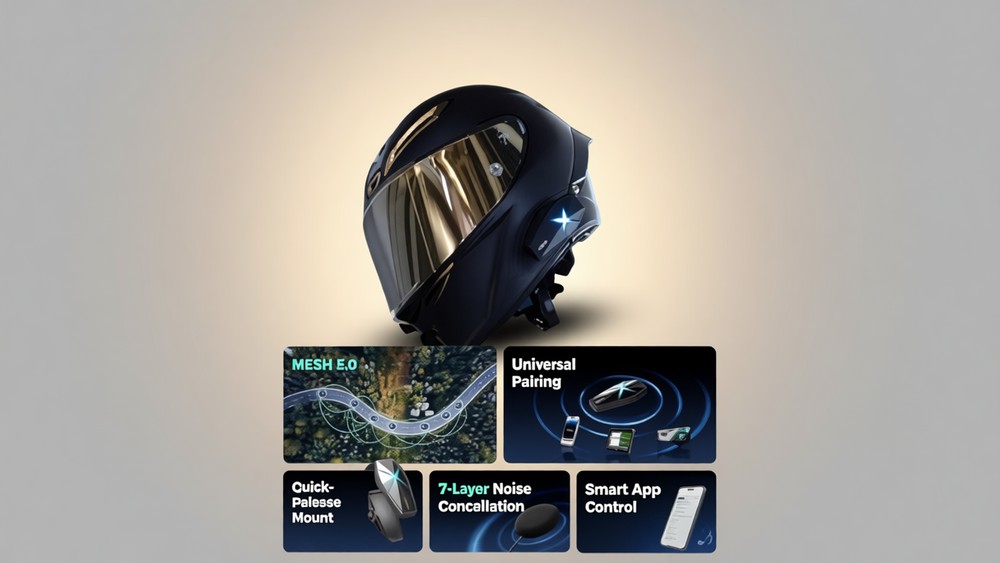
Buying one to join a Sena or Cardo group
The listing claims CloudTalk lets you talk to different brands through a universal pairing, but no buyer has actually reported getting the F1s to work with a Sena or a Cardo. Two buyers who praise the fast pairing are both linking ASMAX kits to each other. One even replaced their old Cardo with an ASMAX so the whole group could run the same gear.
Since universal pairing is just standard Bluetooth, where one unit presents itself as a phone and the other calls it, you get a one-to-one link at best. Mesh networks stay inside each brand, which means even Cardo and Sena units have to fall back on Bluetooth to talk to each other.
CloudTalk runs over the phone network to bridge gaps between brands, but no buyer describes using it that way, so treat it as a spec-sheet feature until someone confirms it in the wild.
Where a single unit shines: phone, maps and music
One owner has replaced a fifteen-year-old Sena headset because the case cracked, and they now run an iPhone for Calimoto turn-by-turn maps while an MP3 player handles music at the same time. The box includes both a wired mic and a boom mic, so you have options whatever helmet you ride. Another buyer still hears it clearly at speed.
Another rider has used the F1s for thousands of miles in all weather, and says it ticks ninety-five percent of their boxes after previously owning Cardo gear.
The volume is loud enough that one buyer did not need the full setting at highway speeds, though another found their ears ringing after just thirty minutes of use.
Voice control works without the phone. The 'Hi Max' wake word runs on the headset itself, so the commands keep working when the phone is off or out of reach. The 40mm speakers handle both music and calls, and Bluetooth 5.3 runs on a dual chip.

Battery, buttons and the voice assistant
The 1250mAh battery carries claims of 22 hours of talk and 35 hours of music, a full charge takes 50 minutes, and the F1s works while it charges. One owner has noted it will not last as long as their Sena, but another has run a 3 to 4 hour ride without issue and watched the charge drop slowly over many short rides.
Three buyers say the buttons are easy to confuse when they wear gloves, and the 'Hi Max' voice control works for some but fails for others. One Spanish-speaking buyer finds the voice commands not very useful, though others find them convenient.
Mounting took some trial and error for one rider on an LS2 Challenger helmet, but it worked out, and support has replaced a faulty unit quickly after some checks. The spec table lists a two-year warranty.
The hardware kit covers the install basics. Mounting runs on a non-magnetic quick-release plate, the IP67 rating handles rain and wash-downs, and the app pushes firmware updates over the air. That last one matters in practice: one owner says voice recognition has gotten better since they bought it, which is the kind of fix that arrives without buying anything.
One now, a second later costs more per unit
Buying one unit puts the F1s in the pricier third of the intercoms we track by price per rider. The two-pack works out cheaper per headset, so buying two singles separately costs more than getting the pair does.
If you know a passenger or a regular riding partner is coming, the pair is the cheaper route from the start. Buying one now and a second later means paying the single-unit price twice, and the per-unit saving only exists on the two-pack.
One detail worth knowing before you decide: the single-unit buyers happiest with the F1s are running it solo, and the two-pack reviews are mostly from riders who got both units at once. Your purchase shape should match how you actually ride. A solo commuter who wants calls and music has the strongest case here. A rider whose group already runs another brand should count on a basic Bluetooth link and nothing more.

FAQ: the unconfirmed cross-brand link, the battery against a Sena and the glove-time buttons
Can the F1s talk to a Sena or Cardo?
The listing claims cross-brand connectivity, with compatibility varying in brackets. No recorded buyer has confirmed it. Cross-brand intercom works over standard Bluetooth by one unit presenting itself as a phone to the other, so expect a basic one-to-one link at best, never the mesh group.
Does CloudTalk actually work?
CloudTalk routes up to 50 riders over the internet through 5G or 4G. No single-unit buyer has reported using it, so it stays an untested claim as far as owners go.
How long does the battery last?
The claim is 22 hours of talk from the 1250mAh pack. One single-unit buyer says it will not last like their Sena. Another reports one 3 to 4 hour ride was fine, then 80 down to 30 percent over many short rides.
Is it loud enough for highway riding?
Loud enough that one buyer's ears rang after 30 minutes. Another stayed well under full volume at speeds well over the limit.
What about the buttons and voice control?
Three buyers say the buttons are easy to confuse, especially with gloves on. Voice control is mixed: some find it convenient, one finds recognition unreliable, and one Spanish-speaking buyer finds it not very useful.