Road-bike conversions live or die on wheel size, and 29-inch front hubs are the rarest corner of the kit market. This ZGEXING listing sells a 48V 1000W gearless front wheel for a 29-inch road frame, with a dual-mode controller that promises to keep running if the Hall sensor fails, and a price that puts it in the cheapest fifth of the 191 conversion kits we track.
The score looks unbeatable. Seven ratings, all five stars, no blemish anywhere. Then you read the four texts behind the score, and only one of them carries a purchase badge.
The short verdict: the ZGEXING 29 inch 48V 1000W front wheel kit is a genuinely cheap 29-inch conversion whose perfect rating rests on thin evidence, and whose one verified owner has written the most useful controller-commissioning guide in this price band. It earns a look if your road bike takes a 29-inch front wheel and you accept that the install is a project. It does not earn trust from its spec table, which answers questions nobody asked.
A perfect score built on three unbadged texts
The rating block reads 5.0 out of 5 from 7 global ratings with a 100 percent five-star histogram. The written record is four texts, and three of them carry no purchase badge. Two of those three landed on the same day, August 11, 2026.
One praises the kit as powerful and straightforward to install. One praises the delivery speed as faster than what the pictures show, which is a comment on shipping rather than a motor. The last says it is easy to install and performs well when ridden.
None of that is damning on its own. Together it means the perfect score is presentation rather than a body of ownership, and a buyer should read the one badged text as the record.
Three wordless five-star ratings say somebody was satisfied. They do not say why, or for how long.
The one owner who wrote a guide
The verified text, from June 2025 with six helpful votes, is five stars that read like a working document. Its author has built three ebikes, and the theme is that the first days with a kit controller are the same everywhere: glitches and initial problem-solving are expected, written instructions are sketchy, and controllers in general arrive with command problems between display, motor, and brain until they learn each other.
The advice is concrete. Double-check every connection. Follow video walkthroughs that match your bike rather than trusting the sheet in the box.
Then the warning that justifies the whole text: do not hold the motor wide open for long stretches, because the controller overheats and starts throwing codes on the display. One owner has flagged exactly this limit, and the lesson costs nothing to apply. Ride it like a 1,000W assist rather than a 1,000W throttle machine and the hardware, in this owner's experience, settles down and works with no issues.
That single text converts the listing from a spec sheet into a procedure. Budget an afternoon for install, expect a debugging session before the first clean ride, and keep the throttle honest. Nothing else in the record contradicts any of it.
A spec table that answers questions nobody asked
The table underneath this kit is a case study in template noise. One row reads Lithium Battery Energy Content 13000 milliamp_hours, which measures an energy content in a charge unit. Read generously, it is the capacity of the pack the designer expected: 48V at 13Ah is about 624Wh, a sensible size for a 1,000W motor, and no battery ships in the box.
Another row reads Battery Life 13 hours with no load or mode stated, which is not a measurable claim for a hub motor at all.
Then come the drivetrain rows. Gear Type cassette and Derailleur Configuration Rear, on a kit whose whole product is a front wheel.
Number of Speeds 5 on a gearless hub, where five speeds can only mean five controller modes. A Maximum Weight Recommendation of 264 pounds sits in the table while the item's own weight appears nowhere. The Warranty Type row says Limited and never names a term, which is worth knowing before the controller throws its first code.
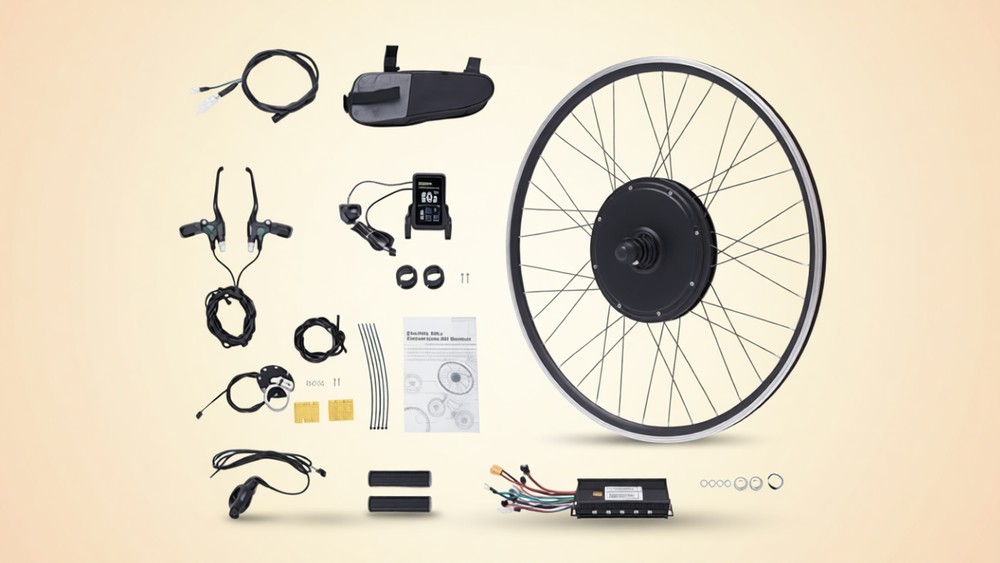
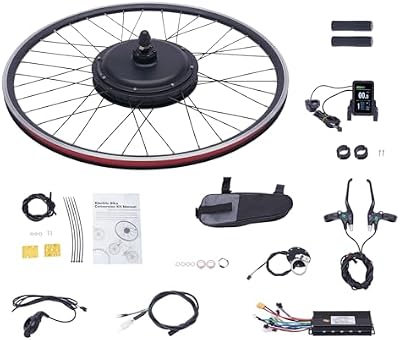
The row that matters most is Included Components, and it names exactly one item: 1* Motor Wheel.
The bullets, by contrast, describe a dual-mode controller, power cut-off brake levers, a pedal assist sensor, a display, and a cruise button. Both cannot describe the same box. Ask the seller what ships before you order, because the difference between a motor wheel and a complete kit is the whole purchase.
Dual mode, cruise, and the speed claim
The kit's one genuinely distinctive claim is the dual-mode controller: it runs the motor with Hall sensors, and switches to sensorless mode if the sensor fails. That fallback has a specific value.
A Hall failure on a single-mode controller ends the ride. On this design it degrades it, because sensorless running starts the motor more weakly and works best once the wheel is already turning. The fallback is a limp-home feature, and the listing is right to advertise it, though no owner has reported ever triggering it.
The cruise function, entered by holding the button for 2 or 3 seconds at a steady speed, is the same convenience road riders know from cars. On a 29-inch front hub it is also the feature that most tempts a rider toward the exact sustained full-throttle running the verified owner warns against.
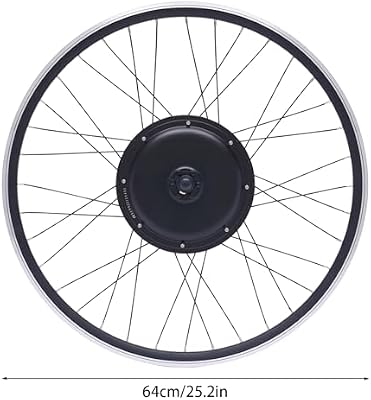
The speed claim reads 45 to 55km/h from the 1,000W gearless motor. No rpm figure backs it. A 29-inch wheel rolls roughly 2.1 to 2.3m per turn depending on tire, so the claim needs about 330 to 440rpm, which sits inside the normal no-load band for a 48V gearless hub.
Plausible, unverifiable, and lower in practice, as every no-load figure is. A gearless direct-drive hub is the simple, durable, and affordable design in this market, and it trades low-end torque for exactly that simplicity (Wikipedia).
Cheap enough to budget for the unknowns
On price this kit is one of the cheapest in our conversion kit comparison table, and cheap changes the math on every open question. A pack sized near the 624Wh the table hints at, a BMS rated for at least 21A of draw at 48V, and an afternoon of connection-checking is the full cost of a 29-inch road conversion. No competing kit at this price carries the dual-mode fallback.
Two things should still be settled before ordering. First, what ships: the parts row names a motor wheel alone, so get the controller, levers, sensor, and display confirmed in writing. Second, the front-mount trade itself, because motor mass on the steering wheel changes handling more than any spec row admits, and road forks are rarely built for the load.
Our Yuasduu 700C review covers the same wheel size on a 28 and 29-inch listing, and our Ddyook 28-inch review documents a front-or-rear dispute on a near-identical motor class.
What would move this kit from cheap-and-promising to recommended is evidence. A second badged text covering range or a hill climb would do it. Until the record grows, buy it for the price and the fallback controller, and treat the five stars as marketing.
FAQ
Does the 5.0 rating mean the kit is proven?
No. Seven ratings produced four texts, three of them without a purchase badge, two of those on the same day, and one about delivery speed. The only badged text is a controller guide, not a ride report. The score is real but the ownership behind it is one deep account.
What battery should I pair with it?
No battery ships. The table hints at a 48V 13Ah pack, about 624Wh, and the motor's 1,000W draw at 48V is about 21A, so a BMS rated for at least 21A continuous is the floor. You can browse 48V ebike batteries on Amazon to compare packs in that range.
How fast will it go?
The claim is 45 to 55km/h with no rpm figure behind it. The wheel arithmetic puts that inside the plausible no-load band for a 48V gearless hub, and real riding speed sits below any no-load figure. No rider has published a measurement.
What does the dual-mode controller actually do?
It runs the motor with Hall sensors and falls back to sensorless mode if a sensor fails. The fallback keeps you riding home on weakened starting rather than leaving you with a dead motor. No owner in the record has triggered it, so treat it as designed insurance rather than a tested feature.