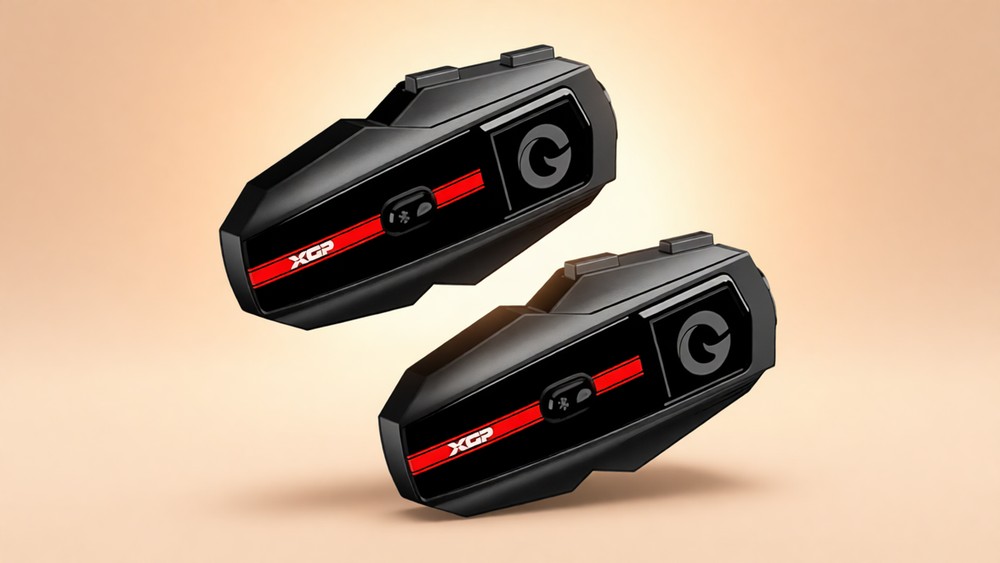
Rider-to-passenger talk is the entry point for helmet audio: two people on one bike, short range, no group management, and no reason to spend flagship money. XGP sells that pair as a two-pack at the low end of the price table, with a big battery figure and an IP67 rating on the box.
Its listing is louder than the hardware. A title advertising Bluetooth 5.4 sits over a spec table that says 5.2 twice, and one of the buyers confirms the older version arrived. That same table puts a 1,000-meter intercom claim beside a 50-meter Bluetooth row and three different battery-life figures.
The buyer record settles into a pattern worth reading before ordering. Around town, owners like these units.
At highway speed, four separate texts across four star bands report the same problem, and the fixes they found cost nothing but repositioning. Support stories split both ways, which says test both units early.
The XGP two-pack sells for 40.99 when I checked, a 4.1 average from 1,145 ratings behind it, and a price-per-rider position near the middle of the 192 intercoms we track. It is a budget unit that does its best work below highway speed, and the listing's headline spec is contradicted by the listing's own table. See the current XGP two-pack price on Amazon.
What 1,145 ratings say about a forty-dollar pair
The rating shape tells the story before any text does: about six in ten of the 1,145 ratings are five stars, but eight in a hundred are one-star, a heavy tail for a product this cheap.
The written record is small and unusually reliable. Every text in it, seventeen in total, comes from a confirmed purchase, including both non-English five-star notes. The most-endorsed text has drawn 84 helpful votes and carries the most detailed account in the record: a 30-year rider who commutes on a Ducati Monster, bought the pair to talk with their son, and likes the units around town.
What nobody in the record has done is test the parts of the listing that are hardest to verify.
No text describes using the music-sharing feature at any length. No text has soaked a unit to test the IP67 claim. Nobody reports measuring the 20-hour music figure, and the closest data points are an eight-hour trip that never hit the low-battery prompt and two full days of riding between charges.
The listing argues with itself
The version fight is the headline problem. The title and bullets say Bluetooth 5.4 with a dual chip.
The spec table says Bluetooth Version 5.2 and names a Qualcomm V5.2 chipset, and one owner writes plainly that they bought the v. 5.2 units. A version number governs phone-pairing features and power draw, so this matters less than it looks, but a listing that disagrees with its own table about its headline spec earns distrust.
The same table carries more collisions. Intercom Range reads 1,000 meters while Bluetooth Range reads 50 meters in the next row.
Talk Time reads 35 hours against a Music Playback Time of 20 hours and an Intercom Talk Time of 15 hours. Item Weight reads 1.06 pounds while Product Weight reads 0.08. The Frequency Response row says 2,402 MHz, which is the Bluetooth operating frequency, not an audio figure any speaker owns.
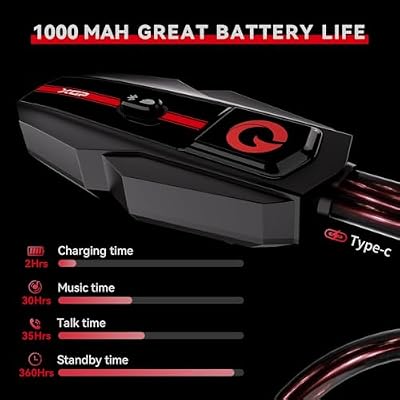
The real feature list is more ordinary. Each headset carries a 1,000mAh battery charged over USB-C in about two hours, 40mm drivers, a three-button layout with a jog dial, and a choice of mounting hardware: clip or adhesive pad for the unit itself, button mic for a full-face helmet or boom mic for modular and open-face lids.
One owner notes the units also pair with other brands and with a GPS device without drama.

Highway speed is the dividing line
Four texts, spread across four different star bands, describe the same failure. A three-star says road noise made intercom choppy over 60 mph.
A four-star calls it a little quiet over 60. The 84-vote five-star reports voices drowning out on the highway and in large groups while town riding stays fine. A one-star simply could not hear their passenger while riding, though the same two units worked when parked.
That consistency across owners who disagreed about everything else is the most useful fact in the record. The physics behind it is not the product's fault alone: wind noise inside a helmet reaches about 90 dB at 40 mph and 100 dB at 60 mph, while the shell cuts only 7 to 10 dB, and the noise processing these units advertise cleans the outgoing microphone for the listener, not the incoming audio for the rider.
The fixes owners have found cost nothing. The four-star author moved the speakers to the outside of the helmet pads and reports any volume concerns resolved once they sat right.
The 84-vote author added thin foam behind the drivers to pull them closer to the ear and tuned the sound with a phone EQ app. An 18-vote text riding loud-exhaust bikes reports the volume more than adequate even at highway speed. The seller also offered a software update that raised the volume, and the update's recipient reports a clear improvement.
The range claim against the range reports
The listing claims 1,000 meters of group intercom. The owners report something shorter: a few city blocks from one, and talk-while-visible-in-your-mirrors from another. Neither is close to a kilometer, and both are honest descriptions of how two riders actually space themselves on the road.
That gap matches the category. An intercom range figure is an open-terrain, line-of-sight maximum, and real riding cuts it to roughly 30 to 50 percent of the claim. Bluetooth itself is a short-range radio: its most common mode manages about 10 meters, stronger radios reach 100, and even the 5.0 class tops out around 400 meters in open air.
The rider-to-rider link is vendor-built on top of that, which is why the version number in the title was never the range lever.
Riders who need more distance have a real option in XGP's own lineup: the X10 mesh unit relays through each helmet in a group, and one owner of these headsets reports their older pairs connect to it through the mesh feature.

Quality control and support, both split
The failures in the record are specific rather than vague. One owner installed a second unit about 60 days after purchase and found the volume stuck on full with the down button jammed, outside the return window. One charger failed after a single use.
One unit died in a week, its replacement died too, and the seller then asked that owner for a video of the charger, which they read as an accusation.
Against that sit three separate support stories. One owner got an answer within an hour where Amazon promised 48.
One received a prompt replacement when a unit failed. One worked through the volume-update process with a seller they describe as friendly. The record does not settle into a clean story in either direction, and the honest read is that the odds are decent but not certain.
One more battery note belongs here: an owner reports the charge draining quickly in standby, even with the units powered off. Top off before a ride rather than trusting last weekend's charge. And test both units early, inside the return window, because the one hardware failure that arrived late cost its owner the return.
Frequently Asked Questions
Is it Bluetooth 5.4 or 5.2?
The spec table says 5.2 twice and names a V5.2 chipset, and one owner confirms the 5.2 units arrived. The title's 5.4 claim is the outlier. Either way, the version number does not control rider-to-rider range.
Does it work at highway speed?
Degraded, per four texts in four star bands: choppy, quiet, or drowned out over 60 mph. Speaker repositioning and a phone EQ helped several owners, and one reports a seller-provided volume update improved it.
Is there a push-to-talk button?
No. The intercom is voice-activated with an open microphone, so wind and breathing pass through continuously, and one owner reports screeching when the two units sit too close together.
Is it really waterproof?
The rating is IP67, which means dust-tight and a 1-meter fresh-water immersion for 30 minutes in a lab. Nobody in the record has soaked one, so the rating is untested by buyers. One owner describes the units as water resistant and durable in rain.
Will it pair with other brands?
One owner reports smooth pairing with other brands' intercoms and with a GPS unit. That is a one-to-one Bluetooth link, not a group, which is how cross-brand connections work across this whole category.
How does it compare with the XGP X10?
The X10 adds mesh, which self-heals a group when riders drop out of range, and these two-packs connect to it over that mesh feature. For a rider-plus-passenger pair that never splits up, this two-pack is the cheaper tool for the job.