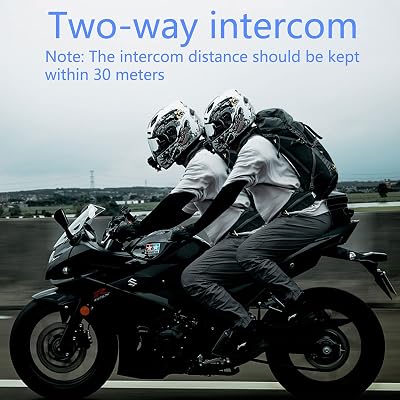
Most intercom listings promise distance they cannot deliver, and the first thing I check now is whether the range claim survives contact with the owners. The Wipeeyes E1 is the rare budget unit that tells you the truth up front. Its intercom reach is 30 meters, the spec table says so plainly, and the listing never dresses that number up as something bigger.
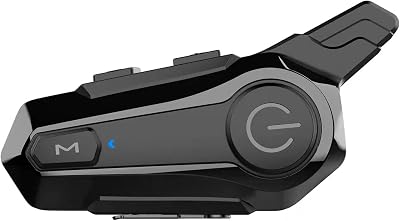
That honesty makes it easy to place in our intercom comparison table. On price per rider it sits in the cheaper third of the 192 units we track, and the listing asks you to believe no distance beyond those 30 meters. See the current Wipeeyes E1 price on Amazon.
The listing showed 36.99 when I checked, a few dollars above the price our table still carries, so read the table for the standing number and the listing for the day's.
What follows is what the owner record actually supports, and the record here is deep enough to trust in one specific way: with 2,476 ratings, the averages are stable, and the detailed texts let me split the loud from the quiet by cause rather than by complaint.
A big record that splits down the middle
The headline is 3.8 stars, and the shape underneath it is genuinely split. Five-star ratings take 51 percent of the total, but one-star takes 12 percent, with the rest spread evenly across the middle at 16, 13, and 8 percent. There is no dominant middle here.
Owners cluster at delighted or disappointed, and the theme counts Amazon generates from the review text show which way each cluster leans.
Installation is the closest thing to unanimity in the whole record. Of the 126 owners who mention setup, 120 call it easy, and the detailed accounts back that up, one describing a helmet with speaker recesses that made the whole job a matter of dropping the parts in place.
Value for money runs 196 positive against 80 negative across 276 mentions, which is a strong showing for anything at this price.
Sound is where the agreement ends. Sound quality splits 150 positive to 160 negative across 310 mentions, and volume runs worse, 45 positive to 94 negative. Call clarity and noise level both lean negative too.
So the record says you will probably find this easy to fit, probably feel fine about the money, and roughly a coin flip on whether the audio is loud enough for your helmet and your bike. The reasons for that split are more interesting than the split itself, and they come later in this review.
The 30-meter claim, confirmed by the one owner with a distance
Amazon review sections are full of range opinions and empty of range measurements, which is why one account matters so much here.
An owner who bought two units for communication between two bikes reports that the intercom held while riding together but disconnected as soon as the other rider fell about 100 feet behind, or whenever anything solid sat between them. One hundred feet is roughly 30 meters. The claim on the box and the one distance any owner reports agree almost perfectly.
That agreement also tells you what the hardware is doing. Standard Bluetooth transmits at low power, typically reaching under 10 meters and about 100 meters in the best case (Wikipedia), and the E1's own spec table files its phone connection at 10 meters.
The intercom side stretches a little beyond that, but it is not using the vendor long-range modes that let other budget units claim 800 meters or more. Those modes trade data speed for distance, and the E1 does not make that trade.
So the honest way to see the E1 is as a passenger and side-by-side intercom. Talk to someone on the back of your bike and it works all day.
Ride a sidecar rig or ride close formation and it works. Fall back on a twisty road, put a truck between you, and the link drops, exactly as the spec table warned. The 12 percent one-star share in the histogram is the share of buyers who expected the numbers the rest of the category advertises.
Volume is where owners split
The volume count, 94 negative against 45 positive, looks like a defect rate at first, but the detailed texts show a different pattern, and loud bikes sit at the center of the worst accounts. One owner reports the headset nowhere near loud enough at full volume even on city streets at low speed, and never attempted the highway on it. A short text puts the usable ceiling at about 30 mph.
A second owner, using the E1 as her own headset, reported her husband on the other end hearing constant wind and gear noise through the microphone, loud enough that the rides turned into shouting, and she replaced the pair with the cheapest Cardo within two months and calls the difference night and day.
Against that, an owner who initially thought the E1 was quiet discovered the actual problem was speaker placement. Once the speakers sat flush against the ears, the headset got loud enough to hear on the freeway at high rpm, and that account carries the useful lesson: the E1's volume depends on where the speakers end up in your helmet, which depends on how much room your helmet gives you.
A third owner reports the opposite experience entirely, calling 25 percent volume right for them and full volume too much.
I read the pattern this way. The speakers are small, the amplifier is modest, and the whole system leaves a narrow band between too quiet and loud enough.
Where you land inside that band is decided by your helmet's ear pockets, your earplugs, and your exhaust, none of which Amazon can measure. If you ride loud and fast, the theme counts say you will join the disappointed half, and no amount of careful setup changes the physics. If you ride a quiet bike or carry a passenger, the same counts say the volume will not be your problem.
What the spec table gets right, and one row that doesn't
The table gets the important things right. Bluetooth 5, three physical buttons with the power button as a center circle, no headphone jack, voice assistant support, and GPS voice guidance all match the bullets. Two rows deserve a closer look.
A Kleer row on a Bluetooth 5.0 unit
The Wireless Technology row on this listing says Kleer. Kleer is a proprietary wireless audio standard, a competitor to Bluetooth that appears in some headphones, and it cannot also be the Bluetooth 5 connection the same table files three rows down.
This is a data-feed error, the kind that happens when a seller fills in a spec sheet from a template, and I would not weight it in any buying decision. It is worth naming for one reason: a listing that cannot keep its own radio standard straight is a listing where you check the numbers that matter yourself, which is exactly what the range section above does.
What the 12-hour battery claim has behind it
The bullets promise up to 12 hours of talk, 120 hours of standby, and a full charge in 2 hours through a micro-USB port. The owner record gives pieces, not a verdict. One owner reports the battery lasting through long rides without issue.
Another covered about ten short trips on a single charge. A third account describes the unit quitting charging entirely after two months of use, and the port itself is dated, since micro-USB has given way to USB-C across the rest of the category. No owner in the record describes a measured full-day test, so treat the 12-hour figure as a listing claim that nothing in the record contradicts and nothing confirms.
One more absence deserves naming. The page carries no product warranty term at all, only Amazon's 30-day return guarantee and a link promising warranty information that never states one.
On a 36.99 electronic device that lives outside in the rain, that is a real gap next to rivals that print one- and two-year terms on their own pages, and it shortens the list of people who should buy one to those who can afford the gamble.
Common questions
Is the Wipeeyes E1 worth 36.99? On price per rider it sits in the cheaper third of the 192 intercoms we track, and the value-for-money count backs the price up, 196 positive against 80 negative. If you need rider-to-passenger talk or close-formation communication, the record supports the purchase. If you need bike-to-bike range, no amount of value makes 30 meters into a kilometer, and you should price a long-range unit per rider before settling for the cheapest honest claim in the category. Check the current E1 price on Amazon.
How far does it actually reach? The claim is 30 meters and the best evidence agrees with it. The only owner reporting a distance watched the intercom drop at about 100 feet, which is roughly 30 meters, with obstacles cutting it shorter. Standard Bluetooth hardware like this typically manages under 10 meters to a phone and about 100 meters at best.
Is it loud enough to hear at speed? Split, and decided by your setup more than by the hardware. Riders on loud bikes at highway speed report it is not. An owner who repositioned the speakers against the ears reported freeway-loud audio afterward. If your helmet has deep ear pockets or you ride with earplugs and a loud exhaust, expect the quiet side of the record.
Can it pair with a Cardo or a Sena? No. An owner states plainly that it only pairs with a second one of itself, which is common at the budget end of the market. Both riders need the same brand, so a two-pack or two singles of the same model is the only configuration that works.
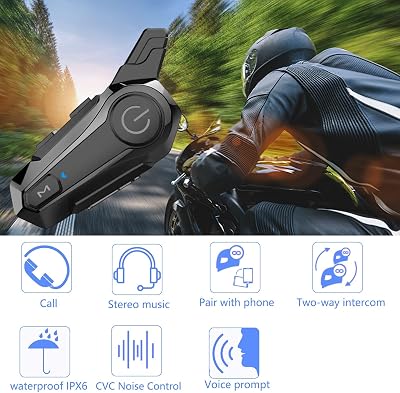
Will it survive rain? The rating is IPX6, which covers water jets and rain but not submersion, since that protection sits at IPX7 (Wikipedia). One owner reports riding in rain and mud with no issues, and another describes the IPX6 rating holding up through light rain. Keep it out of deep water and the rating matches the use.