Most motorcycle dash cams start life as car cameras with a bike-shaped mount bolted on.
The VINGVO Recorder 09011 did not. It shipped with a wired handlebar button, an ignition-triggered power path, and a housing split that put the tougher waterproof rating on the camera pods rather than the recorder box. Then it disappeared, and in the entire time it sold, not one buyer left a written word about the hardware.
A dead listing with zero reviews would normally end the conversation, except the price was the point. At 51.74 for two cameras it sat among the cheapest dual rigs we track, and cheap dual coverage is what riders ask for first. Anyone restocking this category will meet its successors within a week of looking.
What follows records what the listing committed to while it lived, checks the few claims that can still be tested on paper, and turns the rest into a checklist for judging whatever replaces it.
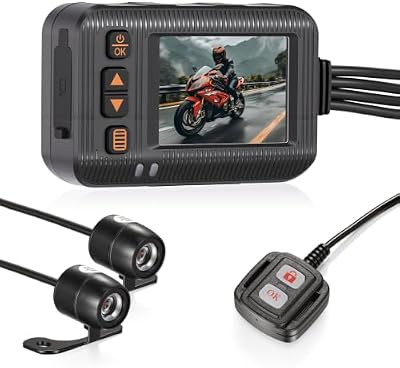
The VINGVO Recorder 09011 was a wired dual-lens motorcycle camera system: a 1080P front pod, a 720P rear pod, a handlebar-mounted controller with a status light, and a recorder box rated IP65 against rain. Its last recorded table price was 51.74, which put it 11th cheapest of the 82 dash cams we track by price per channel.
The listing has since gone Currently unavailable, and it died with zero ratings and zero written reviews, so everything below is built from the listing's own printed claims and nothing else.
A dual rig that died before anyone graded it
Zero is the whole owner record. The reviews page read zero customer reviews while the listing was alive, the star widget never rendered, and the November 2026 recheck still shows no rating at all.
The old version of this review said buyers would be among the first to test the hardware. That window closed without a single test report arriving, so nobody knows how the seals, the wiring, or the cards held up in the rain the listing promised to shrug off.
A zero-evidence listing leaves only two honest ways to write about it. One is to record what the seller claimed, with every claim labeled as a claim.
The other is to turn the gaps into questions worth asking the next listing you meet, because the successor to a cheap dead dual rig is usually another cheap dual rig with the same shape. This review does both.
There is one more thing the death itself tells you. A listing that sells long enough to reach a comparison table and then vanishes often died of supply rather than scandal, since a product with real owners leaves reviews behind and this one never collected any. Read the absence as "never proven", not as "proven bad".
The specs the listing actually committed to
The hardware story, as printed: two camera pods recording at the same time, 1080P in front and 720P behind, feeding a recorder box built from ABS plastic that weighed 3.52 ounces on paper.
The listing attributed the simultaneous streams to an AIT chip and said the pods send their video to the box over lossless AHD transmission so engine vibration does not tear the picture. Both are seller claims about parts we could never open and no owner ever described, so they carry exactly the weight of the printing.
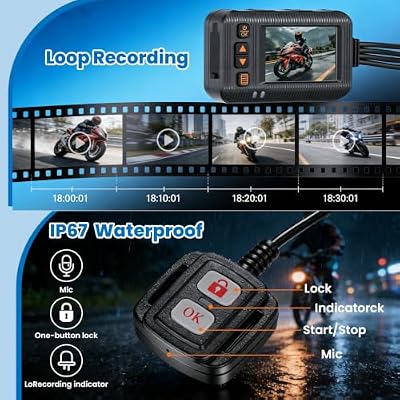
The waterproof split is the one spec pair that holds up under its own logic. The recorder box carried IP65, which covers water jets from any direction and never immersion, while the camera pods carried IP67, which adds a half hour underwater at one meter, as the IP code's own wording spells out. That is how a motorcycle rig should be built.
The pods sit low on the bike where wheel spray hammers them, the box mounts higher where rain reaches but spray does not, and each housing carries the rating its position needs. Whoever specced this pair understood the mounting positions, even if nobody ever tested the seals in rain.
The asymmetry in the cameras matters more than the marketing around it. A 1080P front pod can carry a license plate in decent light.
A 720P rear pod gives up roughly half the pixels, so a plate behind you at night is a blur at best. That trade was priced in: the rear angle exists mainly to prove you were hit from behind, and for that job a smudged plate with a clear timeline still helps.
The 32GB ceiling on two streams
The listing capped storage at 32GB, and that ceiling was the smallest number in the whole spec sheet.
A 1080P dash cam at a typical bitrate writes about 3.5GB per hour, a figure the storage calculators we checked agree on. One camera fills 32GB in roughly nine hours. A second stream cuts that close to in half, and the listing never printed bitrates, so treat the pair as a planning estimate rather than a spec. Even so, a full riding day can start overwriting its morning footage before you reach home.
Loop recording makes that survivable, since the oldest files go first, but survivable isn't the same as useful. The riders who lose the most to a small card are tourers and commuters who ride hours before reviewing anything. The honest reading of a 32GB ceiling in 2026 is that it belongs to an earlier generation of dash cams, and most current rigs accept 128GB or more.
Whatever replaces this listing should be judged on its card ceiling first, because it is the one spec that decides how much of your day survives.
Wiring, the handlebar button, and the parking-mode power question
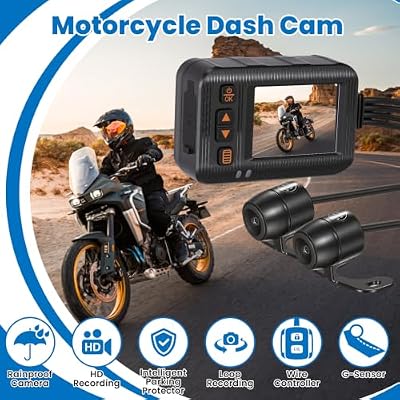
This was not a plug-and-play kit. The power path ran from the bike's electrical system through a step-down line, the camera woke with the ignition and slept when the engine stopped, and a wired button on the handlebar started and stopped recording with an LED confirming the state.
Wired beats wireless on a motorcycle, because a wireless remote loses its battery or its pairing at the worst moment, and a physical button works with gloves in the rain. The wiring itself is the price of that reliability, and anyone uncomfortable cutting and splicing near a bike's electrics should budget for a shop to do it.
The parking monitor is where the listing argued with itself. It promised collision-triggered recording while the bike sat parked, and it also said the system powers on and off with the ignition. Those two sentences cannot both be true without a third thing the listing never mentioned: a circuit that stays live when the key is off.
A g-sensor can't detect a tip-over on a camera with no power. If a replacement listing makes the same pairing of claims, the question to ask the seller is where parking-mode power comes from, and the answer decides whether the parking feature is real or title decoration.
What to check on a replacement dual rig
The 09011's spec sheet doubles as a shopping list for its successors, and every item on it takes five minutes of listing reading to check.
Card ceiling first, because it bounds everything else. Anything still capped at 32GB is carrying an old generation's spec at this year's price. Both resolutions printed second, since a 1080P front paired with a 720P rear is a real trade and some listings hide the rear number.
Power path third: constant power for parking mode, or no parking mode. Waterproof split fourth, with the box and pods rated for their actual positions rather than one badge for the whole kit. Wiring kit contents fifth, because a step-down line, a handlebar controller, and mounts are the difference between a weekend install and a shop bill.
Price is the last check, and it is where this listing was genuinely strong. At 25.87 per camera it undercut most of the dual rigs we track, and cheap dual coverage with a wired controller is a shape worth waiting for.
The dash cam comparison table prices the current field per camera, and the Tewolises 720P dual rig and the Ssontong 25K dual show the two ends of what the same money buys today.
FAQ: the dead listing, the card math and what to buy instead
Is the VINGVO Recorder 09011 still available?
No. The listing reads Currently unavailable as of the November 2026 recheck, with no restock date and no other sellers attached. Any link to its page leads to a dead end until it returns.
Was the VINGVO dash cam any good?
Nobody knows, and that is not a dodge. It sold with zero ratings and zero written reviews from start to finish, so no owner evidence of any kind exists. Everything in this review comes from the listing's own printed claims.
How long can a 32GB card record on a dual dash cam?
At a typical 1080P bitrate, one camera writes about 3.5GB per hour, so a front-and-rear pair turns over a 32GB card in roughly five to six hours of riding. Long ride days will loop over their own morning footage.
Did the parking monitor actually work?
The listing claimed collision-triggered recording while parked, but it also said the system powers off with the ignition, and it never described a constant-power path. On paper the parking feature needed wiring the kit's own description never accounted for.
What should I buy instead?
A current dual rig with a 128GB-or-better card ceiling, both camera resolutions printed, a stated parking-mode power source, and an IP split that matches the mounting positions. The comparison table tracks the field by price per camera.