Cheap 48V capacity usually arrives with a catch, and this one printed its catch in the spec box: no charger. The pack itself captured at 0.22 per watt-hour, which puts it in the cheaper third of everything we track, and the small PVC-wrapped case fits spaces most downtube batteries can't. That listing has since vanished from Amazon, so the numbers below come from the recorded capture, not a live page.
Two things make the pack worth a close read anyway. The required 54.6V charger settles the chemistry question the listing never answered in words. And the missing charger changes the value math, because a first-time buyer's true cost per watt-hour lands well above the row our table shows.
As a package, this was a small pack priced like a small pack, which is rarer than it should be. The 480Wh sits at half the capacity anchor we scale range from, the 20A board honestly covers a 750W motor, and the weight checks out against the rated capacity.
The catches are real too: the board falls about 4 percent short of the title's 1000W ceiling, the UL certification on the title can't be audited by anyone now, and the buyers who metered their packs short left a warning worth reading before you order any successor. Current small 48V listings can be tested against every check below.
The value row and the charger it forgets
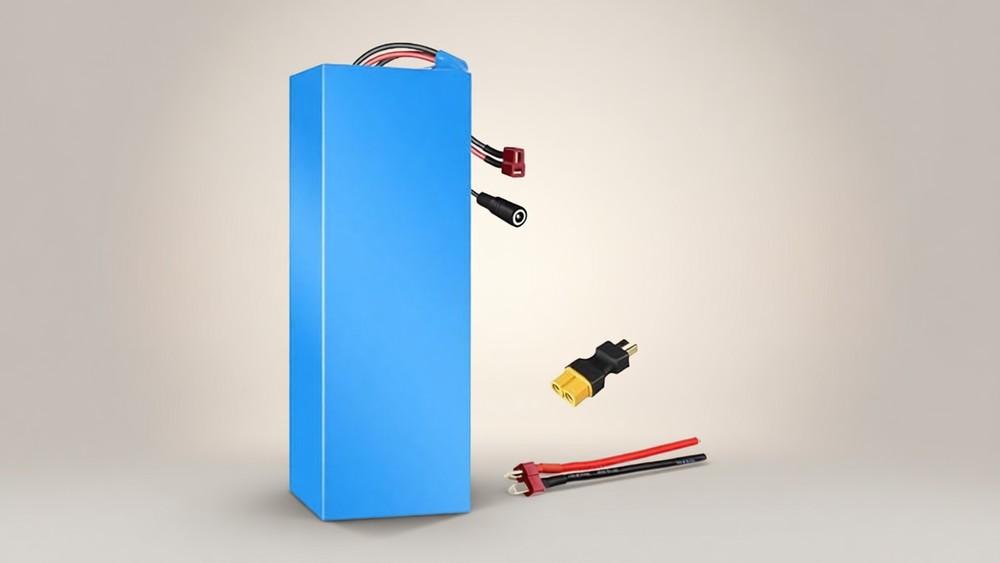
Our comparison data tracks 324 packs by price per watt-hour, and this one sits in the cheaper third of that table, comfortably inside the 48V field's better half. The exact position renders in the specs box on our comparison table. On the row alone, 0.22 per watt-hour for 480Wh is genuinely good value, and it's the reason this pack earned a rebuild rather than a one-line death notice.
The row has a hole in it, though. No charger came in the box, and a 48V pack is a paperweight until it has one. The required charger prints 54.6V at a common 2A, and a working charger adds real money to the true cost of the package.
Add it in and the true cost per watt-hour climbs out of the cheaper third and into the middle of the table. A buyer who already owns a 54.6V charger gets the row price as printed. A first-time buyer doesn't, and should price the pair before calling this a bargain.
The LGNUO 48V 10Ah review covers a same-capacity shell from the same size class, and it's the natural first comparison for anyone shopping this capacity today.
A 20A board under a 1000W title
Twenty amps at 48 volts is 960W of continuous output. The title claimed support for 250W to 1000W motors, and a 1000W motor draws about 20.8A at this voltage, so the top of the claimed range sits about 4 percent past the board. That's a small overreach by this season's standards, where several listings promised motors their boards couldn't power at all, but it's still an overreach.
Plan the build around 750W, which draws about 15.6A and leaves the board working well inside itself. A 500W motor draws about 10.4A, and even the 250W floor pulls about 5A.
The smart BMS protections were recorded in the spec box: over-discharge, over-voltage, short-circuit and temperature cutoffs. That's the standard set, and it's what stands between a PVC-wrapped pack and the failure modes buyers should care about.
The chemistry the charger settles
The listing never said which lithium chemistry the cells use, but the required 54.6V charger answers it. Thirteen cell groups times 4.2 volts is 54.6V, the classic 13S layout for standard lithium-ion cells in the NMC family. A 48V LiFePO4 pack would charge at 16S times 3.65V, or 58.4V, per the Battery University chemistry tables.
So the cells are conventional lithium-ion, which means the 400-to-1,200-cycle band applies rather than the longer LiFePO4 figures, and any replacement charger must print 54.6V.
The UL badge nobody can audit
UL 2271 was printed on the title, and no certificate number was ever recorded in any capture.
A certification claim without a number is a claim, not a fact, and with the listing dead there's no listing page left to check it against. Buyers who cared about the badge were trusting the seller's word. Anyone evaluating a successor listing should ask for the certificate number in writing, and treat silence as an answer.
Fitting a small case into a small frame
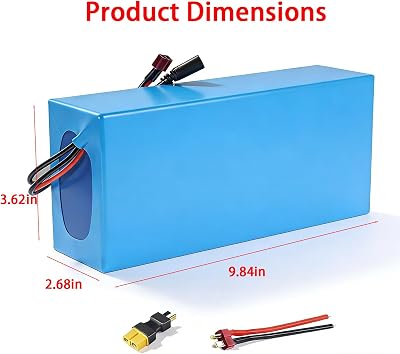
The case measures 9.84 by 3.62 by 2.68 inches, just under ten inches long, and weighs 5.84 pounds. That's a footprint most downtube mounts can take and plenty of frame triangles can swallow, and it's the whole reason a buyer picks a pack this size over a bigger, cheaper-per-watt-hour one.
The weight also passes the density check. 5.84 pounds is 2.65 kilograms, and 480Wh at that mass works out to about 0.18 kWh per kilogram, right at the bottom of the 0.18-to-0.21 band where complete packs usually land. The weight doesn't prove the capacity is real, but it doesn't contradict it either, which matters given the complaints below.
A pack that metered 20 percent short at this weight would sit at about 0.15 kWh per kilogram, below the band where complete packs usually land, so a successor listing's weight tests its capacity claim in one division.
Connectors came as a pair, XT60 and T-plug, which covers the two most common controller inputs in the DIY world. The PVC case is splash-resistant rather than submersible, and it straps or brackets to the frame rather than docking into one, so the buyer supplies the mounting hardware and the mounting point.
Range and the five-hour floor
At 480Wh, half the 0.96 kWh anchor in the em3ev 48V battery guide, the scaled range is about 15 to 20 miles on throttle alone and 25 to 32 with a light pedal assist. Hills, cold weather and high assist levels pull the real number toward the bottom of each band. For a commuter with a 10-mile round trip, one charge covers a couple of days.
Charging has a floor and no promise above it. At the common 2A rate, 10 amp-hours takes five hours from empty. The old listing's 4-to-5-hour claim assumed a charger the buyer had to source separately, at a rate no capture ever recorded, so the five-hour floor at 2A is the number to plan around unless the charger you buy prints more.
What the old capture recorded
The June 2026 capture recorded no rating figure for this listing, but it did record the shape of the feedback.
The positive classes were consistent: buyers have liked the compact size, the light weight, the price and the pair of connectors. The complaint classes are the part worth carrying forward. Some buyers received packs that metered below the advertised capacity, and a few reported packs that would no longer hold a charge after several months.
Neither class came with counts attached, so there's no way to say how common either failure was. What the pattern suggests is standard for budget PVC-wrapped packs: the design is sound on paper, and quality control at the cell level decides what actually arrives. A buyer who wants certainty should meter the pack on arrival, at full charge and again after a known distance, before the return window closes.
Frequently Asked Questions
Was it good value?
On the row, yes, 0.22 per watt-hour sits in the cheaper third of our table. Add the mandatory charger a first-time buyer needs and the true cost per watt-hour climbs into the middle band.
Can it run a 1000W motor?
Not honestly. A 1000W motor draws about 20.8A and the board is rated 20A continuous. A 750W motor draws about 15.6A and runs with margin.
Did it come with a charger?
No. The buyer supplies a 54.6V charger, which is also the figure that settles the pack as 13S standard lithium-ion rather than LiFePO4.
How long does a charge take?
About five hours from empty at the common 2A rate. Faster needs a higher-amperage charger, which was never part of the package.
Is the PVC case waterproof?
Splash-resistant is the honest reading. It handles rain and road spray, not submersion, and it straps to the frame rather than docking into a mount.
What should a buyer of a similar pack check first?
Dimensions against the mounting space, a 54.6V charger in hand or in budget, the connector pair, and a meter reading on arrival before the return window closes.