You land here because a search or an old link promised a 48V 20Ah SWQQWEI battery, one of the cheaper big packs Amazon carried. That battery is gone. The ASIN now shows a 36V 10Ah pack, a third the size, and the page says it's currently unavailable.
Listings change hands more often than buyers realize. When a seller walks away from an ASIN, a different product can move into the old URL with the old reviews still hanging off it. Here the record tells on the swap: reviews from 2024 and early 2026 describe a 20 amp pack carrying 48V builds for thousands of miles, then the texts turn short, and one buyer says outright that the pack in the box was 36V labeled 48V.
What's left is a page you can't buy from and a record that measures a pack you can't get, and the gap between those two things is the whole story.
There's nothing to buy on this page today, and whatever returns tomorrow won't be what sold here last spring.
The ASIN now carries SWQQWEI's 36V 10Ah pack, model ZBL-36V10AH-1, a 360Wh brick currently marked unavailable with a stale 169.96 price and no buy button. The 48V 20Ah pack the URL promises lives on only in the reviews, which is also where most of the good news lives. The current era shows up in the one-star block, and that block is 16 percent of the record.
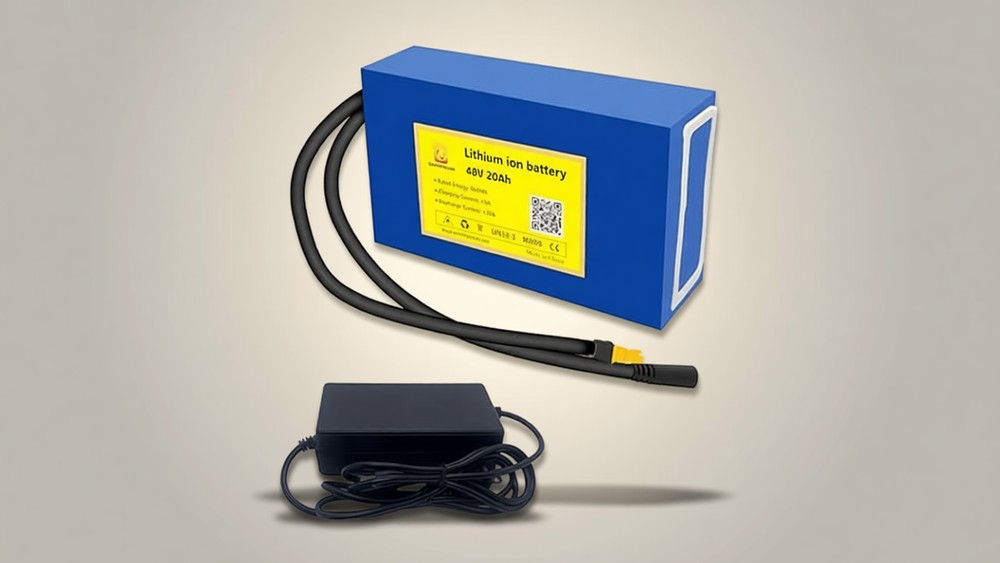
One ASIN now ships two different packs
The URL and slug promise a 48V 20Ah pack, but the live listing now shows a smaller 36V 10Ah version, model ZBL-36V10AH-1. This ASIN changed products underneath the people who bought it, and one buyer noted in August that they received a 36V pack labeled as 48V.
The pack is currently unavailable, there's no buy box, and the 169.96 third-party price on screen is stale. Our table still holds 89.99 from the last fetch. Neither number buys anything today.
Every substantive review so far describes a 48V 20 amp-hour pack, while the page now lists a much smaller 36V 10Ah version. The top-voted feedback comes from a rider who ran the old pack on a 1500w peak front hub motor build and found it covered most of the power on 10 to 20 mile rides.
Over 3200 miles on two of these packs, one owner reports no problems. They carried the packs in saddle bags because they didn't fit the frame, and praised the caulk sealing over the shrink wrap most packs use, plus the 3 amp fan chargers.
The scooter swap in the record replaced a heavy lead-acid set at a fraction of the weight and tripled the range. A jump from 17 miles to roughly 44 sold one owner on a second unit. These texts measure the old pack, not the current one.
Since the review record mostly covers the old 48V build, there's no owner data on how this 10Ah pack performs over time. You'd be betting on a spec that doesn't match the page, which matters for any rider who needs a specific range. Compare it against the rest of the field in our battery comparison table.

The ratings are polarized, with sixty-eight percent five-star texts and sixteen percent one-star, and almost nothing in between. Every five-star mark carries purchase confirmation, so the one-star block is the more meaningful signal for a buyer to watch.
One owner has reported a pack failed just out of warranty with only occasional use, and the seller wouldn't stand behind the longevity claims. Another buyer received a pack labeled 48V that was actually 36V, and doubted the 10Ah rating from the weight. One Spanish-language text reports a pack arriving outside its original box.
The current era also turned the texts short, so the record can't tell you how long the 10Ah pack lasts or whether its seller answers a warranty claim on it.

The current pack on paper
The listing shows a 36V 10Ah pack that holds 360Wh, a small 3.3 by 3.1 by 7.7 inch brick at about 4.5 lb. The spec table lists a 30A draw, which implies a 1080W continuous ceiling, though the bullets never state a watt limit.
Arithmetic, not a claim: about 18 miles at 20 Wh per mile, dropping to about 10 if you pull hard at 35. Depth of discharge takes the honest figure below that.
The lead-acid replacement angle is real. Lead-acid batteries store 35-40 Wh per kg, so a set with this much energy weighs roughly 20 to 23 lb before the charger, which is the arithmetic behind one owner calling this pack a fraction of the weight it replaced.
At 176 watt hours per kilogram pack level, the figure is high but inside what 18650 packs reach, so the lightness one buyer questioned is a reason to meter capacity on arrival, not proof of a fake rating.

Longevity claims outrun the warranty
The listing claims 700 to 1000 cycles and a lifespan of up to ten years, on a one-year warranty. Battery University puts the manufacturer spec for most consumer lithium-ion at 300 to 500 cycles, with depth of discharge and storage conditions moving that number hard.
One owner has reported a failure just outside the warranty, and the seller wouldn't honor the longevity language. A ten-year promise backed by a one-year guarantee is a gap to read first, and the cells themselves are unnamed 18650s.
If a pack like this returns to the market, meter the amp-hours on arrival with a known load, weigh it against the spec sheet, check the label voltage before wiring it in, and store it part-charged in a cool room. The listing's own advice to keep it at 60 to 70 percent is directionally right.

What a buyer should take from this page today
There's no version of this listing you can act on right now. The pack is unavailable, the 169.96 on screen is a leftover from a third-party offer that's gone, and the 89.99 our comparison table still carries comes from the last data fetch. Both numbers describe a product you can't order, so treat either figure as history rather than a deal.
At the stored price the pack sat close to the middle of the battery comparison table on price per watt-hour, and at the stale displayed price it would have drifted into the pricier band, but the honest value line is simpler: there's nothing to buy at any price today.
The comparison table carries the live position, and it sorts every pack that's actually in stock. Anyone who landed here from the old 48V 20Ah article should know the pack that article described is gone from this page, and the 36V 10Ah that replaced it has no owner record worth trusting yet.
Frequently Asked Questions
Is this the 48V 20Ah battery the link promised?
No. The listing is now model ZBL-36V10AH-1, a 36V 10Ah pack. The ASIN changed products, and the URL's slug is the only place the old pack still exists.
Can I buy it right now?
No. The page says it's currently unavailable and shows no buy box. The 169.96 on screen is a stale third-party price, and our table's 89.99 comes from the last data fetch.
How far does the current pack go?
360Wh gives about 18 miles at 20 Wh per mile and about 10 at a heavy 35. Depth of discharge takes the honest figure below that, and gentle scooter speeds stretch it.
Do the cycle and ten-year claims hold?
Battery University puts most consumer lithium-ion at 300 to 500 cycles. In the current era, one owner has reported a failure just outside the one-year warranty, and the seller would not stand behind the longevity language.
Why do the old reviews describe different batteries?
The record splits. Texts before August 2026 describe a 20 amp-hour pack on 48V builds, then the texts turn short and one buyer reports a 36V pack labeled 48V in the box.
No text describes how the current pack holds up. If it isn't the right fit, the battery comparison table sorts every option we track.