Budget intercoms sell the same dream every season, a pack of two units, a six-rider group call, and a range figure borrowed from open-sky marketing. The SKYVENT Q4 dual pack plays that game at a price that undercuts most of the group-communication field, and its buyer record tells you exactly which parts of the dream survive contact with a road.
The record here is decently sized for a budget listing, 130 ratings with 80 written texts, and it splits on one line sharper than most.
At low speed, owners get what they paid for. On the road, the two longest failure accounts describe the same wall, wind and speed shutting the conversation down, and the one owner who measured the headline claim came up short by a factor I will walk through below.
I have read the whole written record, the spec table, and the listing's own numbers, because this listing argues with itself in four separate places and each argument tells you something about what actually ships.
The SKYVENT Q4 intercom earns its sub-four average honestly, a cheap pair link that works around town and disappoints at highway speed, with a range claim nobody in the record has come close to and a spares situation worth knowing before you buy. The intercom comparison table tracks 192 units by price per rider if you want the wider field.
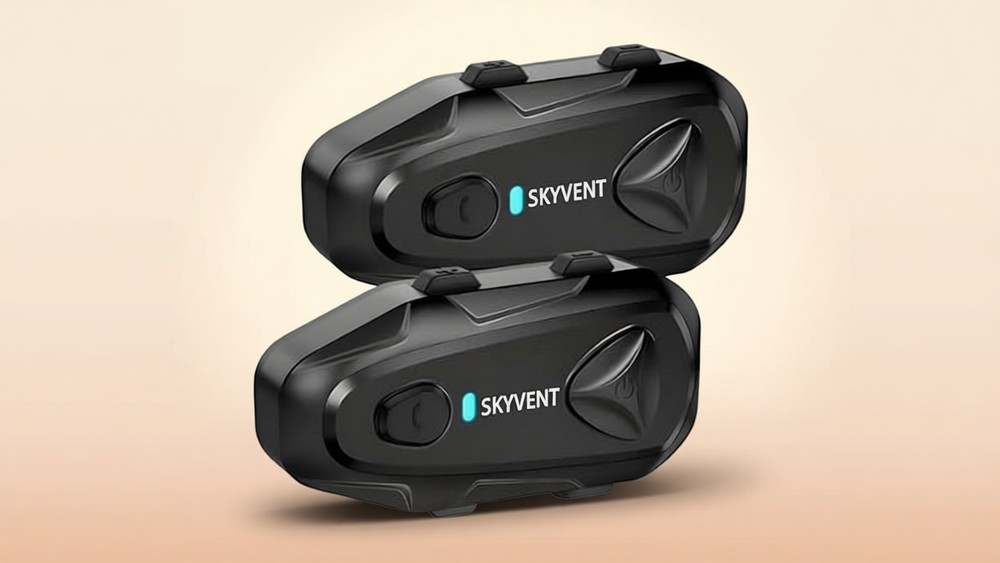
The range claim meets one owner's tape measure
The title sells 1500 meters, which is just under a mile of rider-to-rider contact. The spec table repeats it as a 1.5 km Bluetooth range. The only owner in the record who put a number on actual performance measured something else entirely.
Their text is otherwise positive, battery life strong, communication clear, and it comes with the detail that matters.
Contact between the two units dropped within 60 feet. That's about 18 meters, roughly one-eightieth of the printed claim, and the same owner failed to link the Q4 with a com system from another brand at all. They kept the units, because the same plug-ins made moving them between helmets easy, and their use case was talking to small passengers on short rides, which the measured range covers fine.
Before treating that as one bad unit, put the Bluetooth numbers next to it. Bluetooth 5.1, the version in this listing, has a best-case line-of-sight range of 40 to 400 meters, and the typical figure at default transmit power is 10 meters.
The measured 60 feet sits right inside Bluetooth's typical band, not inside open-sky marketing space. One report is not a bench test, and nobody else in the record offers a competing measurement. But the record's single datum agrees with the standard's typical behavior, not with the listing's headline, and that is the honest way to read a 1500-meter figure on any budget intercom.
The listing's own rows back that skepticism up. The title says 4 riders. The bullet copy says 6-person intercom. The spec table says Maximum Intercom Users, 6 riders. One of those numbers is wrong, and nothing on the page resolves which, though the Q4's own buyers never describe a group larger than three attempting to connect.
Then there is the filing. Amazon's spec table treats this rider intercom as a pair of headphones, product type, impedance 32 ohm, active noise cancellation claims, the same template filing we found on the Fodsports and SCSETC listings. The audio rows carry the pattern's usual artifacts, a frequency response of 20 hertz stated as though that were a curve, and sensitivity figures quoted without the speaker context that would make them mean something.
None of it is disqualifying, and the hardware list itself is complete, two units, both mics, both mounts, both USB-C cables, foam windscreens, which is more than some budget listings print. It just means the spec table is decoration, and the buyer record is the only evidence that counts.
The practical takeaway is to buy this as a same-lane or same-group-at-walking-pace link unless you can test the range inside your return window.
Sound holds at parking speeds and frays on the road
The record's failure pattern is about speed, not about broken units. An ATV owner who replaced a pair of Lexins with these reports the exact boundary, fine parked and at close distance, and above 20 mph with wind the words stop resolving. Their verdict on a set bought for trail riding was a paper weight at 80, and they wished they'd listened to earlier reviewers who flagged sound quality.
A motorcycle owner on the highway describes the same ceiling from the other side, able to hear that the other person is speaking but not to understand them.
The same owner text also contains the fix the record supports, the microphones. The soft wired mics were so muffled the pair could not understand each other, and switching to the boom mics improved things, which matches the listing's own choice to include both types. Mic placement against helmet wind noise is the variable that separates the failure accounts from the success ones.
Because the successes are real. One owner took a highway call wearing a modular helmet with the face shield open and reports the other person heard them perfectly without a raised voice, call quality like holding the phone to the ear. Another simply reports bass better than on sets that cost more.
A third praises the volume over engine noise with earplugs in. And one buyer adds a fitting caution that explains part of the spread, you need enough interior room in the helmet for a speaker on each side, so a tight shell will hold the speakers off your ears no matter what the electronics do.
So the honest envelope reads like this. Around town, at pillion distance, in a roomy helmet, with the boom mic fitted, the record says this pair works. Sustained speed and wind push it past what its speakers and mics can push through, which is the trade the price buys.
Pairing works best as a pair
The pairing record has a clear shape, two units pair easily and bigger groups are where it frays.
The clearest positive comes from a pair of riders in their seventies on trikes, self-described as tech challenged, who charged, linked, and rode with flawless contact, no more shoulder taps before a shouted comment. That is the intended use, one rider and one passenger, and the record says it works for people who do not want to think about technology.
Add a third helmet and the account changes. One owner reports connecting three or more helmets is hard and the instructions are complicated. Another needed about four tries to power a unit off, fought a volume control that would not step down with the phone at max, and ended up pulling over to fix it from the phone side, asking what the buttons are for if they do nothing.
The same text concedes the one performance point in the unit's favor, it runs loud enough over the bike with earplugs in, though they also heard crackling when linking with a family member's unit.
Cross-brand pairing failed outright in the one account that tested it, which is normal for budget Bluetooth intercoms and matches the wider pattern in our review archive. If your group rides mixed brands, this is the wrong tool. The Fodsports FX6 review covers a budget six-way unit with the same constraint and a deeper group record.
What breaks, and what you cannot replace
Two failure threads run through the newer texts, and both matter for a purchase you expect to keep for seasons.
The first is hardware mortality. One owner's unit stopped accepting a charge at seven months, tried on multiple chargers and outlets, with the volume okay and the buttons rated not great. The spec table cannot even settle charge time, one row reads 2 hours and another reads 3 for the same 750mAh battery. The listing carries a 1-year warranty, so that failure sits inside the claim window, and no text says whether a claim was made or honored.
A second buyer reports a mounting bracket that broke off within a week, alongside pairing complaints. Seven months is the only lifespan datum in the record, and it is one unit, so treat it as a question rather than a rate.
The second thread is the one that has no workaround. A buyer who went looking for replacement speakers reports they cannot be bought for the Q4, and that the company did not answer their contact attempt. That text lands harder because another owner had planned around the opposite assumption, buying the clip-on mount in order to move units between helmets and adding an extra mic and speaker set for a half helmet later.
The spares record says that plan now has no parts pipeline behind it. On a budget intercom, where the speakers are the first thing owners want to upgrade, that dead end is worth weighing before the purchase rather than after.

The decision this pair forces
What the 89.99 dual pack buys at check is a two-helmet link at about 45 a unit, cheaper than most of the dual packs we track, and mid-table across the 192 intercoms when you divide by the title's four riders. What it buys in the record is a pair link that works at conversation speeds, pairs easily for two, runs loud, and has pleased owners who wanted exactly that.
What it does not buy is the headline. The 1500 meters has one measurement against it and no measurement for it, the six-way claim has never been exercised past three in the record, the sound envelope ends where wind begins, and replacement parts have no path.
If your rides are two-up at moderate pace, this is a rational cheap choice. If your use case is a fast group, a long-range tour, or a unit you expect to upgrade with better speakers, the intercom table sorts the field by price per rider and the group-oriented reviews linked above show what a deeper record looks like.
Frequently asked questions
Does the SKYVENT Q4 really reach 1500 meters?
The only owner who measured it lost contact within 60 feet, about 18 meters, and Bluetooth 5.1's typical range at default power is around 10 meters. Nobody in the record reports a long-distance success. Plan around pair-distance use.
Can it connect to other brands of intercom?
The one owner who tried reports cross-brand pairing failed. Budget Bluetooth intercoms generally do not interoperate with other makes, and this record offers no counter-example.
How long does the battery last?
The listing claims 24 hours of talk on a 750mAh battery, and one owner reports life consistent with the advertised specs. One unit stopped charging entirely at seven months. Nobody reports measured hours.
Are replacement speakers available?
One buyer reports they cannot be purchased and that the company did not respond to contact. If you plan to upgrade the audio, this listing currently has no parts path.