Two helmets, one conversation. That's the whole job for most riders shopping in the middle of the intercom price range, and the shorter the feature list gets, the harder the choice seems to become. The big brands want flagship money for systems built around groups of fifteen.
Below them, the budget shelf is full of units nobody's heard of, promising the world on a card.
The Sena SF2 sits in the awkward middle. It's a 2-person Bluetooth intercom from a company every rider recognizes, and it strips out almost everything: no mesh, no group modes, no voice assistant. What's left is the pairing, the audio, and a price tag that asks a real question about what the name is worth.
There's also a gap between what a listing promises and what the people who paid actually report, and on the SF2 that gap runs through the sound, the battery, and the paperwork.
The Sena SF2 sells as a single headset at a checked price of 169, rated 4.4 from 227 ratings with 74 percent five-star. It runs Bluetooth 5.1, pulls music, phone calls and turn-by-turn directions from your phone, and Sena's Audio Overlay keeps the music playing under the intercom instead of cutting it.
The claimed working distance is up to 800m in open terrain, rider to rider, and that is the entire group capacity: two riders, no more.
That cap frames the value question: our comparison table computes it by dividing the price across two seats, 84.50 a rider, which lands the SF2 in the pricier third of the 192 intercoms we track. A rider plus a passenger needs two boxes, about 338.
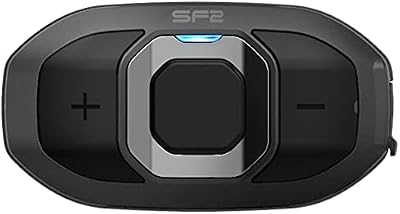
The record splits on sound, and speed draws the line
The most-endorsed owner text on the listing is not a rave. It's a 3-star one, and it describes a headset that works until the road speeds up: conversation holds under 45mph, and on the highway the same rider says you might as well turn it off. The boost setting gets its own complaint, adding loudness without making words any clearer.
A 1-star report reads much the same, calling the sound quality bad and saying speech does not survive above highway speed.
The positive texts do not contradict them so much as describe a different ride. One owner who had tried several other brands before settling here reports quick pairing to the phone, a solid rider-to-rider link, and very good listening quality.
The short non-English texts praise the sound, a battery that lasts, and an easy install. None of them states a speed.
Both sides can be true, and the box itself explains part of why. Sena ships two speaker sets with every SF2: a standard 32mm pair and a louder HD 40mm pair, and the manufacturer notes the smaller ones may suit some helmets better. Which set sits behind your ears, and how flush it sits against them, decides most of what you hear at 70mph.
What the two speaker sets change
The HD set is the one the listing advertises, and it's the louder of the two. The standard set is thinner and sits easier in shells with shallow ear pockets. A rider fighting highway wind noise should try both before deciding the SF2 is quiet, because the failure the two critical texts describe is exactly the one a badly seated speaker produces.
Three answers on noise control, one on water
The paperwork cannot agree with itself. The Amazon spec table reads Noise Control: None.
Two rows later, Noise Control Features reads Basic Noise Reduction. Sena's own product page claims a third thing, Advanced Noise Control. None of the three tells you what the microphone does to wind at 60mph, so treat noise handling as something to test on your own helmet inside the return window rather than something the listing settles.
On water the spec table is blunt in the other direction: Not Water Resistant. Sena's page lists no water rating at all for the SF2.
At 169, in a bracket where many rivals claim IPX7, that is worth knowing before a wet season. The record neither convicts nor clears it, because neither critical text mentions weather.
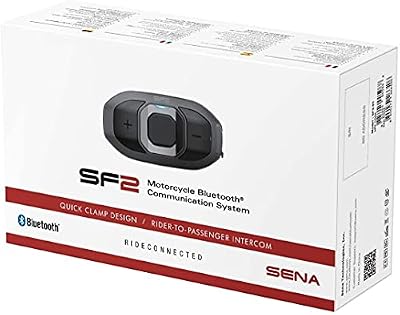
Two battery numbers, one dead unit
The listing's battery field says 13 hours. Sena's own page says 22 hours of talk time. Both agree the full charge takes 1.5 hours, and the manufacturer adds quick charging: 30 minutes on the cable buys about 4 hours of intercom.
Nobody in the owner record meters battery life. The Italian texts call it long-lasting, the positive US text says nothing about it, and that is the whole evidence file.
The one hardware failure in the record was a charging failure. One headset stopped working after a single use, and its owner tried it on multiple USB-C cables, including ones that charged another Sena product the same day, and could get neither charge nor power. That is one report among 227 ratings, and single reports happen to every brand.
It is also why the 2-year warranty in the spec table matters: this is the exact failure a warranty exists for.
Living with it: box contents, mounting, and the app
The mount is the part the record actually likes. The kit supports clip-on or adhesive attachment, and the same reviewer praises how easily the module detaches from the helmet, which matters when you park somewhere you'd rather not leave 169 of electronics on the lid. The main module weighs 35 grams, so it doesn't fight the helmet's balance.
The same reviewer's main criticism is the paperwork: the instructions and online guides need a lot of work, in their words. Setup otherwise runs through Sena's apps, which handle settings and firmware, and the pairing sequence the happy US owner describes is phone first, then rider to rider.
Getting it onto a helmet
Plan for two decisions at install time. Clip or adhesive: the clip comes off with the module, the adhesive stays put but holds less securely on textured shells.
Boom mic or the wired mic option: full-face lids want the boom, and the wire between the speakers needs routing past the liner. The owner record contains no install failure reports, which is better than several budget shelves can say. Riders who want a version of this with a newer design can compare the Sena 5R before deciding.
FAQ: the 800m figure no owner has measured, the music that ducks under a conversation and the cross-brand question with no answer
Will it really reach 800m?
That's the manufacturer's open-terrain figure, and it deserves context. Bluetooth 5.0-class radios specify maximums of 40 to 400 meters, with typical phone-class transmission reaching about 10 meters (Wikipedia, Bluetooth). Intercom makers quote line-of-sight figures between two matched units on open road, which is a different situation from riding a switchback.
No captured owner text reports any distance at all, so plan for the figure to shrink with terrain and judge inside a return window.
Can music and intercom play at the same time?
Sena's page says yes, under the Audio Multitasking name, with music dropping under the conversation instead of pausing. No captured owner text confirms the feature by name, so it's a manufacturer claim here, not a reported one.
Does it pair with other brands?
It's a standard Bluetooth headset, so phone pairing is ordinary. Cross-brand intercom is a different matter, and the record contains no report of the SF2 talking to a Cardo or a budget unit. Buy it as a Sena-to-Sena link.
How long does the battery last?
The listing says 13 hours, the manufacturer says 22, and nobody who bought one has published a number. The honest read: a full day of riding with charge to spare is plausible on either figure, and the 1.5-hour charge makes overnight top-ups cheap.
What does a rider plus a passenger pay?
Two boxes at about 338. Our table divides one box across two seats and shows 84.50 a rider, which is how every single-unit listing looks cheaper than it rides.