The Sena 5R family sells one intercom four ways, and the rung math is stranger than the spec sheet. Two speaker levels exist, the standard LITE and the HD upgrade, each in single and dual packs, and every rung prints the same 4.0 rating from 68 buyers. Odd rung out: the LITE two-pack at 99.00, which costs less than the 107.12 single and lands at 49.50 per helmet.
HD means a speaker upgrade, and the owner record argues with it from both sides. Daily riders report the speakers don't get loud enough, and one says wind and bike noise take over above about 30 mph on a quiet bike. Intercom range holds up better, surprising a rider sitting many car lengths away, and a passenger-setup owner runs the 5R alongside a Sena 30K that stays clear at 70 mph.
Rung choice comes down to the use. A rider and passenger pair saves with the LITE dual, a solo rider inside the Sena world buys a single, and the HD dual rung at 257.87 runs a 3.1 percent premium over two singles with only 7 left in stock. At 125.10, the HD single sits in the pricier third of the 210 intercoms we track.
What the speaker money adds, where the volume complaints actually land, and the support story behind two hard failure reports: that's the whole 5R decision.
The Sena 5R HD is the top speaker rung of the 5R line, and its price per rider lands in the pricier third of the 210 intercoms we track, right in the middle of the two-rider class. Every 5R listing carries the same pooled record, so the differences between rungs are pack size and speakers, not hardware generation.
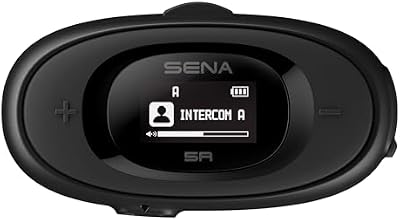
Four rungs, one rating record
The ladder has exactly four rungs, and all four probed live on the same day. The 5R LITE single we reviewed earlier this month sells at 107.12. The HD single reviewed here sells at 125.10, a 17.98 step up for the HD speakers. The LITE dual pack sells at 99.00. The HD dual pack sells at 257.87 with only 7 units left and more on the way.
Do the per-helmet math and the ladder turns upside down. Two LITE singles cost 214.24, yet the LITE two-pack costs 99.00, which is 53.8 percent under two singles and cheaper than one LITE alone. At 49.50 per helmet it's the cheapest way into the 5R family by a wide margin. The HD two-pack runs the other direction: 257.87 against 250.20 for two HD singles, a 3.1 percent premium for buying the pair in one order.
Season pricing across the intercoms we've measured ran mostly two to eighteen percent under two singles for a two-pack, with a couple of premium rungs. The 5R LITE dual isn't a discount, it's a mispriced rung, and it may not last. The HD dual's small premium plus its low stock makes it the rung to skip: you pay more per helmet than the single costs and you get the identical pooled record.
Because all four rungs print the same 4.0 from 68 ratings, rung choice is purely about price and pack. The histogram splits 55 percent five-star, 19 percent four, 14 percent three, 3 percent two, and 9 percent one, so about one buyer in eight ends up in the bottom two bands.
What the HD speakers add, and where volume complaints land
The HD rung exists for its speakers. The gallery card prints High Definition Speakers, the bullet lists HD Speakers on their own line, and the spec table gives the drivers a 32 ohm impedance rating with a 20 to 20,000 hertz frequency range. That's the upgrade you're paying the 17.98 for.
The record pushes back. A commuter who uses one every day reports the speakers don't get loud enough for him. A two-star owner measured the ceiling in road terms: it works maybe OK to about 30 mph, then wind and bike noise take over, and that's on a quiet bike. The same owner adds a detail worth knowing before you buy: the beep tones run more than twice as loud as the music, so at max phone and unit volume with ear plugs in, the beeps stay painful while the music stays faint.
A three-star account explains where the ceiling comes from. This owner bought the 5R as a passenger unit to pair with a Sena 30K, and on the 30K at 70 mph, callers can't tell he's riding. The passenger's 5R struggles more: voices are hard to hear at 45 mph with visors closed on full-face helmets, riding touring bikes with full windshields. His verdict was to buy into a higher tier next time.
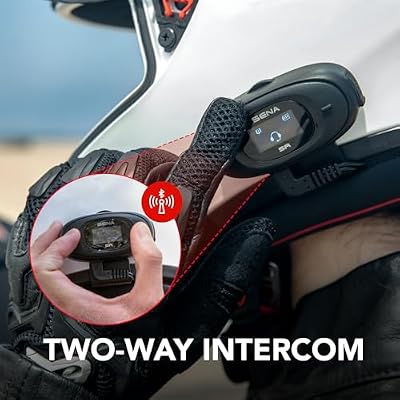
The positive half of the record is just as consistent. One owner replaced an older Sena S10R with the 5R and reports it out-performs it, then bought a second unit for the passenger helmet. Another uses it daily for the ride to work and pairs it instantly to the phone and to his father's headset. Two Spanish-language owners call the pairing easy and the price fair against high-end units. The pattern: rider-to-passenger and short-range rider-to-rider both work, and the volume ceiling shows up at highway speed with wind.
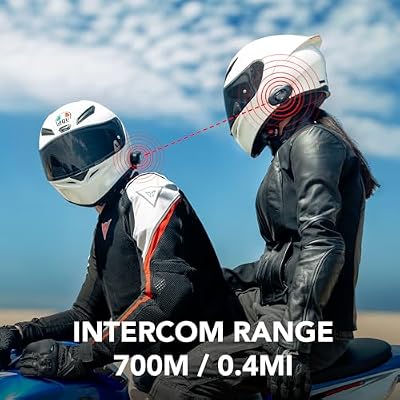
The range card says 700 meters, the table says 10
The 5R's own listings disagree about range, and the disagreement is decode-able. The gallery range card prints an intercom range of 700M, about 0.4 miles. The HD dual pack's spec table prints a Bluetooth range of 10 meters. Both figures describe different links, and neither is a lie.
Per Wikipedia's Bluetooth article, Bluetooth Classic links in the common power class reach about 10 meters, which is phone-to-headset territory. That's the row the spec table prints, because it describes the phone link. The 700 meter card figure is the rider-to-rider intercom claim, a line-of-sight maximum with no obstacles between helmets. Real distance shrinks with bodies, fairings, and terrain, which is why the owner who stayed connected many car lengths back called the range surprisingly good rather than measured.
One catch: the range row only survives on the dual pack page. The single's spec table carries no range line at all, so the 700 meter claim lives on in the gallery card and the dual listing.
Two hard failures and a support pattern
Two failure accounts sit in the pooled record, and both arrived early in ownership. One unit stopped working and wouldn't charge after about a month of use, and the owner contacted Sena at the start of September 2025 with no reply when the record closes. A second owner's right speaker died on the fourth use, one day past the return window, with the left ear fading behind it.
The helpful-sorted page adds a support complaint that isn't about hardware at all. An owner with five Sena units spent more than a week trying to update firmware through apps he describes as feeling like something from the DOS era, while the support website rejected his question with a system-down message on every attempt.
None of this means the hardware fails often. The 5R shares its pooled record across four listings, 68 ratings is a small sample, and the 5R LITE review drawn from the same pool reads the same way. What it does mean is that both failures landed inside the first month, one of them a single day past the return window, and the 2-year manufacturer warranty printed on the page is the backstop. Registration on day one is what turns a dead unit into a claim instead of an argument.
Which rung to order
The 5R HD single fits a solo rider already inside the Sena world who wants the loudest speakers the line ships and the LCD for settings without a phone. You can check its current price on Amazon against the other rungs.
Order the LITE two-pack if you're buying for a rider and passenger pair, because at 49.50 per helmet nothing else in the family comes close. Order the HD single if you ride solo and want the speaker step. Skip the HD dual unless it's the only rung in stock when you buy, because its 3.1 percent premium buys nothing the single doesn't have.
If your group mixes brands or you ride in rain, shop the category before committing. The 5R pages print not water resistant, and budget two-packs with IP67 ratings cost a third as much per rider. The EJEAS V6 Pro+ two-pack is the standing comparison, at roughly half the per-helmet price with a confirmed-purchase record of its own.
Common Questions
Is the HD worth the extra 17.98 over the LITE?
Only if speaker volume is your specific problem, and the record suggests it may not fix it. Both rungs draw loudness complaints from highway-speed riders, so the HD speakers buy clarity more than ceiling. The LITE single at 107.12 is the same intercom with the quieter drivers.
What's the real range between two riders?
The card claims 700 meters, about 0.4 miles, which is a line-of-sight maximum. The one owner account that describes distance stayed connected many car lengths behind another bike. Treat the claim as open-road best case, not a promise through traffic.
Can two 5R units pair with each other?
Yes, and the record shows 5R units pairing cleanly with each other, with phones, and across the family: one owner pairs with his father's headset, another moved up from an S10R. First-pairing friction shows up in the record too, and one owner needed help before it clicked.
How's the battery?
The spec table prints 18 hours of average life with a 2.5 hour charge. One junk row also prints a carrying case battery charge time, but no case in the box list contains a battery. No owner account in the pool disputes either real figure.
Does it work as a passenger intercom?
That's the job most of the positive reports describe: rider-to-passenger talk with no taps or shouts. The volume ceiling matters most here, because a passenger behind a windshield at 45 mph is exactly where one three-star owner hit it.