Two helmets, one box, one decision the listing quietly gets wrong. Sena sells the 50S dual pack at 611.10, and two single headsets cost 636.00, so the pack saves you 24.90.
That's a real discount, and it's also one of the smallest we've measured on a pair this season, because Sena prices its dual rungs the same regardless of model: the 50R pack, with the same 611.10 sticker, saves 138.90 against its own singles, and our 50R dual pack review walks that rung in full. Which pack is the bargain depends on which single you would have bought.
Buyers inherit a decade of riding history with it. Above roughly 50 mph, wind rush gets read as voice, and music or intercom cuts until you slow down - a complaint running through the reviews from 2022 into this September. Set against that: call clarity at speed, one-click mesh re-joining, and a seven-hour ride on one charge from owners who treat the headset as solved.
What follows starts with the ladder math, because the pricing quirks decide what a fair comparison even is. After that comes the record itself, and a check on which spec rows survive on a page that can't count its own two headsets.
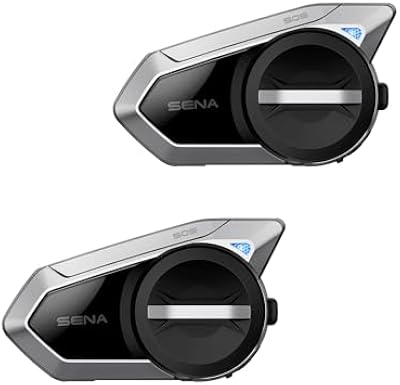
The Sena 50S dual pack is two model 50S-10D headsets with Harman Kardon speakers and microphones, helmet clamps, boom and wired microphones, a jog dial apiece, and a 3-year warranty.
It shares a pooled record with the covered 50S single - 4.4 stars from 1,735 ratings prints identically on both pages - and it ranks 19th in Powersports Helmet Communication at a live price of 611.10. That per-rider figure sits among the priciest rows of the 210 intercoms we track, and the exact live number renders in the specs box under this review.
The pair math, and why the 50R pack discounts harder
Two 50S singles at the live 318.00 run 636.00, so the pack at 611.10 saves 24.90, about 4 percent, and 12.45 per headset. Compare that with the 50R pair: two 50R singles at 375.00 run 750.00 against the same 611.10 pack price, a saving of 138.90 or about 18.5 percent, close to the top of the pair-discount band this season, which has run from about 2.5 percent to 18.
The dual costs the same whichever model you pick, so the size of the discount depends entirely on which single you would otherwise have bought. The 50S single is the cheaper single, and that is exactly why its pack looks worse as a deal.
There's a wrinkle that turns this from a pricing curiosity into a decision input. The 50S single page prints Only-15-left in stock, while the dual prints plain In Stock. If the single sells through, the pack becomes the only way to buy the 50S at all, and the 24.90 saving stops mattering next to availability.
The same ladder logic applies one generation up: the 60S dual costs 154.05 more than this pack, and its own pricing runs in the opposite direction, which the 60S dual review covers in full.
For calibration across brands, the discounts elsewhere this season have been real but modest: the Cardo FREECOM 4X pair saved about 7.9 percent against two singles, while the BTQILEYOO X6 two-pack ran about 13.6 percent above its own singles, a premium rather than a discount. Against that spread, the 50S rung sits at the stingy end, and 18.5 percent on the 50R rung is the outlier.
The pack-only path if the single sells out
If you need two 50S units and the single is gone, the pack's per-headset price of 305.55 is still 12.45 under the single's 318.00, so nobody loses money buying the box. What changes is choice: no picking one headset now and one later, no mixing a 50S with a cheaper backup unit for a second helmet. Buying the pack commits both helmets to the same model on the same day.
The wind complaint that spans four years of reviews
One pattern in this record deserves its own section because it refuses to go away. A November 2022 four-star text describes riding in open mesh mode with background noise shutting the music down above 50 mph: the 50S hears wind as voice, ducks the audio, and the music stays off until the rider slows to where the outside noise level drops.
The owner had already run every fix Sena's support directed and concluded the microphone can't separate human voice from wind.
Now read the September 2026 texts. One two-star account reports lots of wind noise even with a full-face helmet and states the headset only works well below 50 mph. Another describes the same mechanism from the microphone side: above 60 mph, sound cuts out continuously because the mic keeps reading a voice command, through every setting and placement change the owner tried.
A one-star from October 2026 adds poor sound above 50 mph, Bluetooth that started dropping after a couple of months, and a mesh partner who comes through quiet at speed. Four years apart, same behavior, same speed threshold.
That span is why this reads as a design characteristic rather than a bad batch: an always-listening voice-command microphone and an open-mesh mode that monitors for speech both give wind a path into the audio path. Nobody in the record reports a fix, and the covered single review documents the same theme in its own pool.
What the deep record answers back
The helpful-sort texts are older and mostly enthusiastic, and they explain what the 4.4 average is averaging over. A November 2022 owner who came from a Cardo FreeCom 4 plus calls the 50S ahead of the Cardo in every aspect, with phone calls holding at speeds where the FreeCom became hard to hear.
A March 2024 text adds the battery case: an earplug wearer with a loud exhaust hears a riding buddy clearly, rode seven hours on one charge, and re-joins the pair with one press of a large button after they split up in traffic.
An April 2025 account confirms full compatibility with a BMW's bike console, including the grip's twist control, and calls the sound quality high-end though a touch quiet.
Those positives share a theme: rider-to-rider and phone-call audio, at speed, work. The complaints concentrate on the music side and on the always-listening behavior, not on the intercom core.
Fitment fights and the bike-integration accounts
The helmet models that push back
Install friction shows up in the record more than any electrical fault. A July 2026 owner states installation in an LS2 Stream 2 was super difficult, rates the headset four stars and gives five only because the seller is not the manufacturer, and reports a buddy with a Scorpion helmet had to force the mount in too.
A December 2025 Triumph owner had to cut the communication cubby in a Nolan helmet to seat the mount at all. Against those, a September 2026 buyer reports the dial, speakers, and mic all fit great on a Scorpion EXO-420 with no fighting.

The speakers themselves draw a size comment from the July 2026 text: about the size of an AirTag, in the owner's words, which is the trade for a low-profile unit. Plan for the possibility of trimming or forcing the mount on some helmet models, and check your helmet's comm-cubby dimensions before ordering a pair of them.
The two accounts that say plan before wiring one in
Two texts describe using the 50S as part of a bike's own audio system rather than helmet-to-helmet, and both went badly. One owner paired it with a Sena Freewire on a Goldwing, spent two days troubleshooting, and watched the 50S grab the phone's Bluetooth and disconnect from the bike system, and they suspect the 50S side of the pairing.
The Triumph owner above bought it as the brand-recommended integration for a Tiger 900 and got about twenty minutes of working audio followed by hours of resets. Neither account involves plain rider-to-rider use, which is what the rest of the record supports, so treat these as a caution specific to integrated setups rather than a verdict on the hardware.
Spec rows that hold, and a table that can't count
The details table carries real specifications worth keeping: Bluetooth 5, a 16-hour battery row, a 20-minute fast-charge row that the bullet ties to two hours of use, water resistance, voice assistant access through Hey Google and Hey Siri, gold-plated audio plugs, and a 3-year warranty. On the Bluetooth row specifically, the version number describes the phone link, which in its common class reaches about 10 meters, not the helmet-to-helmet intercom distances the listing advertises.
Then come the rows that fell over. Number of Items says 1. Package Configuration says Dual Pack.
Number of Packs says 2. Unit Count says 1 Count. That's four pack-count rows with three different answers on a box containing two headsets.
Impedance prints 2200 ohm, the same template junk value that shows up on headphone-filed listings across this category. Maximum Mesh Connections says 3 riders, which contradicts Sena's own mesh claims that the covered single review checked against the manufacturer's spec sheet.
Control Method says Touch on a unit whose controller type is a jog dial. Style Name says Retro. Treat every auto-filled number on this page as a rumor until you find it on Sena's own page.
Common questions before buying two 50S headsets
Does the dual pack save money over two singles?
Yes, but barely: 24.90 on a 636.00 two-single total, about 4 percent. The same money buys a 50R pack that saves 138.90 against 50R singles. Decide the model first, then let the ladder tell you what the pack is worth.
Can one rider buy the pack and use the second unit later?
Physically yes, since the box holds two complete headsets. The record's value is in rider-to-rider use, and nothing in it reports problems from delayed second-unit activation. What you give up is spreading the cost, since the pack is one purchase.
Is this the same product as the 50S single?
Same headset hardware, model 50S-10D versus the single's model number, one pooled 4.4-from-1,735 rating record across both listings, and the same 3-year warranty. The differences are the box contents, the price per headset, and the stock position, with the single down to 15 units at capture time.
What speed does the wind problem start at?
The texts cluster above 50 mph, with one owner reporting continuous false voice-command triggers above 60. Below those speeds the record's complaints thin out considerably.
The decision this pack actually forces
Buy the 50S dual pack when two helmets need Sena mesh and the 50S is the model your group settled on, or when the single's 15-unit stock counter runs out. Buy the 50R pair instead if a three-button layout works for you, because the identical 611.10 buys a pack that discounts four times harder.
Skip the pack, and buy singles, only if you need to split the purchase or expect to upgrade one helmet sooner than the other. And if your plan involves wiring into a Goldwing or a Triumph's integrated system, read those two accounts again before spending 611.10 on a pair of them.