When a replacement battery fits your rail but not your bike, the listing usually takes the blame. The SDTYYP 48V 18Ah shows why: the pack is a silver fish, the shape most budget ebikes settled on, and yet three of the ten reviews that have any text are failures to fit or to charge rather than failures of the cells.
Its own page makes that harder than it should be. The title sells a 48V 18Ah pack, the spec table describes a 36V 15.6Ah battery, and one bullet lists every capacity the family comes in without picking one.
This review works through what the 147 ratings can actually tell you, the fit check that all three failures turn on, the claims the page can't settle, and what the watt-hours cost.
This SDTYYP 48V 18Ah silver fish pack is a big capacity in a standard shape, sold by a listing that can't say what it sells.
The title promises 48 volts and 18 amp-hours, Amazon's own spec table describes a 36-volt 15.6Ah battery, and one bullet lists the whole family without picking a variant. The record behind it is 4.1 stars from 147 ratings and ten written texts, every one carrying purchase confirmation and nine of them in a language other than English.
All three failures in that record are fit or charging problems rather than cell problems, so the fit check matters more here than on most packs we have reviewed. Get the fit right and it's decent value for what it holds. Get it wrong and one owner has reported a 400.00 loss on a pack the seller wouldn't take back.
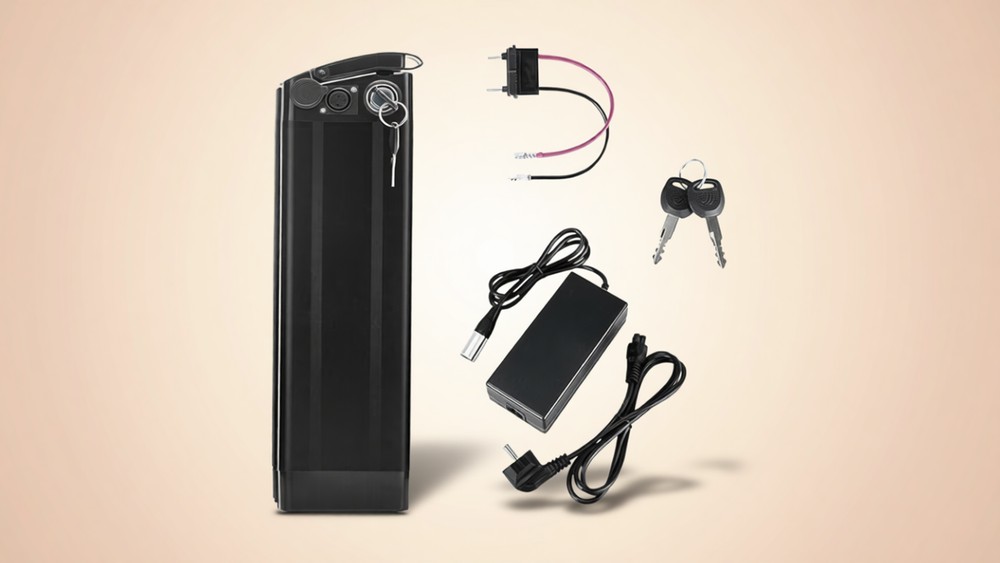
One listing, three answers about what arrives in the box
Count the answers this page gives and you get three, and they don't agree. The title says 48V 18Ah, which is 864 watt-hours by the only arithmetic that matters. Amazon's spec table says the voltage is 36 volts and the capacity is 15.6 amp-hours, which works out to about 561 watt-hours, about a third less energy than the title's number.
Bullet one skips both answers and lists the family at once, 36V and 48V at 15.6Ah, 18Ah and 21Ah, the way a storefront lists every pack it makes rather than the one in the box.
The difference isn't cosmetic, because the two identities charge differently. A full 36V pack sits near 42 volts, a full 48V pack near 54.6, and a charger built for one won't fill the other. A buyer also plans range around watt-hours, and the gap between the two answers is about 300 of them.
Around the disagreement sit the details that show how little care went into the page. The spec table says this battery requires 1 A batteries, included, which is a rating and not a type.
Bullet four ends mid-sentence, promising a battery immobilizer to get you out of the, and stops there. What the page does keep consistent is the hardware: an aluminum alloy shell, a key lock, an ON/OFF switch, an LED gauge, and a weight of 11 pounds that the spec table repeats as 5 kilograms. Those are the parts you can trust the listing on.
The which-pack question you settle another way, in writing with the seller, before the return window closes rather than after. Compare it against the rest of the field in our battery comparison table.
What 147 ratings say when only ten of them speak
The star spread leans positive with a hard edge: 68 percent five, 17 percent one, and almost nothing in between. Ten buyers have written text. Nine of the ten wrote in a language other than English, six of the ten ran a single line, and the whole written record fits in a paragraph.
The tell is a rating and its text pointing in opposite directions. A five-star rating sits on a two-word German text that translates to doesn't fit, so the stars say one thing and the sentence another. That's worth knowing before you read the 68 percent as unqualified good news.
All three one-star texts describe fit or charging failures. The only text on the page with a helpful vote is the most detailed of them: a parent bought this for a child's QUAWAY ebike, found the pack can't mount there because that bike carries its battery behind the front wheel and ahead of the seat, and notes the company emailed before shipping.
A second owner in Italy reports a pack that wouldn't charge and a refund they call impossible. A third, in Canada, reports the pack doesn't fit their bike and calls it non-refundable, a 400.00 loss. The positive texts are thinner on substance: identical to the original, more power than the original, works perfectly for now.
One owner writes that they'll come back and rewrite if it fails soon, which is the most useful promise on the page and the least confirmed.
What nobody covers is the list a replacement buyer actually wants. No text gives a range figure, a measured capacity, a charge time, or a word on how it holds up past a few weeks. One of the ten texts names a bike at all, and it is a fit failure.
The fit question all three failures turn on
None of the three failures has anything to do with the cells, which is the useful part. The pack did its job or never got the chance. The QUAWAY owner explains the mechanism precisely: that bike mounts its battery in a spot no silver fish rail reaches, and nothing on the page would have told them that except careful reading.
A silver fish pack slides into a rail on the frame's bottle-mount position, and plenty of bikes, especially ones with unusual battery placements, can't take one at all.
The checklist that prevents this is short. Measure the rail and the space around it.
Match the mounting style, because silver fish is a family of shapes, not a promise. Confirm the discharge connector on your bike against what ships. Then use the pre-shipping email this seller actually sends, and put your bike's make and model in it, so there is a written answer before the pack leaves the warehouse.
The record leans one way, and that makes the check necessary rather than optional. Nobody who reports a fit success names their bike, so a buyer can't find their own model among the positives.
The failures are the only texts that name a machine. Who should skip this pack is easy to state: anyone whose bike doesn't take a rail-mounted silver fish pack, and anyone who can't test the fit inside a return window, because the page's own record shows what that omission costs.

Claims the page can't settle: IP68, 800 cycles, and a BMS that might be 25A or 30A
Three claims on this page outrun its own specifications, and each has a plain version a buyer can rely on instead.
The loudest is IP68 waterproofing on the aluminum shell. The IP code comes from the IEC 60529 standard, and the 8 at the end means the maker defines the depth and duration the enclosure survives, because the standard itself sets none. This listing states no test conditions at all, so the claim can't be checked by anyone.
The level with fixed, published conditions is IPX7, one meter for 30 minutes, and a rail-mounted pack on a bike faces rain and puddles, never a dunking. Ride it as a rain-resistant pack and the claim costs you nothing.
The cycle claim is a gap of the same shape. Bullet three says capacity exceeds 80 percent after 800 cycles.
The consumer norm for lithium-ion packs is retirement at 300 to 500 full cycles near that same 80 percent line, which Battery University documents across the industry. Treat 800 as a promise the listing makes and nothing on the page supports.
Then there is the BMS, which bullet three describes as 25A/30A while the spec table says 30 A. At 48 volts that is the difference between about 1200 and 1440 watts of continuous output, a 240-watt margin that decides whether a 1000W motor sits under the limit with headroom.
The value story is plain either way: at the current 259.00 the pack lands at about 30 cents per watt-hour, in the pricier third of our 301-battery comparison table, and the live position sits in the specs box where you can compare it yourself.
Range you won't find claimed, and charging you can't plan
The listing makes no range claim anywhere, which is unusual and, in one narrow way, honest. It leaves the math to you. The pack's best-case identity, 48V at 18Ah, is 864Wh, and at a full-throttle figure of about 20 watt-hours per mile that is roughly 43 miles.
Pedal assist stretches the same energy a long way, because the electric-bicycle range band runs 25 to 75 miles per charge depending on assist level, terrain and rider weight. If the pack that arrives is really the spec table's version, the one whose table claims 561Wh from 36 volts and 15.6 amp-hours, subtract about a third of those figures and you've got the honest answer for that one.
Charging is the genuine blind spot. No charger output appears anywhere on the page, so there's no recharge time to state, promise or check. The charger that ships in the box has a label, and reading it before you plan a ride is the whole task.
A 2A charger and a 5A charger turn the same pack into two different recharge times on the same pack, and the page gives you nothing to tell them apart.
That leaves the decision this pack forces. It's a fit-first purchase with a thin and partly contradictory evidence record, priced unremarkably. It makes sense when the rail, the connector and the model number check out in writing before the return window closes, and it makes no sense when any of those three is a guess.
FAQ
Will it fit my bike?
Only the physical check answers that. A silver fish pack needs a rail mount and clearance, and the page's own record holds three fit or charging failures, including a QUAWAY whose battery mounts nowhere near a silver fish rail. State your bike's make and model in the seller's pre-shipping email and keep the reply.
Is it really waterproof?
It's rated IP68, and that rating means the manufacturer sets the test depth and duration. This listing states none, and the IEC standard leaves the 8 open by design. Treat the pack as rain-resistant, which is what a rail-mounted battery actually faces, and don't plan to submerge it.
How far will it go on a charge?
The listing claims no range at all. On the title's 864Wh, full-throttle riding at about 20 watt-hours per mile is roughly 43 miles, and pedal assist extends that within the category's 25 to 75 mile band. On the spec table's 15.6Ah version, cut those figures by about a third.
How long does the battery last?
The listing says capacity exceeds 80 percent after 800 cycles. The industry norm for lithium-ion packs is 300 to 500 full cycles near that same capacity line, so the claim has no support on the page and no owner text says how it holds up over the long run.
Can I return it if it doesn't fit?
The record argues for caution. One owner reports the pack isn't refundable and describes a 400.00 loss on a misfit, and another calls a refund impossible after a pack that would not charge.
The spec table lists a one-year warranty, which isn't the same as a fit guarantee, so settle fit before buying. If it isn't the right fit, the battery comparison table sorts every option we track.