RideHaven is a new name in our data, and its X1 Pro Max is a budget helmet headset with a two-way intercom claim, Bluetooth 5.4, and a 39.99 price. On paper it reads like a dozen other budget units we track.
The listing's record is where this one gets interesting, and not in the way the 4.7 average suggests. Seventeen ratings sit behind that average, every one of them at four or five stars, but when you look at the written texts underneath, ten of the eleven we captured carry no purchase badge, and several of those ten read like they were written by the listing's own marketing department.
That split does not prove anything by itself. Unbadged texts happen on every listing, and plenty are honest. But a brand-new product whose rating pool leans this hard on unbadged praise deserves a closer read than its star average, and the closer read turns up a listing that argues with itself about waterproofing, about range, and about how much the box weighs.
Here is what the page shows, what the record can and cannot settle, and what I would check before trusting the intercom claim.
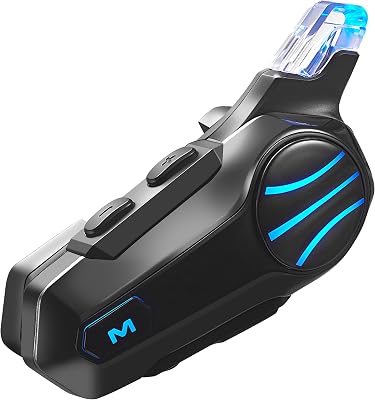
What the box holds
The Built-In Media row is specific: one X1 Pro Max main unit, two speakers, one boom mic, one button mic, a USB-C charging cable, velcro clamps and pads, and two gift body covers in red and blue. The main unit is a single clamp-on module, and the color ladder on the listing offers the same product in Red, Black, and Electric Blue.
Two microphone styles in one box is the pattern every budget headset in this price band has copied from the bigger brands, and it is genuinely useful, because full-face helmets want the boom and open-face shells want the button mic. The details table ships a one-year manufacturer warranty row, which is a year less than LEXIN puts on a 35.99 speaker kit.
The spec sheet claims Bluetooth 5.4, CVC and DSP noise reduction, a 40mm by 11mm speaker driver, IP67 waterproofing, and a two-hour charge. The comparison card in the gallery adds a 12-hour battery life figure, and that comparison card is worth a look before anything else on the page. Note which figures have no number behind them: the battery capacity never appears anywhere on the listing, in any row, bullet, or card.
One verified text in eleven
The histogram prints 71 percent five-star and 29 percent four-star, with no rating bands below that at all. Seventeen ratings, 4.7 average. If you stopped reading there, this would look like one of the best-regarded budget units in the category.
The written record says otherwise. Of the eleven texts captured, exactly one carries the purchase badge, an October 2026 four-star from an owner who reports answering calls and texts and listening to music and audiobooks over the noise of a moped, and who has gone more than a month without a charge, with the battery falling from 80 to 60 percent.
That is the one text on the page tied to a confirmed purchase, and it is a good one.
The ten unbadged texts divide into two piles. A few are specific and readable as real use: one owner describes pairing to an Android phone, crisp sound at maximum volume, thick 3M mounting tape, and speaker wire long enough for the largest helmet shells. Another describes fitting the headset to a riding helmet for horse-sale video work and getting clear communication across a jumping arena.
One trail-ride text describes six hours of heavy use with no low-power warning, though its phrasing sits close to the listing's own vocabulary.
The other pile is the problem. One five-star text states the writer has not been able to install or test the headset yet because of a motorcycle problem, then awards five stars anyway. The top-voted text is a generic essay about how upgrading changes the riding experience.
Another praises budget Bluetooth 5.4 units as a class without a single specific about this one. Read the 4.7 as an early, soft signal, not as evidence about this headset, and read the intercom claim as unexercised, because no text on the page, badged or not, describes a verified ride with two units talking to each other at distance.
The specs argue with the claims
Three waterproof statements
The details table and the bullet both say IP67. The comparison card in the gallery says IPX6. A third card prints IPX67, which is not a rating at all, just a garble.
Those are different tests, not a typo family. IP67 means dust-tight plus immersion up to one meter for thirty minutes. IPX6 means surviving powerful water jets, one hundred liters per minute at close range for three minutes, per Wikipedia's IP code article. The card making the IPX6 claim is the same one shown below.
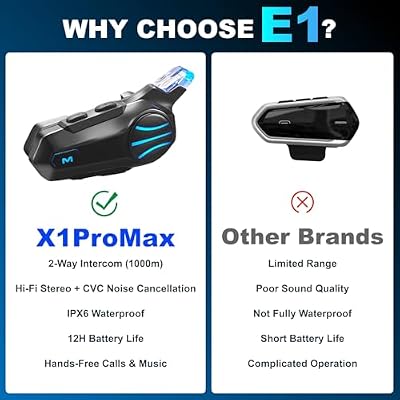
The standard is explicit that water ratings are not cumulative beyond IPX6, so a headset that passes immersion is not automatically jet-proof, and vice versa. A listing that prints both on one page is claiming two different tests, and buyers cannot know which one this one would pass.
A 1000m claim against a 10-meter row
The bullet and the gallery card both claim two-way intercom up to 1000 meters in open areas. The details table's own Bluetooth Range row prints 10 meters.
Bluetooth's typical range runs under 10 meters and up to 100, with the 5.0 generation reaching 40 to 400 meters per Wikipedia's Bluetooth article.
A 1000m figure sits far beyond anything the page's own radio row describes, and the listing offers no other radio spec that could carry it. Budget intercoms make 1000m-class claims regularly, and some back them with better radios than the row suggests, but this listing gives no basis to believe it, and its owner record does not exercise the intercom even once.
A weight row from fantasy
The Item Weight row prints 1.28 ounces, about 36 grams for a battery-powered main unit, two 40mm speakers, two microphones, a clamp mount, and the wiring between them. That figure leaves no room for the battery any 12-hour claim needs.
We caught the same class of row on another budget listing this month, and it means the same thing here: nobody checked the spec table, so trust none of it.
What the record does settle
Strip out the listing-shaped texts and a usable picture remains, just a narrower one than the star average implies. Install works: the clamp bracket locks on, the tape holds, and the wire runs fit large shells.
Pairing to Android phones comes up repeatedly and without friction. Phone audio gets consistent praise, including one owner whose call recipients did not know a helmet was in the way. The buttons draw mixed notes, small for gloved hands in one account and usefully large in another, which probably depends on the glove.
Battery life is the strongest supported claim in the whole record, which is strange for a listing that never states the battery size. One confirmed owner has gone more than a month of occasional use without charging, and another describes six hours of heavy streaming without a warning. Whatever cell is inside, it is not undersized.
What nobody has documented: the two-way intercom at any distance, the noise cancellation against real wind, the 1000m range, and long-term durability. On a record this new and this thin, those are open questions, not features.
Buying before the record fills in
At 39.99, the X1 Pro Max costs about what the budget single-unit tier charges, and our intercom comparison table shows the alternatives with records that have actually filled in. The TreeTree X2 sits below it in price with a mesh-family sibling already covered, and the Wayxin X8S two-pack carries a bigger record on a two-helmet set.
If you want a cheap phone-audio headset for calls, music, and GPS prompts, and you accept that the two-way intercom claim is unproven on this page, the X1 Pro Max's install and battery record is good enough to risk it. If the intercom is the reason you are shopping, this listing has not earned that purchase yet.
Wait for the record to fill in, or buy one of the units above whose owners have already done the testing for you.
Frequently Asked Questions
Is the RideHaven X1 Pro Max waterproof?
The listing cannot decide. The details row and bullet say IP67, which is dust-tight plus one-meter immersion, while the gallery card says IPX6, which is high-pressure jets, and the two tests do not imply each other. Treat any specific claim as unverified until the record shows a wet-weather report.
Does the 1000m intercom range hold up?
Nobody knows. The listing's own Bluetooth range row prints 10 meters, Bluetooth's typical band tops far below 1000 meters, and no owner text describes two units talking at distance. Do not plan a ride around that figure.
How long does the battery last?
The supported picture is good: one confirmed owner has gone more than a month without a charge, and another reports six hours of heavy use with no low-power warning. The listing never states the battery capacity, and its 12-hour card figure has no number behind it.
Is the 4.7 rating trustworthy?
Not yet. Ten of the eleven written texts carry no purchase badge, one five-star admits the headset was never installed, and several unbadged texts read like listing copy. The single badged text is positive, but one text is not a record.