Turning a regular bike electric with a front hub kit starts with the fork, not the motor. The dropouts need 100mm of spacing, the fork blades carry the motor's weight and eat its torque, and a steel fork shrugs off what a thin aluminum one slowly spreads. Every other purchase decision waits on that one.
PEXMOR pitched the rest of the build in a single box: a 26-inch motor wheel, a three-mode controller, a throttle with its own battery gauge, power-cut brake levers, a torque arm, and a battery, at 149.99. No other kit in the battery-included half of our table matched that price, and none claimed more power.
The listing is gone from Amazon now, which turns the question from 'should I buy it' into 'what was it, and what replaces it'. A replacement buyer needs three answers: whether the battery in the box was ever sized, what the disc-rotor complaint means for a build that brakes up front, and how a 1200W claim sits against the law. All three are below.
I read the whole record looking for the catch behind that price, and I found it in the one place the listing stayed quiet: the battery. The box was genuinely well equipped for the money, the torque arm came included at a price where most listings omit it, and the controller carried a sensor-failure fallback worth having.
The catch is that the kit's most expensive component was never sized anywhere, not on the page, not in the spec list, and not by a single buyer. A kit like this one lives or dies on that number, and the record cannot tell you what it was.
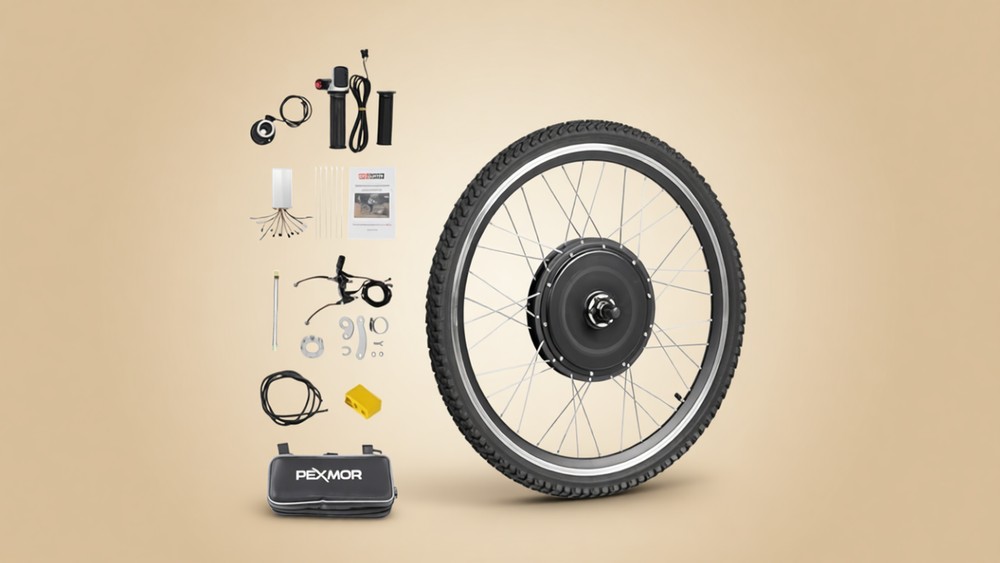
What the box held
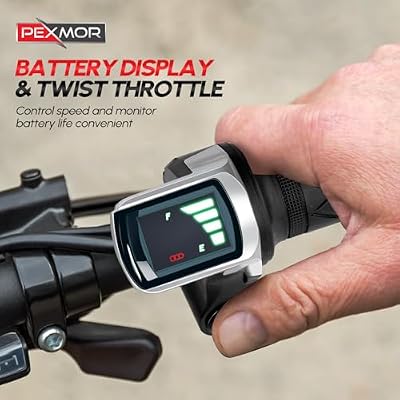
The parts list is the strongest thing about this listing, and it's worth reading closely because most budget listings refuse to write one. It named a 26-inch front motor wheel with a brushless hub, a controller, a twist throttle with an integrated battery gauge, a pedal-assist sensor, power-cut brake levers, a torque arm, install tools, a printed manual, and a video guide.
The battery was listed as part of the kit, which almost nothing in this price band does.
Three riding modes came with the controller: throttle only, pedal assist through the PAS sensor, and a manual mode.
The controller also ran a Hall-effect fallback, meaning it detects a failed sensor and keeps the motor turning without one. That's a genuine reliability feature at budget kit prices, and commuters were the buyers it made sense for, because a sensor failure on a sensorless-capable controller is an inconvenience rather than a walk home.
Braking hardware came in the box too. The brake levers cut power the moment you pull them, which should be standard equipment on every kit and still isn't. The listing claimed CE certification, and that claim was never independently checked by anyone in the record, so treat it as printing rather than proof.
One part of the box carried the most risk. A torque arm clamps the axle so the motor's reaction torque cannot wind itself out of the dropouts, and at 1200W it's the part that keeps a front fork intact.
The long-running torque arm guide on ElectricBike.com puts it bluntly: hub motors twist dropouts harder than any bicycle frame was built for, a front fork failure at speed can be fatal, riders have died that way, and aluminum forks spread easiest of all.
PEXMOR shipping one arm is to the kit's credit, but the guide's advice for a motor this strong on an aluminum fork is two arms, one per side, so plan on a second torque arm even with one in the box. The MIOUYTRT 1500W front hub sibling shipped without any arm at all, which is the more common state of this market.
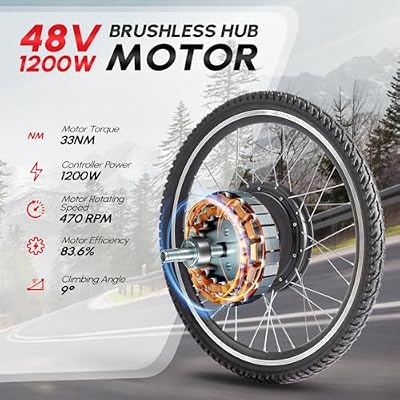
The battery the price assumed
Here is the arithmetic that made the price look unbeatable. At 149.99 for a claimed 1200W, the kit works out to 0.125 per claimed watt, and the battery came with it. Every other kit in our table that includes a battery costs more, and the closest power competitors ask you to buy the pack separately.
Here is the arithmetic that undoes it. A 1200W motor at 48V draws 25 amps at full output, and nothing in the record says the pack could deliver them. No controller amp rating was printed either, so even the motor side of the claim rests on unprinted hardware.
A 480Wh pack, a common size in this class, would drain in under half an hour at a full 1200W draw, and whether this kit's pack was that size, half of it, or twice it, nobody ever said. The old review called the included battery a reason the price read fair, and it never mentioned that the fair price rested on a component with no published size at all.
If you are rebuilding something similar today, the lesson outlives the listing. Size the pack before the motor claim charms you: a 1200W-class build wants a battery rated for 25A or better of continuous discharge, and our battery comparison table sorts the 48V field by price per watt-hour so you can see what a pack that size should cost on its own.
The sticker answered half the value question, and the record never held the other half.
The rotor problem
One buyer has run into the single documented defect, and it matters to anyone who brakes up front. The disc-brake mounting holes on the motor wheel don't follow the industry standard pattern, and that owner could not find any rotor that fit. Their recorded workaround was moving the wheel to a tricycle with two rear brakes, which answers the front-brake question by removing it.
The lesson is to decide your braking before the wheel arrives. Rim brakes avoid the problem entirely, and a 1200W front hub on rim brakes is a coherent build if your frame takes them. If a front disc brake is essential to your project, no listing text could have settled the rotor question, and with the listing dead the pattern can never be re-checked.
Treat the standard-pattern claim as unverified for any PEXMOR wheel you find secondhand, and measure or ask before you build a brake around it.
Fit, weight and the law
The fit case was narrow and clearly stated. The motor wheel is a 26-inch front, it needs 100mm of dropout spacing, and it suits seven-speed gearing. PEXMOR also printed a 220-pound rider weight limit, which is a real constraint for heavier riders and worth more attention than most listings give it.
The wheel itself carries the motor's mass, and a hub motor's weight rides as unsprung mass below the fork, less shielded from road shock than any frame-mounted motor, which is the physics reason front-hub builds feel their road surface (Wikipedia).
Then the law. The United States defines a low-speed electric bicycle at 750 watts and 20 mph of assistance (Wikipedia), and 1200W sits well outside that envelope before any state adds its own limits.
Throttle mode on this kit was off-road and private-land territory in most places. The pedal-assist mode was the compliance-friendly option, though the power under it still exceeded the federal definition, so the honest framing is that this kit was a trail and private-property machine with a street mode, not a street-legal machine with a trail mode.
What the record holds, and what it cannot
The record is two written texts under a four-star average from three ratings. The stronger text is long-term: one owner has run the kit for more than a year, reports it performs the same as the day it arrived, and has bought a second unit for another project.
A repeat purchase is the strongest signal a budget product's record can carry, and it says the motor wheel and controller held up. The other text is the rotor complaint above, and it's the reason the braking section of this review exists.
What nobody ever provided is a speed. The listing recorded about 470 RPM for the motor on a 26-inch wheel, and the arithmetic on that figure gives roughly 36 to 37 mph with no rider and no load, because a 26-inch wheel rolls about 2.1 meters per turn.
Every real number lands below a no-load figure once a rider, a tire, and the controller's current limit join the chain, and since no buyer ever reported a ridden speed, there's nothing to check the claim against. The same silence covers range, because range is a function of the pack nobody sized.
That's the shape of this record: one durable owner report saying the hardware works, one defect report saying the disc mount takes no standard rotor, and two of the kit's three headline numbers - the battery size and the controller rating - printed nowhere at all.
Common Questions
Did the kit really include a battery?
The listing said yes, and the old spec list carried it. The size of that battery - amp-hours, watt-hours, or even a cell count - was never printed anywhere in the record, which is why the price question in this review has no bottom.
What bike does a replacement need to fit?
A 26-inch front wheel with 100mm dropout spacing, which covers most rigid and hardtail forks but not all, so measure the fork opening before ordering. Seven-speed freewheel compatibility was part of the design.
Do you still need a torque arm if one comes in the box?
On an aluminum fork, plan on yes. The ElectricBike.com guide's advice for powerful front hubs on aluminum is two arms, one per dropout. One included arm covered the minimum, not the guide's recommendation.
Was a 1200W kit street legal?
Not under the United States 750W low-speed electric bicycle definition. Pedal-assist mode was the gentler option and still exceeded the federal power line, so treat the whole kit as private-property and trail hardware with local law as the final word.
How fast would it actually go?
Nothing in the record says, because no owner reported a ridden speed. The no-load arithmetic from the listed 470 RPM lands around 36 to 37 mph, and a real rider on a real tire goes slower than that, by an amount nobody measured.
What should a replacement buyer check first?
Brakes, before anything else, because the one documented defect was a non-standard disc rotor pattern. After that: the 100mm dropouts, a torque arm in whatever box you buy, and a pack rated for the amps your motor claim implies. Our conversion kit comparison table shows what the current market charges for each, and the review archive carries the other front-hub builds we have taken apart.