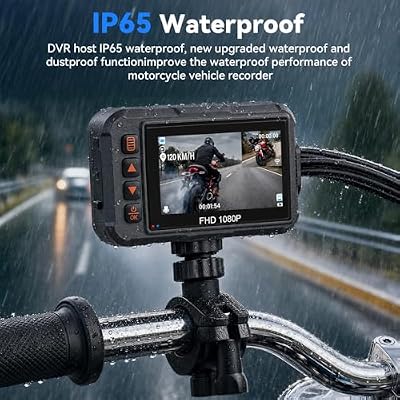
Some listings bury their weak points in the fine print. The OiLiehu dual dash cam makes its weak point impossible to miss, because there is no record behind this camera at all. Not one buyer has left a rating, and not one owner has written a word about installation, daylight footage, or whether the rear camera survived a wet season.
The page carries a full spec table, six bullets, a live buy box, and then it stops.
Zero-review listings are common in the budget dash cam tier, and they are not all the same kind of bet.
Some are brand new, a few weeks old, and the record will fill in. This one has been in our comparison data since early September, and the record has stayed empty the whole time. A listing can sit that long at a live price and still collect nothing, and that silence is itself a fact worth reading.
So this review works through the only evidence available, the listing itself. The spec table turns out to be the most useful part of the page. It contradicts the marketing bullets twice, it names what the box does not include, and it carries the GPS and parking mode details the headline never explains.
The OiLiehu dual dash cam is a live listing with a one-year warranty row and zero buyer feedback, and the honest reading is that nothing on the page proves the camera works on a bike.
What the page does commit to is a camera that logs GPS mileage, speed and altitude, locks a 30-second clip when the G-sensor trips while parked, and carries a one-year warranty. On price it sits in the middle of the 82 dash cams we track, with roughly a third of the table costing less, and the resolution story does not survive its own spec sheet.
How to judge a listing with zero reviews
An empty record does not leave you empty handed. Four checks still work when no buyer has written anything, and this listing fails two of them.
The first check is whether the spec table agrees with the bullets. On a healthy listing the two describe the same product in different words. Here bullet one says the front records at 720P and the rear at 480P, bullet two says the system records HD 1080P, and the Video Capture Resolution row says 1080p.
Three statements, two resolutions, and no camera anywhere on the page is ever named 1080p.
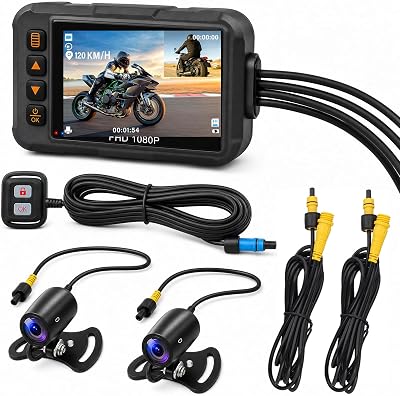
The second check is the box row. Included Components on this listing reads User Manual, and so does the Built-In Media row.
The row that should say what ships lists a manual. More on what that costs you below.
The third check is the warranty row. This one reads a bare one year with no terms, no exclusions and no process named.
A one-year line is common in this price band, so the row is not a red flag by itself. It is just thin.
The fourth check is demand. The listing ranks deep in the category, at 4,292 in Car On-Dash Mounted Cameras, so the silence is not one eager buyer away from ending. Few people are watching this page, and the ones who watched before you did not write either.
The resolution claim the listing cannot keep straight
Here is the whole resolution story, in the order the page presents it. Bullet one: a front HD 720P camera and a rear 480P camera.
Bullet two: HD 1080P high definition recording with a 120 degree wide-angle lens. Spec table: Video Capture Resolution 1080p. The title adds nothing but confidence.
The 1080p figure is the standard resolution for dash cams, and 720p is the typical rear camera resolution. Read against those norms, the only per-camera numbers on this page put the front below the front standard and the rear below even the usual rear figure.
The 1080p claim floats free of both cameras, and since the spec row repeats it without attaching it to either lens, the safe assumption is that the marketing bullet won an argument the hardware table was not part of.
That matters most for the license-plate promise. Bullet two says the camera effortlessly captures the license plate of the vehicle ahead. The camera facing forward is the 720P one.
Resolution alone does not decide whether a plate comes out readable, lens quality and bitrate matter too, but a front camera already below the category standard is an odd place to hang the page's most specific promise.
The 480P rear camera is best read as a did-something-hit-me camera. It will show that contact happened and roughly what the vehicle looked like. Plan on it for events, not for evidence you can read at a distance.
The 120 degree lens is worth one honest note. Wide-angle front lenses commonly run 130 to 170 degrees, so this sits on the narrow end. The trade is real but mild.
A narrower view distorts less at the frame edges, and the license plate of a car you are following sits near the center of the frame anyway.
What the spec table adds that the bullets skip
The GPS logging is the best-supported feature on the page, because the title and bullet three agree on it. Bullet three says the built-in GPS records riding mileage, riding speed and current altitude, for clear proof during disputes. That is a dispute tool, not a navigation tool.
When a driver claims you were flying and you were not, the speed figure stored with the clip settles the argument better than your recollection does.
Parking mode is the second feature the page half-explains. When the G-sensor detects movement or an impact while the bike is parked, the camera records a 30-second clip and locks it so loop recording cannot overwrite it. What the page never says is that parking mode needs continuous power.
Dash cams run in parking mode when hardwired into the vehicle electrical system, and on a motorcycle that means a voltage-sensing connection so the camera does not quietly drain the starting battery over a week of sitting. Budget for that wiring job, or accept that parking mode is something you switch on for the night rather than a permanent state.
The wired remote is a small thing that matters on a bike. It carries a recording status indicator and a microphone, and its buttons are laid out for gloved hands. Locking a clip after a near miss, without pulling over and digging through menus, is exactly the job a wired button does better than an app.
The rest of the spec table is ordinary but consistent. A 3-inch LCD for reviewing clips on the bike, microSD storage with a 128GB ceiling, a 2 f-stop maximum aperture with a 0.25 inch sensor, push-button control, and a 7 ounce main unit with dimensions of 3.2 by 2.6 by 4.6 inches.
One row disagrees with the bullets, though. The Mounting Type row says Rearview Mirror Mount, while bullet five offers under the seat, on the handlebars, or near the fairing. A mirror mount and an under-seat tuck are different installations, and the page never reconciles them.
What the box row does and does not list
Included Components reads User Manual. So does Built-In Media.
On a listing whose headline feature is loop recording, the box row lists no memory card, and no other row or bullet claims one. Treat a card as a separate purchase, and pick a fast microSD card, because slower cards drop frames or corrupt files under the constant rewriting loop recording demands. The camera accepts up to 128GB.
Two more gaps sit in the same corner of the page. The first is the wifi story. Two spec rows, Connectivity Technology Wi-Fi and Special Feature Built-In WiFi, promise a wireless link, and not one bullet mentions wifi, an app, or a phone.
The app is never named. On comparable listings the app carries the firmware updates, the settings that are clumsy on a 3-inch screen, and the easy clip export, so an unnamed app is a real unknown, not a cosmetic one.
The second is Light Vision, which appears in the title and nowhere else on the page.
No bullet explains it, no spec row supports it, and the listing never claims night vision anywhere. Read it as a marketing phrase until a buyer proves otherwise. The sensor and aperture rows are modest, and modest hardware plus an undefined low-light claim usually means street-light-dependent night footage.
Where the price sits, and what one year of warranty covers
At the live price the camera sits in the middle of the 82 dash cams we track, with roughly a third of the table costing less.
The price in our data sat below the live figure until recently, so it has moved up while the record stayed empty. A rising price on a zero-review listing is the wrong direction on both axes, and the comparison table is the place to watch whether it comes back down.
The warranty row reads one year, with no terms beyond that. Set it against the category's known aging pattern. Budget dash cams typically carry LiPo batteries good for an estimated two to three years, and a degraded cell shows up as random on-off behavior and format errors.
The one-year warranty covers the healthiest stretch of that window and stops before the failure mode that actually claims these cameras. That is not a reason to skip this camera. It is a reason to know that the warranty is not the durability plan.
Demand is thin. A rank of 4,292 in Car On-Dash Mounted Cameras means few buyers a day reach this page, which explains the empty record and predicts it staying empty.
If you want a dual dash cam with an actual record behind it, the TERUNSOUl D018D carries a deep purchase-badged record, the Ssontong dual unit has a large record with a documented one-year failure cluster, and the Tewolises listing shows what an honest entry-level spec concession looks like next to this one.
Frequently Asked Questions
What does the IP67 rating actually cover here?
The spec row says IP67 Waterproof. In the IEC IP code, 6 means dust tight and 7 means the enclosure survives immersion up to 1 meter deep for 30 minutes.
For a bike that translates to rain and road spray, not pressure washing. Keep the jet wash away from the camera housings and the connector seams.
Can the 480P rear camera identify a license plate?
Plan on no, at least at any distance worth recording. The rear figure sits below even the 720p that is typical for rear cameras, so expect it to prove that an event happened and to show the vehicle's general shape. Distance reading belongs to the front camera, and the front camera is the 720P one.
What memory card should I buy for it?
A class 10 or faster microSD, since loop recording rewrites the card constantly and slower cards drop frames. The ceiling is 128GB, and nothing in the box, so the card is part of the real cost of this camera.
What does parking mode need to actually work on a bike?
Continuous power. That means a hardwired connection, ideally through a voltage-sensing kit so the camera cuts off before it drains the starting battery. The listing does not include a hardwire kit, and the box row lists a manual, so plan the wiring as its own step.