BMS amps are the spec most riders skip past, and the spec that decides whether a high-power build actually runs. Voltage and amp-hours get the attention. The current limit printed on the battery management system is what stands between a hungry motor and a pack that cuts out on the first long hill.
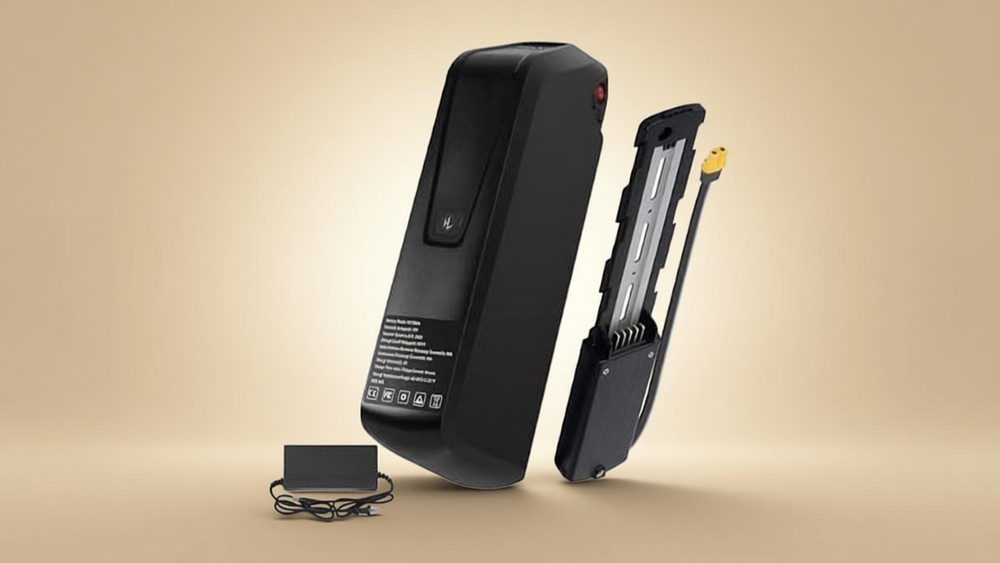
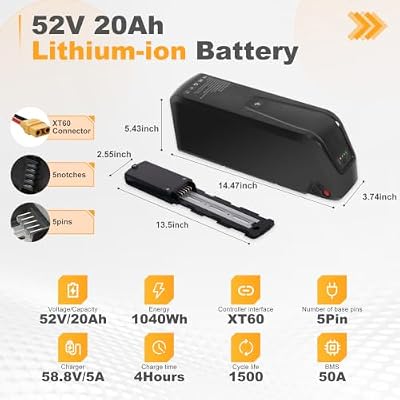
Meaycoty made that number its headline. The 52V 20Ah pack listed a 50A continuous BMS at a time when most packs in the class ran 30A or 40A, alongside a USB port, a power switch, a key lock, and a motor band that ran from 0 to 1800W. On paper it looked like a spec sheet from a more expensive shelf.
Look at the numbers together and the story changes. The very title advertising 50A caps its motors at 1800W, which draws about 34.6A at 52V. On its own terms the headline figure outran the use the listing described.
That listing is gone now, and it never collected a review, so nobody found out which number mattered. What the recorded data can still teach is how to read a BMS rating against a motor, what the missing details cost, and what to check in the packs that replaced it.
The Meaycoty 52V 20Ah ebike battery recorded 1040 watt-hours for 339.99, and its 50A BMS was the loudest number on the page. It was also a number the pack's own motor band never needed continuously, because 1800W at 52V sits near 35A. The listing died with zero reviews, so the gap between the headline and the requirement went untested by every buyer who might have closed it.
A 50-amp answer to a question the listing never asked
Amazon returns Page Not Found for this ASIN as of November 2026, and the Creators API rejects it the same way, so the death is recorded on both doors.
Our data row carried a null rating and a null review count from the day the pack was listed to the day it vanished. Nobody graded this pack. Every claim below is a listing claim or a recorded number, and the article does not pretend otherwise, which is also why the buy links here point at a tagged Amazon search rather than a dead page.
That zero-review record matters more than usual because the headline spec and the motor band point in different directions.
A buyer reading the 50A figure alone would expect a bike the motor band does not offer. A buyer reading both would wonder why the bigger number is there at all. With no owner to settle it, the honest answer is that the 50A rating bought headroom, not a bigger bike.
At the recorded 339.99, the cost per watt-hour sits among the more expensive of the 324 packs on our ebike battery comparison table, where the middle of the market runs noticeably cheaper. The exact position renders live in the table's specs box. For a pack whose listing skipped the details buyers need, that price asked for a lot of trust.
What the record actually holds
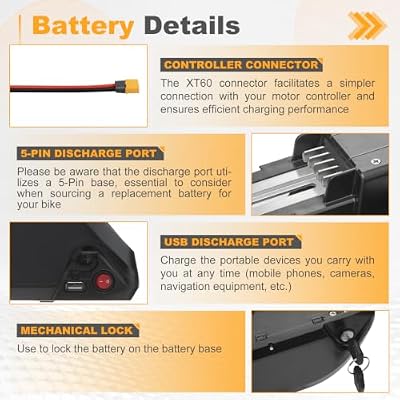
The recorded spec box holds 52V and 20Ah, which works out to 1040Wh, alongside the 50A BMS, a 5-pin base, a USB port, a power switch, an LED indicator light, and a key-operated safety lock.
The motor band ran from 0 to 1800W. The case was described as a waterproof shell with shockproof padding inside. Each of those features carries as a claim printed by the seller, because with zero reviews there was never an owner record to check any of them against.
The gaps are as telling as the entries. No IP rating was ever printed, so the waterproof claim can only mean weather resistance, never submersion. The USB port's output amperage was never specified, so there is no way to know whether it charges a phone or merely trickles one.
No cell model, no cycle-life figure, no weight, no charger specification, and no warranty terms were recorded either. A listing can skip all of that and still sell packs, but a buyer comparing two 52V 20Ah options has nothing to break the tie except price.
Reading the BMS number against the motor ceiling
An 1800W motor at 52V nominal draws about 34.6A, and a 1500W motor draws about 28.8A.
Even a 40A board covers the top motor on the listing's own band without breaking a sweat, which is what makes the 50A figure interesting rather than essential. The extra ten amps buy room for the moments when current spikes: acceleration from a stop, a steep climb, or a pack sagging near empty, when the same power needs more current than the nominal-voltage arithmetic suggests.
Per the em3ev BMS guide, the BMS current rating is one of the most important specs to check for exactly that reason, and it is also one layer of protection that cannot make damaged cells or undersized wiring safe.
Down at the bottom of the band the numbers stop mattering. A 750W motor draws about 14.4A at full tilt, which sits far inside even a 40A limit at every point in the charge cycle. Riders on small motors gain nothing from a 50A board and should spend the money elsewhere.
The buyers this spec was aimed at are the ones running 1500W to 1800W builds uphill, and for them the headroom is real but modest, worth maybe one size class of burst demand.
Range at both ends of the throttle
The old listing-era article threw out a band of 30 to 50 miles with no riding regime attached, which is the kind of number that cannot be planned around.
Scaled from the em3ev range table, where a 960Wh pack covers 30 to 40 throttle miles or 50 to 65 on light pedal assist, a 1040Wh pack covers about 33 to 43 miles on throttle and about 55 to 69 with light pedal assist. Where a rider lands inside those bands depends on motor size, terrain, and how much of the ride is throttle.
The bottom of the throttle band belongs to big motors run flat out. A 1500W motor at full draw burns 1040Wh in about 42 minutes, which at twenty miles per hour is about 14 miles between charges. That is the arithmetic the old throttle figure of 20 to 25 miles ignored, and it is the number a rider should plan around when the ride is mostly throttle on a large motor.
Replacing it without repeating the listing's gaps
A replacement in this class is a fitment problem before it is an electrical one. Match the 5-pin base pattern and connector to the mount, measure the old case against the new one, and confirm the controller's current limit sits under the new pack's BMS rating. Those three checks clear most of the ways a swap goes wrong, and none of them require trusting a headline number.
Then ask for the details this listing skipped. A printed IP rating tells you what weather resistance actually means on the pack you are buying. A charger in the box, with its amperage stated, tells you how long a 20Ah pack takes from empty, which at a 2A charger is about ten hours.
A warranty written down somewhere is worth more than a lock or a USB port, because it is the only feature that costs the seller money when the pack fails. On our comparison table the current 52V 20Ah field offers several packs that print all three, most of them priced below what this one asked.
Frequently asked questions
Can you still buy this exact pack?
No. The Amazon page returns Page Not Found as of November 2026 and the pack is gone from the marketplace. Links in this article point at a tagged Amazon search for the pack's spec, which is the closest a buyer can get.
Does a 50A BMS make a bike faster?
Not by itself. Speed comes from the motor and controller. The BMS rating decides how much current the pack can feed them, and since an 1800W motor draws about 34.6A at 52V, even a 40A board covers that motor continuously.
The 50A figure buys burst headroom on climbs and acceleration, not a higher top speed.
What charger does a 52V 20Ah pack need?
No charger specification was ever recorded for this pack. As a class, 52V packs charge at 58.8V with a 14S charger, and charge time follows from amperage: 20Ah at 2A is about ten hours from empty, and about five at 4A. Confirm both numbers on whatever replacement pack you buy.
Was the safety lock worth having?
There is no owner record to answer that, because the pack never collected a review. A key lock physically secures the pack to its mount and deters casual removal, which is a real feature on a 339.99 pack. Whether this particular lock was any good died with the listing.