Replacing a 48V pack on a budget usually means choosing between brand names you have heard of at prices you have not, and no-name boxes at prices that look like typos. LOLRKO sits firmly in the second camp. This one offers 960 watt-hours, an upgraded 30A BMS, and a charger in the box.
The catch is how little of that you can check before the pack arrives. Two different weights share the same spec table.
A 1000+ cycle promise sits against a one-year warranty. Waterproof gets claimed with no IP rating behind it. And the review record sits at sixteen ratings, most of them one-liners.
What follows is a walk through the numbers on that page, from the weight math and the cycle claims to the voltage question one owner has raised, and what 960Wh means for range on a real commute.
The LOLRKO 48V 20Ah battery sits in the cheapest fifth of the 301 packs we track by price per watt-hour, and it is a bare rectangle with no frame-mounting hardware at all. That combination makes it a DIY and custom-mount battery first, and a replacement pack only for people willing to measure twice.
The record is thin and almost entirely positive, the two weight figures argue with each other on the listing itself, and the 1000-cycle promise rests on a one-year warranty.
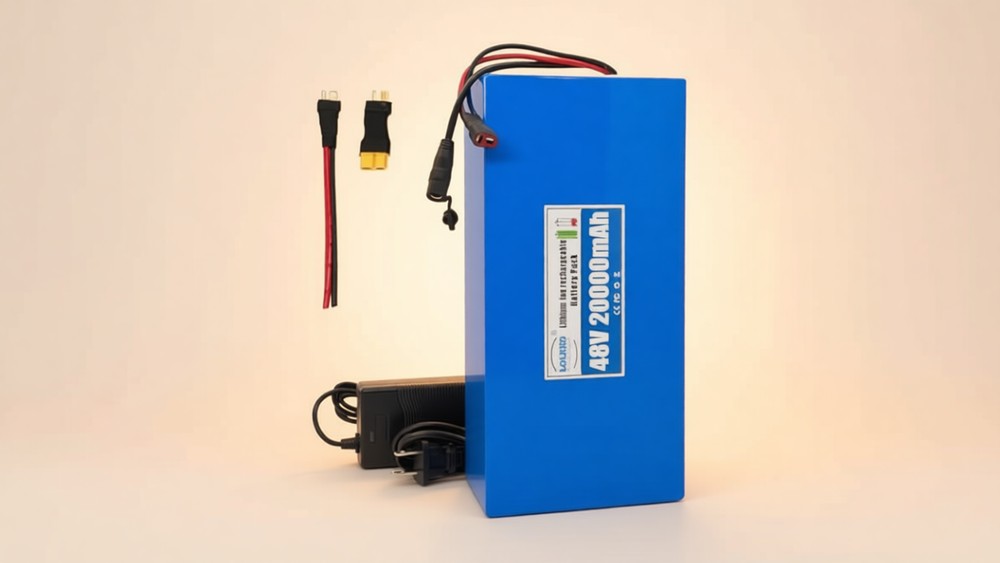
A 960Wh rectangle with nowhere inside the frame to live
The pack measures 4.96 x 2.68 x 9.84 inches, a slim upright rectangle a little under three inches deep. It lacks Hailong rails, a downtube mount, and a rack tray, so there is no way to slide it into a built-in battery slot.
Since the design has no internal home, you have to mount it externally using straps, a bag, or a rack to keep it secure while you ride. One owner used this battery for a wheelchair retrofit, which shows how versatile the box shape is for custom builds. The listing recommends it for bikes, tricycles, scooters, and electric motorcycles with motors from 250W to 1000W on 48V systems.
The title just lists specs without a brand promise, so measure your mounting space before buying. A very specific slot on your bike means this pack will not go into it no matter what. You'll want to be very sure, before the box arrives at your door.
The weight numbers argue with each other
The listing's spec table gives Item Weight as 8.36 pounds and Battery Weight as 4.1 kg, which is 9.04 pounds. Those two figures describe the same pack and do not match, and the page offers no way to tell which one is right.
The arithmetic makes the pair stranger. ebikes.ca states a figure of around 110 Wh per kilogram for a complete lithium pack, counting the case, the BMS, and the wiring.
If the listing states 4.1 kg, a 960Wh pack would carry about 234 Wh/kg, and if it states 8.36 pounds instead, the figure rises to about 253 Wh/kg. Both sit far above what finished packs normally reach, so either the weight or the capacity is not what it seems.
One owner has noted the pack is a good size with decent build quality for a wheelchair retrofit project. That person seemed satisfied with what arrived, despite the confusing figures on the page.
Sixteen ratings and one story that carries them
The record stands at 4.8 stars from sixteen ratings. Ninety percent gave five stars and the remaining share gave three, with no four, two, or one-star ratings at all. The people who gave three stars wrote nothing, so the only sub-five-star signal on the page stays silent.
All five written reviews come from confirmed orders, which is rarer than it should be and means every person sharing words actually spent money on the pack. Four of those texts are one-liners: the battery works as expected, it's great, it's awesome, it arrived fast and works. The fifth carries real detail.
One owner has reported in August 2025 that a wheelchair retrofit worked perfectly, that the pack put out 20A with no issue, and that the build quality and size were good.
Since the record spans only June 2025 to March 2026, it's far too short to conclude how the hardware holds up over years. No owner has reported a single mile of range, so planning a route means relying on the math below.
The voltage you cannot check before the pack arrives
The listing says this pack is 48 volts but never states how many cells sit inside or what the voltage is at full charge. One owner has found the battery reads lower than most other packs labeled 48V, while confirming the description states its voltage accurately.
That gap matters because 48V is a nominal figure built from cells that sit near 3.7 volts each. Two packs with the same label can charge to different full-charge voltages, depending on how many cells the maker put in series.
On a stock bike this usually changes nothing, because the controller defines the operating window the pack works in. It matters more when you're building a DIY rig or matching an existing charger. Ask the seller for the full-charge voltage before ordering, because the page won't tell you, and you don't want a pack your charger cannot fully fill.
Cycle claims against a one-year warranty, and range as arithmetic
The listing promises 1000+ cycles and up to five years of life, yet the warranty in the spec table runs one year, a small slice of the claimed span.
Most makers specify 300 to 500 full cycles for consumer lithium cells, and the count rises sharply when you discharge shallowly instead of running the pack flat. Storing the pack part-charged helps too, if you want the higher figure to stay reachable.
On the power side, the upgraded 30A BMS allows about 1,440W of continuous draw at 48V, which covers the whole stated 250-1000W motor window with headroom for hills. The pack guards against overcharge, over-discharge, over-current, over-voltage, overload, and short circuits, per the listing.
Because no owner has reported a distance, range stays arithmetic. At 960Wh, expect roughly 38 to 64 miles with modest assist at 15 to 25Wh per mile, and roughly 32 to 38 miles riding throttle-heavy. Charging runs about ten hours on a 2A charger or about 6.7 hours on a 3A one, and the listing never states which it ships.
The waterproof claim carries no IP code anywhere, so treat it as seal-and-plug splash resistance until proven otherwise.
On value, this pack sits in the cheapest fifth of everything we track per watt-hour, which you can verify on the ebike battery comparison table.

Frequently Asked Questions
Will this battery fit in my frame's battery slot?
No. This pack is an external rectangle with no frame rails, so it won't slide into a standard slot. Check the comparison table for a shaped pack that matches your bike, or plan on strapping this one to a rack or into a bag.
How long does it take to charge?
The listing includes a charger but never states its amp rating. At 2A, a 20Ah pack needs about ten hours.
At 3A, about 6.7 hours. You won't know the speed until the charger is in your hands.
Is the battery actually waterproof for rainy rides?
The listing claims a waterproof seal and plug design but publishes no IP rating anywhere on the page. Treat it as splash resistance and avoid mounting the pack in a wheel-spray line on that claim alone.
Will the voltage match my existing 48V system?
The pack is 48V nominal, but the full-charge voltage is unstated, and one owner has found it lower than most other 48V-labeled packs. Ask the seller for the full-charge voltage if you're matching a DIY system or a charger you already own. On a stock 48V bike, the controller defines the window and this rarely matters.
Is 960Wh enough for commuting?
Arithmetic says the pack covers roughly 38 to 64 assisted miles at modest assist, which handles most round trips with a buffer. No owner has confirmed a real-world mileage figure for this specific battery yet, so treat those numbers as the math, not a report.
