Folding e-bike owners replacing a tired 48V pack usually land on the same shelf: silver fish and folding cases from brands nobody has heard of, all priced within a few dollars of each other.
The Lockbus 48V 10Ah folding battery sits on that shelf at 139.99 with about 29 cents per watt-hour attached, close to the middle of the 324 packs in our comparison table. You are not paying a premium and you are not getting a bargain.
The record on this listing is the thinnest that can still be called a record: one rating, and one written account underneath it. The account is a purchase-badged failure report from September 2026, and nothing on the page balances it. What keeps the listing worth a look is that its claims are almost all arithmetic, and we have run every line of that arithmetic below.
There is also a second listing that belongs in this conversation. An LGNUO-branded 48V 10Ah pack sells 99 cents cheaper with the same printed weight, the same box list, and card text copied word for word. Both get covered here, because choosing between them is most of the decision.
The whole record is one account
One owner has reported a pack that would not hold a charge from the first rides. The account is purchase-badged, dated September 3 2026, and it has drawn two helpful votes, so it is the newest text on the page as well as the only one.
The owner says they checked compatibility with their AskMy e-bike before buying, which is exactly the diligence the listing's own bullets ask for, and the pack failed anyway. In their words, it "always required to be charging, even after a few minutes of taking the battery off", and it drained one charge bar inside three minutes of riding.
That is one data point, and this article will not pretend a defect rate can be built from it. Sellers replace packs, batteries arrive damaged, and one bad unit happens in every production run.
But the direction of the complaint matters more than its count. Capacity honesty is the failure class that a listing like this cannot disprove on its own page, because a 480Wh claim is a promise about cells nobody can see.
When the only owner evidence that exists is a metered-feeling capacity complaint, the honest reading is that the pack is unproven, not condemned.
Nothing positive counterweights the account. No second text praises the range, the fit or the seller's support. The listing carries no model number, no warranty term and no best-seller rank, so there is no paper trail to lean on either.
Two brands, one case, 99 cents
The Lockbus listing sits on a variant ladder with three rungs: 10Ah, 13Ah and 20Ah, all 48V. The 13Ah rung is our covered Lockbus 48V 13Ah pack, which we have reviewed separately, and it was still in stock at 160.99 when we probed it the day before this was written. If you want more range from the same case, that rung is the one to check.
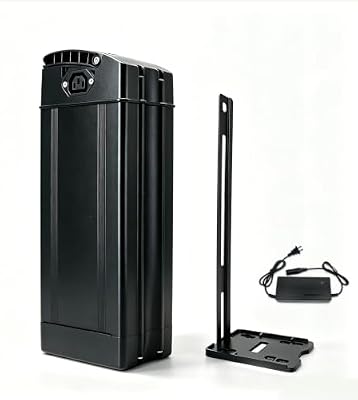
Now the odd part. The LGNUO 48V 10Ah battery sells for 139.00 with a printed weight of 7.58 pounds, the identical figure this listing prints, and a footprint of 365 by 130 by 87 millimetres against this pack's 358 by 135 by 90. Both boxes contain a battery, a holder, a 54.6V 2A charger and two keys.
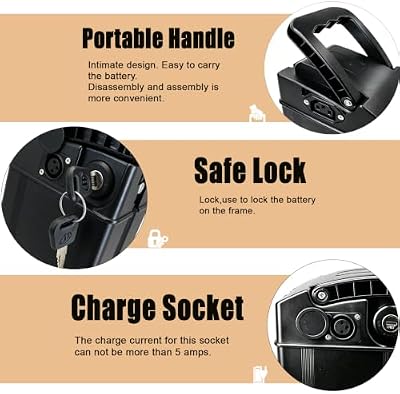
The card copy goes further. The Lockbus card that explains the charge socket carries sentences that appear word for word on the LGNUO card, including the line that the socket cannot take more than 5 amps of charge current.
We have seen this platform's cases sold under three brand names already, so the overlap is context rather than proof, but a buyer should read these as two storefronts for one hardware family.
The differences that remain are small but real. The LGNUO listing claims an IP65-rated aluminium housing, while the Lockbus listing never prints any water-resistance claim at all. The footprints differ by a few millimetres in each direction, which can matter on a tight battery mount.
LGNUO's card prints a 5-hour charge time, where the Lockbus listing prints no charge time anywhere.
What the arithmetic says
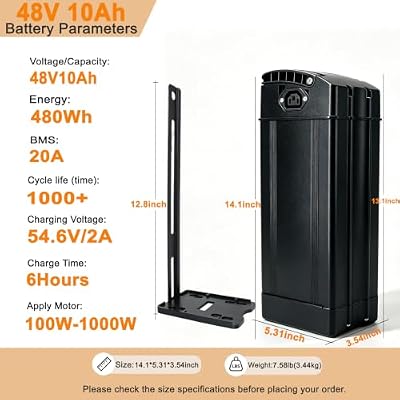
Start with the energy. 48 volts times 10 amp-hours is 480 watt-hours, and the parameter card agrees.
The 54.6V charger in the box is 13 cells in series charged to 4.2 volts each, which is the standard 48V-class arrangement, so the charger and the pack agree with each other. That much checks.
The power claims also hold together, which is rarer than it should be in this class. A 20A BMS at 48 volts caps sustained draw at 960W, and the title sells this pack for motors up to 800W. The claim sits under the pack's own ceiling with room to spare, so a buyer inside the printed band is not leaning on the BMS to survive its rating.
Charging runs at 2 amps from the box charger, which puts the floor at five hours for a full 10Ah, and the socket card caps charge current at 5 amps, so a faster aftermarket charger buys you little on this case.
The printed weight closes the last loop. 480 watt-hours carried in 3.44 kilograms works out to about 0.14 kilowatt-hours per kilogram at the pack level. Mass-produced lithium-ion cells store roughly 0.16 to 0.30 kilowatt-hours per kilogram before any case, BMS or wiring, so honest cells for this pack weigh between 1.6 and 3.0 kilograms, leaving a plausible half-kilo to nearly two for everything else.
Unlike several listings we have covered, this one does not promise a weight the chemistry cannot deliver. The cycle-life claim of 1000-plus cycles sits in the top half of the 400 to 1,200 cycles typical for consumer lithium-ion cells, and nothing on the page substantiates the upper end, so treat it as marketing.
Reading a single-account record
When a listing's only owner text is a failure account, the useful move is to turn the purchase into a test you control. The printed figures give you the checklist. Charge the pack fully and confirm the charger reads 54.6V on its label.
Weigh the pack on arrival, because 3.44 kilograms is the honest figure and a pack landing far under it cannot contain the chemistry the card claims. Then take the first ride short, with the charge gauge watched, and compare the watt-hours that come out against the 480 the card promises. A metered first week costs nothing and answers the exact question the one owner account raises.
Keep the box until that test is done. The listing prints no warranty term, so the return window is the only protection a buyer has, and a capacity complaint discovered in month three has no paper trail behind it. If the pack meters honestly and rides fine, you will have paid a market rate for an unproven pack that behaved. If it does not, the window is your exit.
Frequently asked questions
Will the Lockbus 48V 10Ah fit my folding e-bike?
The printed footprint is 14.1 by 5.31 by 3.54 inches with a mounting holder in the box, and the listing's own connector card tells you to check the drain port before ordering. Measure your old pack or your mount bay against those numbers first, because folding frames have less slack than they look like they do.
How long does charging take?
The box charger runs at 2 amps, so a full 10Ah needs about five hours, and the socket card caps charge current at 5 amps. A bigger charger will not help much on this case.
Is the 1000-cycle claim believable?
It sits in the top half of the 400 to 1,200 cycles typical for consumer lithium-ion cells. Nothing on the page names the cell brand or grade behind it, so plan on the band, not the top of it.
Should I buy this or the LGNUO twin?
They share a case class, a weight and card copy, and they are 99 cents apart, which is why we wrote a separate LGNUO 48V 10Ah review. The LGNUO listing claims an IP65 housing and prints a 5-hour charge time, the Lockbus listing prints neither. The Lockbus ladder holds our reviewed 13Ah rung if you want more range and more owner evidence to read.