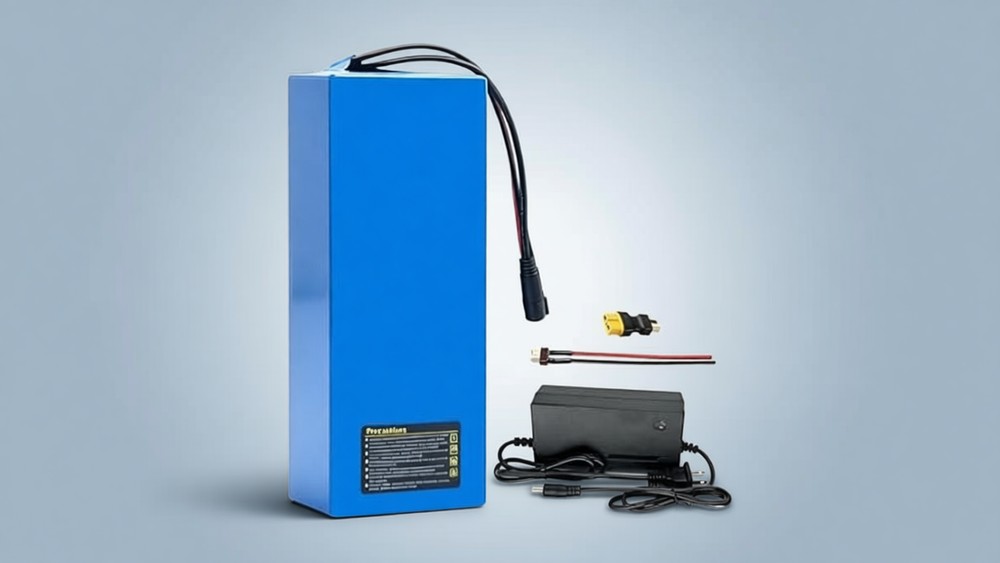
This LOCKBUS pack offers 720Wh at a price in the cheapest fifth of our battery table, in the 36V class where watts-per-dollar goes furthest, and its 30A BMS fully covers the claimed 200W-800W motor range. The trade stack: 36V is the entry voltage, less efficient at speed and with less hill headroom than 48V, the cells are unverified despite the Grade-A claim, and the universal case needs measuring against your mount. Flat-city daily riders and conversion builders win here. Hill climbers and 48V owners should look elsewhere.
36V or 48V: choosing the voltage before the pack
Voltage is the first choice, ahead of brand or capacity, because it shapes the rest. A 36V pack is cheaper and lighter, and it's the practical choice for short-to-medium city rides on flat ground, where its lower cost per watt-hour buys the most capacity. That advice is steady across the category: 36V suits lighter, flatter riding, while 48V earns its extra cost with better efficiency at speed and more room for hills and heavier riders.
The honest test is your route. If your daily ride stays under twenty miles with gentle grades, 36V gives you the miles at the lowest cost. If you climb serious hills daily or ride at the top of the speed range, the extra cost of 48V buys real range and longevity advantages a 36V pack cannot match at any price.
This pack is not dual-voltage. Your controller must be 36V, and plugging a 36V pack into a 48V system doesn't work in either direction. Check the controller's label before the pack's listing.
The practical test for whether 36V is enough is your speed and your route's grade profile together. A rider holding 15 mph on flat streets draws modest current, and a 20Ah pack at 36V covers that profile for days between charges. The same rider adding a six-percent grade for two miles pulls sharply more current per mile, and how far the pack's voltage sags under load decides whether the controller delivers full power. Riders who spot their route in the second picture should plan on 48V before they shop for capacity, because no amount of amp-hours fixes a voltage misfit on a climb.
Range math for 720 watt-hours
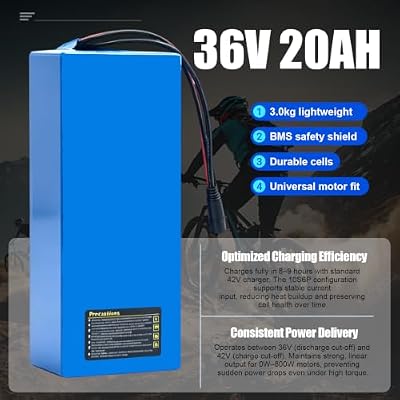
Start with the pack: 36 volts times 20 amp-hours is 720 watt-hours on paper. Depth-of-discharge limits put usable energy at roughly 580 to 620 watt-hours.
Consumption next. Pedal-assist riding at 15 to 20 watt-hours a mile gives you roughly 29 to 41 miles. Throttle-only at 25 to 30 watt-hours a mile lands between 19 and 25 miles. Those bands cover most flat-city daily rides several times over, which is the honest use case for this class. Cold weather narrows them: lithium cells give less in winter, and a daily ride that used a quarter of the pack in summer can take a third in January.
The riding pattern matters too, since stop-and-go city riding with frequent throttle pulls drains faster than steady cruising at easy assist. Treat the first week as your test, note the percentage consumed on your actual route, and your own numbers will replace every band in this article with something better. The band that matters is the one you measured yourself.
The 1000-cycle claim follows the familiar pattern. Lab cycle counts assume shallow discharges and stable temperatures, and generic packs commonly land in the 500 to 1000 cycle range in real use before dropping to 80 percent capacity. The Grade-A cell claim is unverifiable until the first full rides, and voltage sag on a hill is the early sign that the label was optimistic. The 6.6-pound weight is genuinely light for 720 watt-hours, consistent with a real NMC lithium-ion build.
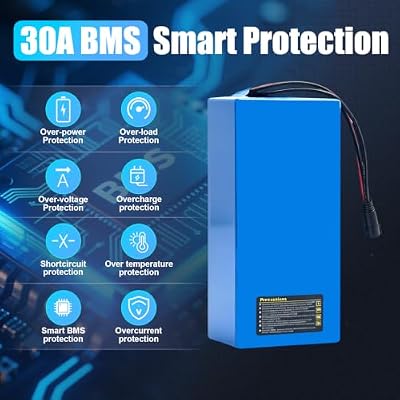
The 30A BMS actually matches the motor claim
A 30A ceiling at 36V supports about 1080 watts of draw, which covers the full claimed 200W to 800W range without the BMS clipping peak power on hills. That internal match is worth noting, because plenty of listings claim motor ranges their battery can't feed. This one can, and the LOCKBUS listing states the motor range and the BMS number on the same line, which makes the check easy.
The protection set matters at this price, because budget packs sometimes ship with fewer protections than the listing claims, and the ways they fail are not subtle. Overcharging ages cells for good, a pack without a heat cutoff turns a stuck charger into a fire risk, and a short-circuit failure discharges the pack at once. This listing claims the full set, which is the minimum a buyer should accept at any price.
The universal case measures 8.15 by 4.72 by 2.75 inches, which suits conversions, scooters, trikes, and DIY builds. Branded bike trays vary, so measure the space before ordering. The protection set covers overcharge, over-discharge, overcurrent, overvoltage, short circuit, and temperature, which is complete for the class.
Charging pace is worth checking at buy because the listing doesn't state the charger's amperage up front, and a 720Wh pack on a 2A charger is an overnight proposition while a 3A charger cuts that by a real amount. Ask before ordering if your schedule depends on same-day turnaround. The 6.6-pound weight makes off-bike charging handy in a way that heavier packs are not, which in part offsets the slow pace for riders who bring the pack inside.
Who should buy it, and who should spend differently
Buy it if your system is 36V, your riding is flat-to-rolling city, you want the cheapest credible watt-hours in the class, and your build takes a universal pack. The price-per-watt-hour is the case, and it's a strong one.
Spend differently if your controller is 48V, because this pack won't work at any price. Spend differently if you climb steep hills daily, because 48V headroom is the durable fix. And spend differently if you need certified cells or UL papers, because this listing claims neither, and the battery table shows the packs that do. The 36V class is thinner than 48V, so verify dimensions and plug type before ordering.
Frequently Asked Questions
How far will I go on one charge?
Roughly 29 to 41 miles on pedal assist and 19 to 25 on throttle alone, from about 580 to 620 watt-hours of usable energy.
Can I use this on my 48V bike?
No. Match the voltage first: a 36V pack doesn't work on a 48V controller in either direction.
Is this battery good for riding hills?
It handles gentle grades. Steep daily climbs are where 48V headroom earns its extra cost.
Are the 1000-cycle claims real?
Plan for two to four years of daily riding. Lab cycle claims assume ideal treatment, and the first full rides show what the cells give.
Will it fit my bike?
The universal case measures 8.15 by 4.72 by 2.75 inches. Measure branded mounts before ordering.