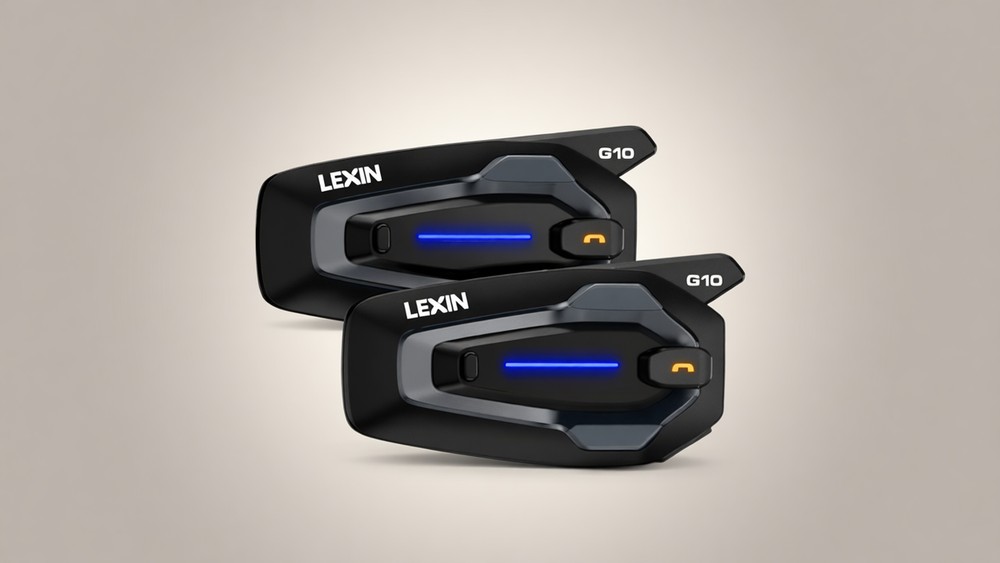
Two helmets come out of this box, and that one fact separates the LEXIN G10 dual pack from the single-unit listings it sits beside. You're not buying one intercom and promising yourself you will buy a second one before spring. You're buying both ends of the conversation at once, and the listing prices it that way.
The category makes this harder than it needs to be. Boxes routinely say Dual or Duo or 2-Riders when they hold a single unit, and we've unpacked that trick on cheaper listings before. Lexin's page carries a different confusion in the other direction: the title says 8 Riders while the spec table files the headset under headphones.
A buyer has to work out both what actually arrives and what the rating pool says about it.
Here is how we read the page. We scraped the Amazon listing and its reviews, sorted the written texts by date and by helpful votes, and pulled our own price-per-rider ranking across the intercoms we track. What follows is the pack arithmetic, what the purchase-badged owners have found, the pairing record, the range story, and the spec-table numbers that need decoding.
The G10 dual pack is a mid-pack value on our intercom comparison table, and it sits near the expensive end of the eight-rider units we track.
At 189.99 for two complete units, each helmet costs about 95, and for that you get 40mm speakers, Bluetooth 5.1, music sharing, a dual microphone set and a one-year warranty on each unit. The purchase-badged record is the weakest part of the page, so we read it first and let the louder unbadged praise wait its turn.
What the pack costs and what the price buys
The arithmetic is simple enough to do in the aisle. One box, two units, 189.99, so about 95 per helmet once you split it.
Lexin sells the single unit on its own listing, and we rebuilt that page separately, because the two ASINs collect different rating pools even though the hardware is the same. If you already own one working headset from any brand, the single unit is the cheaper door into this review. The pair is for two people starting from zero.
The eight-rider label is doing less work in the price than the title implies. Group size is a spec that far cheaper units claim too, and nothing in this record shows the G10 earning a premium for it.
What 95 per helmet actually buys is the hardware list: 40mm drivers, a boom mic for open-face helmets plus a wired mic for full-face, two mounting bracket options, IP67 sealing, a 1200mAh battery with a 2-hour charge, and Bluetooth 5.1. That's a complete kit per helmet, not a starter pack that expects you to supply the rest.
Where the pack sits in our own ranking is the claim no listing can make about itself. Across the 192 intercoms we track by price per rider, this one lands close to the middle, and among the eight-rider units it sits toward the expensive end. Compare it against the rest of the field in our intercom comparison table, because the exact position moves every time we refresh prices.
The purchase-badged record is three texts, and every fault in them is hardware
Thirteen written reviews cover this pool. Three carry the purchase badge.
One more opens by disclosing an Amazon Vine relationship in its own words. One unbadged text restates the listing's claims almost phrase for phrase, from the Qualcomm chip to the waterproof housing, and is the least useful text on the page. The histogram shows 56 percent five-star and a completely empty one-star band, which reads friendly until you notice where the badges sit.
The three badged texts are where the real friction lives. A passenger on the back of a bike hasn't been able to hear music, and has found communication with the front rider hard to catch while riding.
A long-time Lexin owner, whose previous headset lasted six years before the battery faded, has found the volume on the newer models weaker than the older ones the brand stopped making. A third buyer has found the microphone cable too short for some mounting layouts and wished the box included an extension.
None of those faults is mysterious, and none is a dud box. Volume that disappoints a passenger, volume that stepped backward from an older model, and a mic cable that misses some helmet shapes are design-level complaints, the kind that show up in the hardware rather than in one unlucky unit.
The unbadged majority is uniformly positive, and three of its deepest accounts read as careful, detailed riding reports rather than ad copy. But the badge asymmetry is the first thing a careful buyer should see on this page, because on a pool this small the badged texts carry weight far out of proportion to their count.
Pairing takes minutes, and three accounts agree on the number
Three separate accounts, written by three different buyers, land on about ten minutes to pair the two units and mount them, and one of those counts the mounting hardware in the total.
Nothing in the record describes a required app or a firmware update, which matches the two bracket options and physical buttons in the kit list. The deep account calls it easier than expected going in. The Vine text was up and running in maybe ten minutes including mounting both helmets.
One account holds back deliberately, and it is worth reading closely. A buyer who picked the pack as a gift for a brother praises the complete setup and the build quality, then declines to judge the one thing that matters most, because long-term connection stability is exactly what the brother's current system fails at.
That text still carries four stars, but its honesty is the counterweight to the ten-minute pairing stories: setup being quick says nothing about how the link behaves deep into a long ride.
Range on paper versus range in terrain
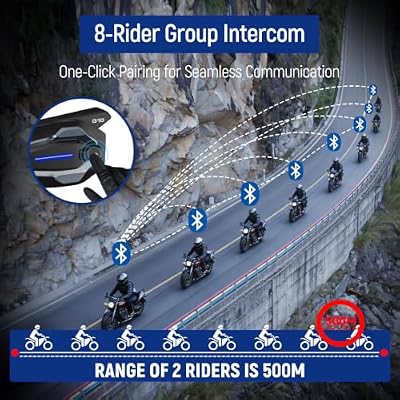
The bullets promise up to 1 km in ideal conditions and up to 500 m between two riders. No text in the record measures a distance, so those numbers remain marketing figures on this page. What three accounts converge on instead is a terrain pattern.
On open straight road the link holds solid. In hills and curves it gets choppy. The Vine account estimates the pair was dropping signal at maybe a third of what they advertise once terrain got involved, and the other two accounts describe the same shape without putting a number on it.
That divergence is normal for Bluetooth, and it's worth knowing what the radio can actually do.
Classic Bluetooth is a short-range technology: a phone link typically runs under 10 metres, and even Bluetooth 5 radios list 40 to 400 metres in the standard's best-case conditions, with the long figures demanding open line of sight (Wikipedia, Bluetooth). Hills, curves and helmet obstructions eat that margin fast, which is exactly the pattern the owners describe.
On the group claim, the record tops out lower than the title. The largest group any text reports is six riders, three couples who each bought a pack, and they report the connection went spotty once riders spread too far.
Nobody reports riding with seven or eight. The eight-rider figure stays a spec-sheet claim on this page.
Rain, battery and the features that earn their space
Three accounts have taken the G10 into real rain, and all three report it unbothered. One rode through what the text calls a proper downpour and neither unit hiccupped.
A second pair rode through South Florida rain that arrives without warning, which is the honest way to test an IP67 seal. A third ran heavy rain on a long trip with no problems. Nothing tests immersion, which is what the second digit of the rating actually covers, but the rain record is consistent.
Battery is where the record thins out. The bullets claim 25 hours of music and 17 hours of intercom from the 1200mAh cell, and no owner offers hours against those figures. What the texts do support is a full day of riding without a mid-ride charge, reported by three accounts, and one single-unit owner who has gotten 4 or 5 long rides per charge.
The spec table adds a 350-hour Battery Average Life row that nothing else on the page explains. Given that the bullets top out at 25 hours, that figure most plausibly decodes as standby, though the listing never says so, and we treat it as unlabeled rather than as a promise.
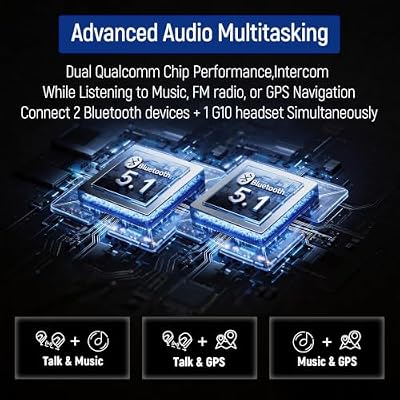
The smaller features split between earned and padded. Music sharing between two units has worked for two accounts that tried it. The FM radio drew the sharpest line in the record: the Vine text calls it a weird inclusion that feels like it inflated the price a little, and another owner admits never using it once.
Universal pairing with other brands has one positive report from a single-unit owner, so far, with no badged confirmation. Those are the features to weigh last, after the range pattern and the passenger-volume fault, because they are the ones the record either supports or quietly punctures.
FAQ: the box that matches the title, the eight-rider claim that stops at six and the 350-hour row nobody labels
Does the Lexin G10 dual pack include two complete units?
Yes, and this is the rare listing where the title matches the box. The spec table carries Number of Items 2, Number of Packs 2 and Unit Count 2 Count, and the 15.5-ounce item weight covers the pair. Each unit is a full kit with 40mm speakers, both microphone types, a mounting bracket and a USB-C cable.
Does the 8-rider claim hold up in the owner record?
The largest group any text describes is six riders, and they noted the link went spotty at distance. No owner has reported riding with seven or eight. Treat the eight-rider figure as a capability claim, not an owner-tested one.
What did the purchase-badged owners find?
Three texts carry the badge, and all three report hardware friction: a passenger who could not hear music or the front rider clearly, a long-time Lexin owner who found volume weaker than the brand's older models, and a microphone cable too short for some mounting layouts. No badged text praises the pack.
How long does the battery actually last?
No owner reports hours. Three accounts cover a full day of riding on one charge, and a single-unit owner reports 4 or 5 long rides per charge. The listing claims 25 hours of music and 17 hours of intercom, which nothing in the record confirms or contradicts.
What does the 350-hour battery row in the spec table mean?
The listing never explains it. The bullets top out at 25 hours of music playback, so the 350-hour figure most plausibly refers to standby time, which is a common way that row gets filled on listings filed under headphones. Treat it as unlabeled rather than as a use-time promise.