A helmet intercom you can pull off the helmet in one second, without a screwdriver, changes where the thing lives when you park. That single design idea is the pitch behind the JESIMAIK H6, and it is a good one. Most budget headsets stay bolted to the shell, which means the battery, the buttons and the whole investment sit outside in the parking lot.
The rest of the listing reaches further. The H6 claims a 10-rider mesh group on QIK-MESH 2.0, dual Qualcomm chips on Bluetooth 5.2, a 900mAh battery rated for 23 hours of intercom time, and IP67 waterproofing, at a price that lands in the cheapest fifth of the 192 intercoms we track.
Claims that big usually rest on owner evidence. Here the owner record is small, all eight written texts are purchase-badged, and the newest one is also the unhappiest.
The short version before the detail. The JESIMAIK H6 costs 81.69 at check time and carries 4.2 stars from 46 ratings, with no one-star band at all in the printed histogram. The speakers and the mount earn that rating on the evidence.
The group-mesh claim in the title is the part this record cannot confirm, because exactly one owner has used it helmet to helmet, and that owner has reported words getting lost.
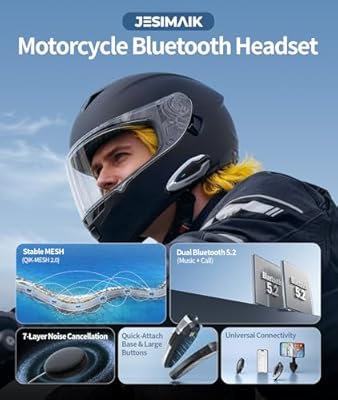
The mesh claim this record never exercises
Start with what the title sells, because that is where the gap sits. A 10-rider group that joins with one click is the headline, and the word mesh is doing real work in it. Mesh networking is a topology where every unit relays for the others, so a group can span further than any single radio link, at the cost of hops and lag (Mesh networking, Wikipedia).
Classic Bluetooth, which is what handles the phone pairing on a headset like this, is a different animal: typically less than 10 metres, up to about 100 in good conditions, and Bluetooth 5 long-range modes reach 40 to 400 metres only under clear line of sight (Bluetooth, Wikipedia). A product that pairs to your phone over Bluetooth and groups riders over mesh is claiming two radios doing two different jobs.
Here is the part that surprised me. The listing never prints a distance figure anywhere. Not in the title, not in the seven bullets, not in the spec table.
Ten riders is stated, metres are not, which is unusual either way you read it: either the number did not survive the copywriting or somebody decided not to print one.
Now the record. Eight texts carry the purchase badge, and only two of them touch rider-to-rider use. One owner has reported that it somewhat works with others on the same brand, and that there are times you hear the other person talking but have no idea what they are saying.
The other is the owner of the four-star text, who has not used the intercom at all because they do not ride with anyone. A third owner took it on multiple dune trips in a group setting and says every function works, which is the closest thing the record has to group praise, and even that text never describes a conversation at distance.
So the 10-rider claim stands on arithmetic and marketing, not on anyone's report. If group talk is why you are shopping, that is the fact to weigh, and our R16 Pro review covers the brand's pricier take on the same idea. The intercom comparison table shows where the H6 lands against the rest of the field on price per rider.
What the eight verified owners actually report
Strip the group claim out and the record gets simple. Four of the eight texts praise the sound or the quality in some form: nice and clear, clear communication through the mic, excellent quality in general, and one that wants a little more bass but still calls it worth it at the price. Two owners report an easy install.
Another owner calls the ability to remove the headset from the helmet for charging a big plus, which is the magnetic mount doing exactly what the listing promises.
The most enthusiastic text comes from a rider who took it on multiple dune trips, has called every function amazing, compares it directly with the high-end stuff at a more affordable price, and gifted one to a biker dad who loves it too. That is the deepest account in the record, and it is unreservedly positive.
One honest note on how to read this record: it has no ranked center. Amazon's dedicated reviews page returned an error for this listing through the whole session I scraped it, so the record here is the listing's own inline review block, eight texts out of 46 ratings, with no helpful-vote counts shown.
The newest text happens to be the most critical one, and the oldest are the happiest, so treat the average as a small and slightly tilted sample rather than a settled verdict.
The microphone is the weak part
The one detailed complaint in the record deserves its own section, because it is the part a music-first buyer will not think to test until somebody on the other end complains.
The owner of the four-star text has not used the intercom, but has used the mic plenty, and their account is specific: sound quality from the speakers is good, but people on calls say the voice sounds weird and distant, even with the microphone just about touching the mouth. The same owner reports callers can hear every breath, and closes by saying their old AirPods mic was far better.
Set that against the listing, which claims 7-layer noise cancellation in the title and lists Active Noise Cancellation and Wind Noise Reduction as spec rows. Whatever those seven layers are doing, this owner's callers heard through it. One detailed negative is not a pattern, and no other text mentions the mic at all.
But it is the only hardware criticism the record contains, it is specific about cause and effect, and it lands on the exact feature the 7-layer claim advertises. Speakers good, microphone unproven at best.
The magnetic mount, and the one sticky pad
The anti-theft quick-mount is the other headline, and the record splits on it in a way that teaches you how the feature actually behaves. The positive case: one owner has praised being able to pull the headset off the helmet for charging, which is the mount working as designed.
The negative case is the same mechanism used in anger. The owner of the two-star text, whose wife kept hers, took their own off the helmet and stopped using it, after finding that switching music sharing on and off and getting back to normal pairing was a hassle. The mount made that easy, which is both the feature and the escape route.
Then there is the catch the listing does not volunteer: one sticky pad ships per unit. The owner of the two-star text flags it directly, and the logic is simple.
The bracket mounts once, with adhesive, and if you place it wrong you are peeling that same pad to fix it. There is no spare in the box. Measure twice before you press, or buy a pad of your own as insurance, because the magnetic half of the mount is only as good as where the sticky half landed.

Reading the listing before you buy
The spec table is where this listing gets interesting, because it does not quite match the headset on the page above it.
The table files the H6 as headphones: 32 ohm impedance, 95 dB sensitivity, Active Noise Cancellation, and both Over Ear and On Ear placement rows, which disagree with each other. That is a recurring filing pattern across budget intercoms, and it tells you the spec sheet is template work, not measurement.
Three more decodes belong here. The certification row reads ANATEL with a registration number, which is Brazilian radio type approval, the same class of mark as FCC. It says nothing about impact protection or audio quality, so do not read it as an endorsement.
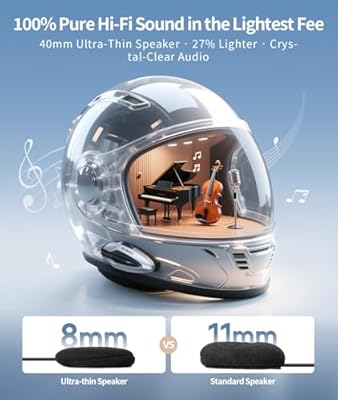
The audio bullet claims 98 percent long-distance signal stability with no method, no sample and no distance attached, so treat it as decoration. And the speaker claim decodes cleanly once you separate the two dimensions: 8mm is the speaker's depth, the slimness figure the bullet advertises, while 40mm is the driver's diameter. The two numbers describe different axes, not a contradiction.
The battery numbers are the last thing to read carefully. The listing gives 23 hours of intercom time, 25 hours of music, 450 hours of standby from the 900mAh cell, and a one-hour charge over USB-C. Those are the manufacturer's figures, and nobody in the record has run a battery test, so they are paper until proven. The strongest paper claim on the whole page is the 2-year warranty row.
Frequently Asked Questions
Does the 10-rider mesh actually work?
The record cannot say. Exactly one owner has reported helmet-to-helmet use, on the same brand, and that account says it somewhat works with words getting lost at times.
A second owner rode dune trips in a group setting and reports every function working, without describing a conversation at distance. The claim is unproven either way in this record.
Can it pair with other brands of intercom?
The listing claims Bluetooth 5.2 cross-brand pairing with most mainstream third-party headsets, and no owner in the record confirms or denies it. One owner's frustration centered on the H6's own music-sharing modes rather than cross-brand pairing. If you ride with a mixed fleet, treat this as the first question to test inside the return window.
What is the battery life in practice?
No owner has reported a measured figure. The listing's own numbers, 23 hours of intercom and 25 hours of music from a 900mAh battery, are manufacturer claims. The one owner who discusses the battery at all is the two-star text, and theirs is a complaint about charging convenience, not duration.
Is it really waterproof?
The listing claims IP67, and the spec table's water resistance row agrees. Nobody in the record has reported riding in rain, so the rating is paper. IP67 as a standard means dust-tight plus protection against immersion, and that is the standard talking, not this product's report card.
What happens if I mount the bracket in the wrong spot?
You get one sticky pad per unit, so a placement mistake means peeling and resticking the same pad, which the two-star text calls a serious drawback. Dry-fit the bracket with the headset on your helmet and your visor through its full travel before you press the adhesive down. If it isn't the right fit, the intercom comparison table sorts every option we track.